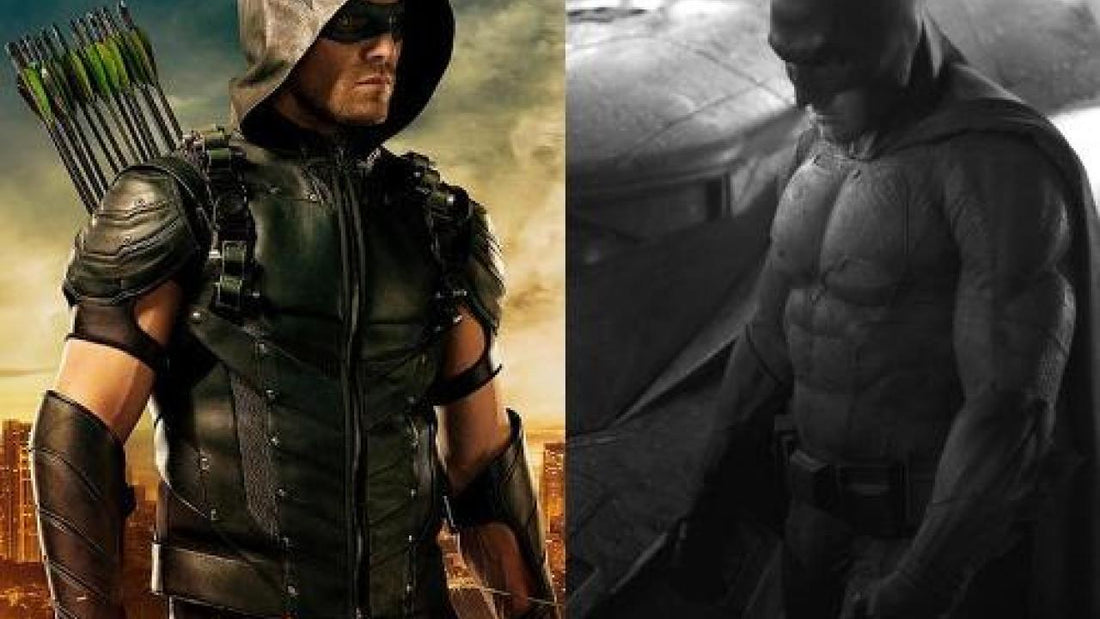
Batman and Green Arrow: Two Faces of the Same Justice
The answer in brief
Their foundational trauma differs, and everything stems from that. The Gotham orphan develops a personal crusade, a refusal of firearms, and an almost monastic discipline; the castaway, rescued after five years on a desert island, develops a publicly declared social anger. Both inherited wealth and lacked powers, but one protects his city while the other seeks to reform society.
In the grand gallery of DC heroes, two figures share a rare singularity: they are billionaires without powers. Bruce Wayne and Oliver Queen — Batman and Green Arrow — embody the same heroic philosophy, that of the vigilante who creates himself without cosmic inheritance, without radioactive bites, without divine tutelage. But behind this superficial resemblance, two radically opposing visions of justice clash. One acts in the shadows, the other openly declares his political convictions. One wants to protect, the other wants to transform.
This article thoroughly explores the relationship between the two heroes — their origins, their methods, their occasional alliances, their ideological conflicts, and their legacy in pop culture. To place this dynamic within the broader DC universe, a detour through the path that turned Bruce Wayne into the Dark Knight and the creation of the Justice League provides the essential framework — it is in the Justice League that Batman and Green Arrow most regularly cross paths.
Two origins, two dramas
On paper, the two heroes share a common starting point: foundational trauma. Bruce Wayne loses his parents as a child in a Gotham alley. Oliver Queen, meanwhile, is shipwrecked on a desert island after his yacht sinks, and spends five years surviving there, which transforms him. Both stories are tales of transformation through loss. But the moral consequences diverge radically.
Bruce emerges from his trauma with an obsession: individual justice. He refuses to kill, refuses firearms, refuses any fraternization with criminals. This monastic rigor structures his entire journey. To delve deeper into this dimension, a detour through why Batman doesn't kill is essential — it is the code that defines Bruce against all others.
Oliver emerges from his island with an opposite obsession: social justice. He uses his fortune to fund programs against poverty, gives engaged political speeches, openly supports unions and minorities. This militant dimension is almost entirely absent from Bruce Wayne, who prefers to act in the shadows. Where Batman protects on an individual basis, Green Arrow wants to change the structures that produce crime. This difference in approach is probably the most profound between the two heroes.
Two heroes without powers, but not without limits
The most fascinating aspect of the duo is their lack of real superpowers. Within the Justice League, they are the only pure human beings (Black Canary aside). This dimension deeply connects them — there is a fraternity of the mortal vigilante among gods that only they can understand.
But their methods differ greatly. Bruce is an absolute hand-to-hand combatant, trained in the fortresses of the League of Assassins according to some continuities. Oliver is an exceptional archer, capable of hitting a moving target at 200 meters. This specialization with the bow makes him a visually distinct hero in the Justice League — his quiver full of special arrows (boomerang arrows, trick arrows, light arrows) is as iconic as the Batmobile.
The other crucial difference is their relationship with technology. Bruce is a technical perfectionist. His Batcave is a technological cathedral, his gadgets are cutting-edge R&D products, his fortune is entirely reinvested in his equipment. Oliver, on the other hand, relies on simplicity — a bow, arrows, and that's it. This difference reflects two philosophies: Bruce believes in technological mastery, Oliver believes in bodily mastery.

The powerless detective
Batman Mask - The Dark Knight Rises
Like Green Arrow, Batman compensates for his lack of superpowers with absolute discipline and state-of-the-art equipment. This official Dark Knight Rises mask reproduces the iconic silhouette of the detective at the height of his art.
€39.90
View the Dark Knight Rises mask →Collaboration or confrontation? Major arcs
Batman/Green Arrow encounters oscillate between tactical collaboration and ideological conflict. In arcs where they work together — especially within the Justice League — their complementary skills prove formidable: Bruce plans, Oliver executes from a distance, and the enemy falls before understanding what happened.
But other arcs see the two heroes clash. The most frequent cause: political disagreement. Oliver intervenes in strikes, supports progressive candidates, openly criticizes capitalism. Bruce, for his part, remains politically neutral — his Wayne fortune forbids him from taking any public stance. This divergence creates tensions that are never truly resolved. In some recent arcs, Oliver directly reproaches Bruce for his political silence. In others, Bruce reproaches Oliver for his ostentatious moralizing.
The most striking arc of this dynamic probably remains Identity Crisis (2004), where the Justice League faces an existential threat. Bruce and Oliver take opposing positions on the memory manipulation of their enemies. This moral divergence reveals their deep philosophies — and ultimately temporarily breaks their friendship. To compare this tension with other internal conflicts within the Justice League, a detour through No Man's Land and Gotham left to its own devices is illuminating — Bruce makes decisions there that Oliver would never have condoned.
Two symbols, two cities, two methods
The cities of the two heroes say a lot about their identity. Gotham City is a gothic metropolis, rooted in American history, marked by systemic corruption that seems irredeemable. Star City, Oliver's city, is more modern, more Californian, marked by acute social and environmental inequalities but theoretically more reformable.
This urban difference shapes the heroes. Bruce confronts individual madmen — the Joker, the Scarecrow, Two-Face, the Riddler. Oliver confronts structures — gangs, crime syndicates, toxic multinationals, corrupt senators. The enemies dictate the methods: Bruce tracks cases, Oliver tracks systems.
The other important dimension is their relationship with the local heroic ecosystem. Bruce has his Batfamily — see all of Batman's allies explained — primarily composed of adopted and trained orphans. Oliver, for his part, has his team (Team Arrow), which is more collaborative and less hierarchical. This organizational difference also reflects their personalities: Bruce is a general, Oliver is an activist.

Iconic DC duos
Batman and Superman Sweatshirt
When Batman and Green Arrow cross paths in the Justice League, their duo joins the gallery of iconic DC duos. This Batman and Superman sweatshirt celebrates this tradition of heroic pairs. For fans who love the fraternal spirit of DC heroes.
€49.90
View this sweatshirt →The legacy in pop culture: series, films, animation
In cinema, Batman has obviously dominated. Nolan's Dark Knight trilogy redefined the superhero genre on its own. Green Arrow, for his part, has never had his big cinematic moment — Oliver Queen remains largely absent from live-action blockbusters. But television has brilliantly filled this gap.
The Arrow series (CW, 2012-2020) featured Oliver Queen for eight seasons and over 170 episodes. This television longevity far exceeds Batman's live-action appearances. The show inspired an entire DC television universe — The Flash, Supergirl, Legends of Tomorrow — collectively called the Arrowverse. This colonization of the small screen by Green Arrow has contributed to massively popularizing the character with the general public.
In animation, the two heroes regularly cross paths. Justice League Unlimited (2004-2006) offers memorable episodes where Bruce and Oliver collaborate or clash. Young Justice extends this dynamic with a young cast. Fans who want to explore this animated dimension will find some of the best representations of the two heroes — and especially their ambivalent relationship — in these series. To delve into how Batman functions within the Justice League in general, a detour through the creation of the Justice League provides the foundational framework.
When two worlds meet: crossovers and tensions
Arrow/Batman crossovers are rare but impactful. In The Brave and the Bold comic book (1955-1983), Batman teamed up with Green Arrow dozens of times — often against enemies that exceeded the capabilities of a single hero. This anthology remains one of the references for understanding how the two heroes complement each other tactically.
In modern continuity, several major arcs explore their relationship. The Longbow Hunters (1987) places Green Arrow in a darker, almost Bat-like stance, and sparks an interesting dialogue between the two heroes. More recently, Heroes in Crisis (2018-2019) confronts Bruce and Oliver with a collective trauma of the Justice League — and reveals psychological tensions that neither had ever publicly admitted.
The other dimension to explore is their shared enemies. Several DC villains have challenged both Batman and Green Arrow — Deathstroke, for example, a fascinating antagonist who fights both. These shared enemies reinforce the idea that, beyond their differences, Bruce and Oliver belong to the same category: the mortal, vulnerable hero who survives only through his rigor. To delve deeper into this dimension, a detour through Knightfall and the Bane vs Batman confrontation provides a useful counterpoint.

The DC Comics aesthetic for everyday life
Batman DC Comics T-Shirt
For fans who love the entire DC universe — Batman, Green Arrow, Justice League — this classic t-shirt captures the aesthetic of American comics. Comfortable, timeless, and ideal for wearing the heroic spirit every day.
€29.90
View the t-shirt →Why the Batman/Green Arrow duo remains fascinating in 2026
Three structural reasons explain the duo's durability. First reason: dramatic complementarity. Where Batman operates through silence and mystery, Green Arrow operates through declaration and commitment. This narrative opposition allows screenwriters to create dialogues that simultaneously reveal both characters. Bruce says little, Oliver says a lot — and together, they say everything.
Second reason: political relevance. In an era where issues of social inequality, climate justice, and civic engagement dominate public debate, Green Arrow brings to the Batman world a political dimension that Bruce has always refused. Arcs that place the two heroes in political dialogue speak directly to the modern concerns of readers. To delve into this dimension, a detour through Anarky and the political dimension in Batman is illuminating — Bruce sometimes confronts politically engaged enemies without ever being one himself.
Third reason: the possibility of new cinematic adaptations. While the Arrow series featured Oliver for eight years, the character still lacks a major live-action big-screen adaptation. Several studios are currently hinting at Green Arrow movie projects. If one of them comes to fruition and intersects with a modern Batman film, the result could be one of the most anticipated of the 2030s.
Conclusion: two faces, one mission
Batman and Green Arrow embody two sides of the same ethos: that of the mortal vigilante. Where most DC superheroes rely on cosmic powers, Bruce and Oliver only have their will, their training, and their fortune. This shared means creates a brotherhood between them that other Justice League members cannot truly understand.
To further explore this, several essential avenues. First, read The Brave and the Bold — the anthology that features multiple encounters between the two heroes. Then, watch the Arrowverse, especially the crossover episodes that bring together several DC heroes. To materialize this passion into a collection, the Batman action figure collection, the Batman sweater collection, and the Batman poster collection offer visual hooks into the entire DC ecosystem.
One thing is certain: as long as DC produces comics, Bruce and Oliver will cross paths. Not because they particularly like each other, but because they cannot avoid each other. Two powerless billionaires who chose justice: there aren't that many in the DC universe, and their paths are destined to intertwine indefinitely. It is precisely this narrative obligation that makes their duo one of the most enduring in the genre — not friendship, not rivalry, but the forced brotherhood of those who share a destiny.