Batman: Year One – The Realistic Genesis of the Myth
The answer in brief
Published in issues 404 to 407, this miniseries details an heir returning after years of exile, who makes a disastrous debut: injured, trapped, humiliated. The bat that enters the manor finally reveals to him his emblem and his method: to generate terror. This documentary realism now permeates Christopher Nolan's trilogy and Matt Reeves' film.
Before becoming a universal symbol, Batman was first a man alone against a corrupt city. With Batman: Year One, screenwriter Frank Miller and artist David Mazzucchelli redefined the origins of the Dark Knight in a cult work, published in 1987. Gone was the larger-than-life hero: here, Gotham is raw, violent, realistic — and Bruce Wayne, still imperfect, slowly forges the legend he will become.
This mini-series, originally published in Batman #404 to #407, is now considered the cornerstone of the hero's modern mythology. It has inspired numerous films, including Christopher Nolan's The Dark Knight trilogy and Matt Reeves' The Batman, which adopt its raw tone and realistic approach to justice.
A Bruce Wayne in search of identity
In Year One, Bruce Wayne returns to Gotham after years of exile. Trained in martial arts, criminology, and stealth, he is ready to fight crime — but not yet ready to become Batman. The first pages show a man plagued by doubt, fumbling between vengeance and idealism, unable to channel his anger.
The narrative explores his first failures: disguised as an ordinary vigilante, Bruce is injured, trapped, humiliated. It is in this moment of vulnerability that he finally finds his symbol: the bat that appears in his mansion. A simple but powerful revelation: to inspire fear, he must become the creature that criminals fear the most.

👉 Discover our page on the history of Batman to understand how this first year shaped the rest of his legend.
And if you want to relive this foundational era, explore our Batman Year One figurines or complete your look with a Dark Knight t-shirt inspired by his first appearances.
James Gordon: Gotham's moral mirror
While Batman: Year One explores the birth of the masked vigilante, it also tells the story of another hero, more discreet but just as essential: Lieutenant James Gordon. Transferred to Gotham, Gordon discovers a city consumed by corruption, where politicians and police collaborate with the criminals they should be fighting. His integrity then becomes a threat to the system, just like Batman, who operates outside the law. Together, they embody two sides of the same war: legal justice and shadow justice.
Frank Miller's genius lies in this parallel. While Bruce learns to become Batman, Gordon battles his own demons: fatigue, despair, the temptation to give in. Their meeting, over stifling nights and tense chases, marks the beginning of a historic alliance. Without Gordon, Batman would remain a symbol of fear; thanks to him, he becomes a symbol of hope.
This improbable duo later inspired adaptations such as Batman Begins or the series Gotham, which delves into the commissioner's youth and the rise of crime in the city.
Corruption as a backdrop
In Year One, Gotham is not just a setting: it is a character in its own right. Its dirty alleys, corrupt police stations, and manipulative politicians create constant tension. Every action by Bruce or Gordon seems insignificant in the face of a system rotten to the core. But it is precisely this contrast between powerlessness and perseverance that gives the work its strength. Here, we understand why Batman does not kill: in a city where everything is dirty, he chooses to remain one of the few who do not get their hands dirty.
👉 To explore Gotham's psychology in greater depth, delve into our article "Gotham City: The City of Symbols of Batman," a complete look at this setting that has become a metaphor for fall and redemption.
And for fans of the vintage aesthetic of the 1987 comic, discover our Batman Year One posters.
The birth of a symbol
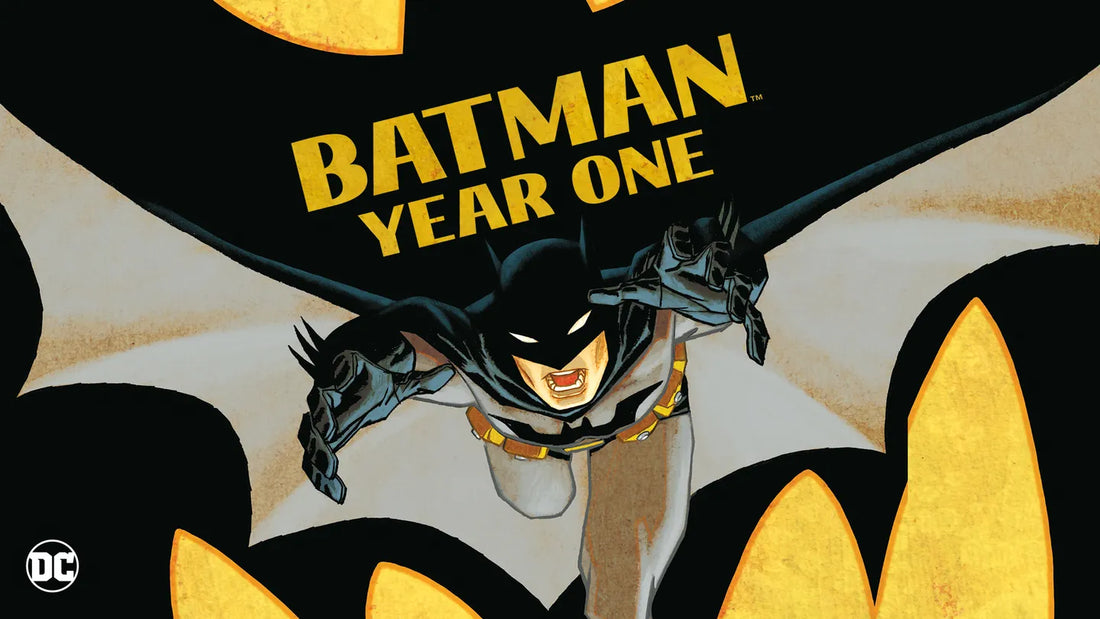
In Year One, Batman's costume is not yet the high-tech armor we know today. It is a homemade, heavy, almost clumsy outfit — but imbued with immense symbolic power. When he first appears before Gotham's criminals, Bruce doesn't just fight them: he inspires fear in them. It is this shift, this moment when the mask becomes a legend, that gives the story its full strength.

The famous scene at the mob dinner, where Batman appears in the dark room, declaring: "Gentlemen... you have eaten well, but tonight, you are sated with corruption.", remains one of the most striking in the entire mythology. It marks the birth of the true Dark Knight — both judge, shadow, and guardian of Gotham.
Catwoman: a feminine reflection of rebellion
The Year One narrative also introduces Selina Kyle, alias Catwoman. A former prostitute turned cat burglar, she is fascinated by Batman and decides to be inspired by him to become, in her own way, a vigilante. Frank Miller makes her a strong and independent character, long before it was common in comics. Her leather costume, her methods, her provocative attitude — everything symbolizes an emancipation from a masculine and violent world.
The relationship between Batman and Catwoman, one of attraction and rivalry, is born here. It will evolve in stories like The Dark Knight Rises or Batman's alternate universes, where their bond takes on different forms, but always retains this unique tension.
The raw aesthetic of David Mazzucchelli
David Mazzucchelli's art plays a central role in the narrative's power. His angular, almost minimalist lines, and his dull color palette (beiges, grays, browns) convey the coldness of Gotham and the solitude of its inhabitants. Every panel exudes tension, fatigue, and gravity. This realistic style will durably influence future representations of the hero, particularly in Matt Reeves' The Batman, which directly draws inspiration from this dark and visceral universe.
🎨 For art and design enthusiasts, discover our Batman Year One posters and prints or our Catwoman figurines inspired by this cult period of comics.
An immense and timeless legacy
Batman: Year One is not just a simple origin comic; it's a total redefinition of the myth. Its mature tone, psychological realism, and cinematic staging revolutionized how superheroes could be told. Frank Miller instilled a depth rarely seen at the time: fragility, fear, rage, and above all, solitude. It's a work that has aged gracefully, as its themes remain universal: justice against corruption, the duality between duty and vengeance, the quest for identity.
Its influence is omnipresent across all media. Films like Batman Begins and The Batman are directly inspired by its dark and realistic staging. The animated adaptation Batman: Year One (2011) faithfully recreates this murky and tragic atmosphere, where every punch seems to weigh on the hero's conscience.
Why Year One remains essential
Reading Year One is going back to basics. It’s understanding that Batman is not just a man with gadgets, but a symbol forged in pain and obsession. It’s also seeing how a simple human being, without superpowers, can change the destiny of a ruined city. For many, this work represents the ideal entry point into the DC universe — a story that is at once accessible, dramatic, and profoundly human.
🎭 For fans of the Dark Knight
Discover our selection of collector Batman figurines inspired by the hero's origins, or complete your collection with a realistic Batman mask reminiscent of his first nights in Gotham. And for passionate readers, our range of essential Batman cosplays will allow you to relive the evolution of the myth from its beginnings to modern sagas.
Batman: Year One remains a pillar, an eternal benchmark for all fans of the Dark Knight. For before the legend, there was a man... and a promise made in pain: never let Gotham sink again.
📚 To go further: contextualize this work within the great history of Batman comics by consulting the overview of the 7 eras of Batman comics, which brings together the 39 major works organized by the 7 major publication eras from 1939 to today.