
Batwoman: The Red Shadow of Gotham
The answer in brief
Long overlooked after her creation in the 1950s, the vigilante reappears in 2006 as Katherine Kane, a wealthy heiress and cousin of Bruce Wayne. The kidnapping of her twin sister Beth pushes her toward the army, which dismisses her because of her sexual orientation. Never trained by the Dark Knight, she carves her own path and favors a dazzling presence where he cultivates dread.
In this article
While Batman embodies fear and rigor, Batwoman has established herself as an equally striking figure in the DC universe. Created in 1956, forgotten for decades and then reinvented for a modern audience, she embodies resilience and individuality in a world dominated by male heroes. Her stories move between personal drama, the fight against crime and the affirmation of her identity.
Originally introduced as a potential “love interest” for Bruce Wayne, Batwoman quickly evolved far beyond that secondary role. The modern version of Katherine "Kate" Kane made her debut in 2006, marking a decisive turning point in the comics. An army veteran shaped by her military past and her private wounds, Kate chooses to become Batwoman in order to keep fighting for justice in another form.
The origins of Batwoman: Kate Kane
Kate Kane is a Gotham heiress, Bruce Wayne's cousin, and she shares the same obsession with him: turning pain into strength. Her past is marked by a violent trauma — the kidnapping and presumed death of her twin sister Beth — which drives her to join the army. Rejected because of her sexual orientation, she decides to carve her own path.
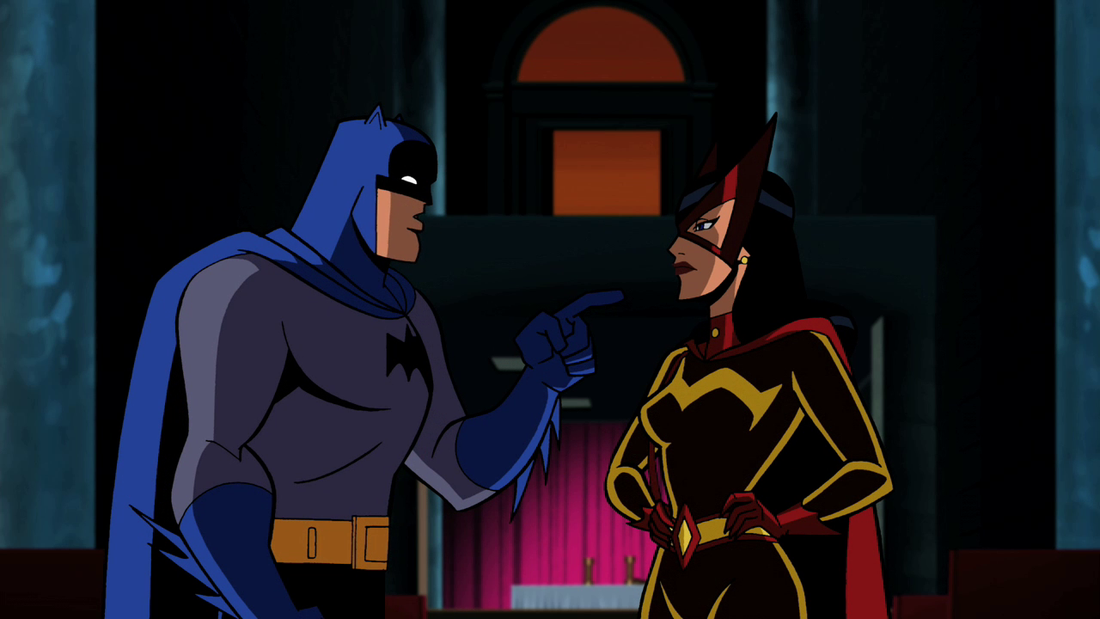
Armed with her combat skills, her military discipline and unwavering determination, Kate adopts a flamboyant identity: a dark suit adorned with a red bat emblem, a scarlet cape and long blood-red hair. Unlike Batman, who relies on fear, Batwoman embraces the visibility and psychological impact of her appearance.

🎭 To embody your own Gotham vigilante, discover our Batman costumes or add a dark touch to your collection with a Batfamily figure.
Key takeaway
Kate Kane, Bruce Wayne's cousin, joins the army after the presumed death of her twin sister Beth, before being rejected. Unlike Batman, who relies on fear, Batwoman embraces the visibility of her appearance.
Batwoman and the Batfamily: between independence and legacy
Although she shares the bat symbol, Batwoman has never been a mere secondary member of the Batfamily. Unlike Robin, Batgirl or Nightwing, she was not trained by Bruce Wayne. Her journey is her own, forged by her personal trials and the skills she acquired in the army. This independence sometimes causes friction with Batman, but it also earns her the respect of her allies.
The relationship between Kate Kane and Bruce Wayne is complex. Both heirs of wealthy Gotham families, they share the same sense of duty but differ in their approach. Where Batman often acts in the shadows, Batwoman chooses a more direct and visible stance. This duality makes her a valuable yet unpredictable ally, capable of making decisions Bruce would not dare to make.
Her interactions with other members of the Batfamily reinforce her individuality. With Oracle (Barbara Gordon), she shares a strong bond built on strategy and trust. With Robin and Nightwing, she maintains a dynamic of camaraderie mixed with rivalry. And against Ra’s al Ghul or the League of Assassins, Batwoman stands out as a force determined to protect Gotham on her own terms.
This proudly embraced independence makes her an inspiring figure for readers, especially because she embodies themes rarely explored in traditional comics: identity, difference and self-affirmation. Her openly acknowledged sexual orientation, her lifestyle and her refusal to conform to convention make her a modern heroine, emblematic of a new generation of vigilantes.
🦇 To show that you belong to the Batfamily, explore our Batman t-shirt collection or treat yourself to pajamas featuring the Dark Knight's allies.
Bruce Wayne
They share the same sense of duty, but Batwoman chooses a more direct and visible stance.
Oracle (Barbara Gordon)
She shares a strong bond with Batwoman built on strategy and trust.
Robin and Nightwing
Batwoman maintains a dynamic of camaraderie mixed with rivalry with them.
Batwoman's iconic enemies and major story arcs
While Batman faces a gallery of iconic enemies, Batwoman is not to be outdone. Her adventures pit her against terrifying criminals, sometimes tied to the Dark Knight's universe but often specific to her own journey. This allows her to develop a distinct mythology while remaining rooted in the vast world of Gotham.
Her most memorable adversaries include:
Beyond the villains, Batwoman has also been involved in several major story arcs of the DC Comics Universe. Her participation in crossovers such as Infinite Crisis or Batwoman: Elegy has strengthened her status as an essential protagonist. These stories give her a dimension that is both heroic and dramatic, where her mental strength is tested as much as her physical abilities.
Her struggle with her own demons is also an integral part of her legacy. Kate Kane must constantly juggle her mission as a vigilante with her personal flaws, a duality that echoes Bruce Wayne's, but with a decidedly different voice.
Batwoman's legacy and adaptations
Over the decades, Batwoman has gone from a secondary character to an essential icon of the DC universe. Her stories stand out for their psychological intensity, the complexity of her dilemmas and the richness of her evolution. She has become a symbol of resilience, diversity and representation, paving the way for modern and inclusive stories in the world of superheroes.
In comics, she has had her own series, notably Batwoman: Elegy by Greg Rucka and J.H. Williams III, praised for its dark and striking art. In animation, she regularly appears alongside the Batfamily, cementing her place in Gotham's mythology. More recently, the TV series Batwoman produced by The CW featured Kate Kane, then Ryan Wilder, a new heroine who takes up the mantle, proof that her legacy continues to inspire.

More than just a masked heroine, Batwoman carries a message: never give up, even in the face of the deepest wounds. Her journey shows that courage is not defined by physical strength alone, but also by the will to stay true to yourself and your convictions.
🎭 To keep exploring the world of Gotham, also check out our articles on Oracle (Barbara Gordon), Poison Ivy and Harley Quinn, three female figures who, like Batwoman, are redefining the rules of Gotham.
The comics
Batwoman has had her own series, notably Batwoman: Elegy by Greg Rucka and J.H. Williams III.
Animation
She regularly appears alongside the Batfamily.
The TV series
The CW's Batwoman series featured Kate Kane, then Ryan Wilder.