
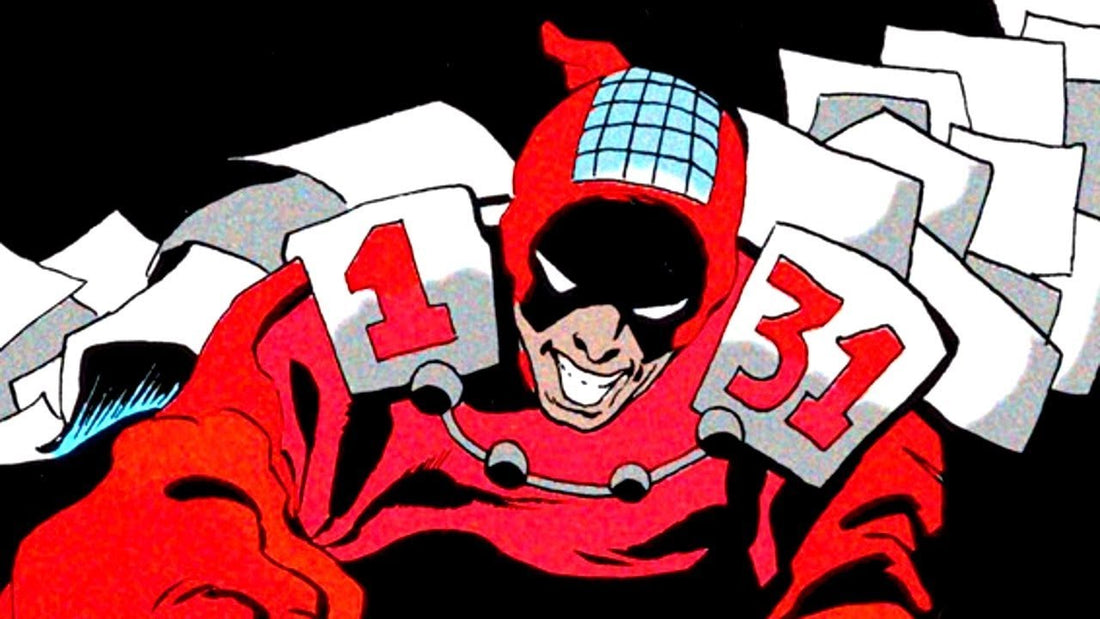
Calendar Man: An underestimated but terrifying enemy in comics
The answer in brief
Julian Day premeditates each crime based on a holiday, a time of year, or a symbolic date, and even changed his disguise according to the celebrations. Revealed in 1958, long scorned, this meticulous criminal owes his reputation to the story The Long Halloween: his chilling precision is more unsettling than the Joker's noisy ramblings.
When thinking of Batman's enemies, the first names that come to mind are the Joker, Two-Face, or the Scarecrow. Yet, a much more discreet but formidable adversary haunts Gotham's alleys: Calendar Man, also known as Julian Day. Behind his almost ordinary appearance lies a chilling obsession: time and dates.
Introduced in comics in the 1950s, Calendar Man is often perceived as a secondary character. However, his meticulously planned crimes based on holidays, seasons, or symbolic dates make him an unpredictable and terrifying enemy. His ability to turn the calendar into a weapon demonstrates that Gotham does not need overpowered monsters to be plunged into anguish.
This methodical criminal reminds us that danger lies not only in the chaotic madness of the Joker or the brutality of Bane, but also in the clinical precision of an obsessed mind. His role in seminal stories like The Long Halloween has bolstered his reputation, making him one of the most underrated antagonists in the Batman universe.
👉 To explore other equally fascinating adversaries, discover our pillar page dedicated to Batman's enemies, as well as our analyses on Two-Face and the Scarecrow, two equally iconic figures of Gotham.
The origins and first appearances of Calendar Man
Julian Day, alias Calendar Man, made his first appearance in Detective Comics #259 in 1958. At the time, the character was introduced as an eccentric criminal whose activities followed a theme related to seasons, holidays, or calendar cycles. His costumes changed according to the day he committed his crimes, which gave him a theatrical and unsettling look.
While his beginnings may have seemed lighthearted, almost close to a caricature of the colorful villains of the era, Calendar Man very quickly evolved. In the 80s and especially the 90s, writers reinvented the character in depth to make him a much darker, more intelligent, and calculating figure. It was no longer just a gimmick based on dates, but a true morbid obsession with time and its symbols.
The work that truly cemented his role in the Batman universe is undoubtedly Batman: The Long Halloween (1996-1997), written by Jeph Loeb and illustrated by Tim Sale. In this cult story, Calendar Man is imprisoned in Arkham Asylum but acts as an enigmatic advisor to Batman, much like Hannibal Lecter in The Silence of the Lambs. He knows secrets, manipulates information, and subtly guides the Dark Knight in his investigation, marking a major turning point in his portrayal.
This evolution transformed Calendar Man into a psychological criminal, obsessed with the repetition of time and the inevitability of cycles. Unlike enemies like the Joker who embody chaos or Ra’s al Ghul who represents immortality, Julian Day is an allegory of passing time, of death that inevitably returns, making his crimes all the more symbolic and disturbing.
👉 If you want to explore other characters who, like Calendar Man, play on psychology and symbolism, check out our article on the Scarecrow or our analysis on Hugo Strange, two figures obsessed with fear and the psychology of the Dark Knight.
Calendar Man in modern stories: from background character to psychological icon
While Calendar Man was long perceived as a secondary villain, he gained a new dimension with Batman: The Long Halloween. In this major work, he is not the main antagonist, but his role resembles that of Hannibal Lecter: imprisoned in Arkham, he guides Batman through cryptic clues about the identity of the Holiday killer. His obsessive knowledge of time and dates makes him a unique witness to the crimes shaking Gotham.
His presence is brief, but it is enough to reinforce the character's unsettling aura. He no longer acts as an extravagant criminal with colorful costumes, but as a master manipulator, cold and cerebral. This reinterpretation marks a decisive turning point and inspires all his subsequent incarnations.
Julian Day also appears in the series Batman: Dark Victory, where he continues his function as a menacing shadow, reminding Batman and the reader that time is an inevitable enemy. More recently, he appears in the Arkham video game series. In Batman: Arkham City, he is locked in a cell, reciting macabre riddles related to each calendar holiday. Players must return to see him on specific dates to unlock his dialogues, reinforcing his obsessive and unpredictable side.
Calendar Man thus embodies a less physical threat than enemies like Bane or Killer Croc, but his power lies in his psychological and symbolic dimension. Where other villains attack the body, Julian Day attacks the mind, with his chilling words and morbid obsessions.
👉 To further immerse yourself in Gotham's cult stories, you can consult our pillar page on Batman's enemies, where Calendar Man stands alongside more famous figures like the Joker, Scarecrow, and Poison Ivy.
An underestimated enemy, but a strong symbol
Calendar Man perfectly illustrates the richness of Batman's rogue's gallery. While he may not have the notoriety of the Joker or the brute force of Bane, he represents a different threat: that of time, ineluctable and oppressive. His transformation, from a criminal with an almost kitsch concept to an unsettling figure worthy of psychological thrillers, proves that even secondary DC characters can become iconic.
In the collective imagination, Calendar Man reminds us that every date can carry dramatic weight. His calendar madness echoes Gotham's traumas, a city where every day can be marked by tragedy. This is what makes him a terrifying enemy despite his lack of superpowers.
📚 For comic book enthusiasts, his appearances in The Long Halloween and Dark Victory are essential reading. And for gamers, his dialogues in Arkham City remain an immersive experience that pays homage to his unique obsession.
🎭 If you wish to further immerse yourself in the Batman universe, explore our Batman figurines, find a Dark Knight costume to embody your favorite hero, or decorate your interior with a Batman poster inspired by the greatest comics.
Calendar Man may not be Gotham's most famous villain, but he remains an essential piece of the puzzle. By fighting him, Batman is not just fighting a criminal, but an idea: that time always catches up with all of us.