
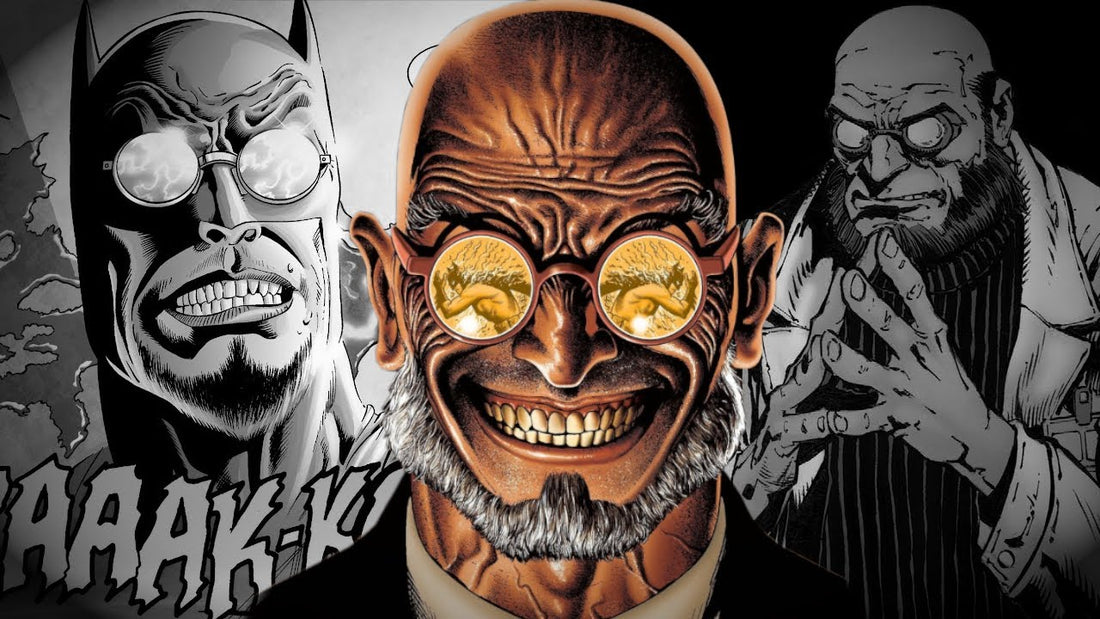
Hugo Strange: The Mad Scientist Who Uncovered Batman's Secret
The answer in brief
Hugo Strange is a Gotham psychiatrist turned criminal who first appeared in Detective Comics #36 in 1940: he predates both the Joker and the Penguin. What sets him apart is that he deduced Batman is Bruce Wayne, making him one of the very few enemies to hold that secret. He attacks through analysis, manipulation, and experiments that turn men into creatures, and he dreams less of killing the Dark Knight than of taking his place.
In this article
There are two ways to attack a masked man. The first is to strike the mask until it gives way: that is the plan of half of Gotham's criminals, and it is also the one that fails most often. The second is to sit across from him, do nothing at all, and calmly ask yourself what kind of man agrees to spend his nights under a cowl. Hugo Strange chose the second, and that is exactly why, more than eighty years after his creation, he remains one of the Dark Knight's most unsettling adversaries.
For Batman, the mask is not a costume accessory: it is the condition for everything else, the line that separates the billionaire from the symbol, and the one thing no one is allowed to lift. Our guide to Gotham's masks explores this mechanism in detail. Hugo Strange never tried to tear it off: he analyzed it, the way a psychiatrist analyzes a patient who does not yet know he is in a session.
This article follows that thread from start to finish: where this scientist comes from, how he uncovered the secret all of Gotham is chasing, what he did with it, why he wanted to become Batman rather than destroy him, and what remains of him on screen and on collectors' shelves. To place him among the other figures in the rogues' gallery, our complete guide to Gotham's legendary villains gives the big picture.
Who is Hugo Strange: the psychiatrist who turned Batman into a case study
Hugo Strange is a scientist and a psychiatrist. That is all, and it is already a great deal. He does not lift cars, he does not survive a thirty-story fall, and he has neither a permanent strength serum nor a signature weapon that identifies him at first glance. As he is most often drawn, he is a middle-aged man with a balding head, a trimmed beard, and round glasses, whose only visible violence lies in his gaze. In a city that churns out monsters, he looks like an outside consultant who came to take notes.
That is precisely what makes him so dangerous. Where most of Gotham's criminals want something from Batman — for him to suffer, to back down, to die — Strange wants to understand him. He treats the Dark Knight as a subject of study: a behavior to model, a discipline to break down, a will whose active ingredient must be isolated. An enemy who wants to kill you leaves a trace; an enemy who wants to explain you leaves nothing at all, until the day he knows more about you than you do.
This approach moves the fight onto ground where Batman is far less comfortable. The vigilante built his edge on preparation, anticipation, and intelligence gathering — a modus operandi you find even in our crossover matchups, such as his face-off with Deadpool. Against Strange, that advantage flips: two minds that prepare, two minds that anticipate, and only one of them wears a mask that the other has already started taking apart in his head.

★ The Dark Knight's selection
Giant Batman poster
The format that makes the silhouette impossible to miss: fitting when the article is about what the mask protects.
From €9.90
View product →1940, Detective Comics #36: an enemy who arrived before the Joker
Hugo Strange makes his first appearance in Detective Comics #36, in 1940. The date matters, because it places him among Batman's very first adversaries, ahead of the Joker and ahead of the Penguin. The character is therefore not a late variation on an established theme: he is one of the building blocks laid down when the Dark Knight's universe had almost no rules yet, and when every new enemy defined, by contrast, what this hero could take on.
What stands out, in hindsight, is his motive. The criminals of that era wanted money, turf, a place in the underworld. Strange was chasing neither loot nor political office: he wanted control and understanding, in that order. His early schemes show him able to manipulate entire crowds and to use hallucinogenic gases to plunge the city into chaos — a playbook that other Gotham villains would later exploit heavily, starting with those who made fear their declared specialty.

This tells us something about the universe itself, not just about the character. Before Gotham filled up with costumed criminals and spectacular set pieces, the very first territory explored by the Dark Knight's stories was that of the rogue scientist, the manipulative mind, and the chemical that warps perception. Strange never needed to reinvent himself to stay relevant: the role he fills, that of the threat that thinks, was already there on day one and has never stopped being available.
This founding period is a reading journey in its own right, and the character takes on a special flavor when you place him back in his timeline: our chronology of Batman comics by era lets you follow how the rogues' gallery evolved decade after decade. The imagery of those early years also enjoys a second, purely visual life in the Batman posters that borrow the silhouettes and contrasts of the Golden Age.
Key takeaway
Hugo Strange appears in Detective Comics #36 in 1940, before the Joker and the Penguin. His motive is neither loot nor political power: he wants control and understanding.
The man who cracked the secret: when Batman becomes Bruce Wayne again
This is what sets Hugo Strange apart from almost the entire rest of the gallery. By observing, cross-checking, and reasoning, he eventually deduces what all of Gotham does not know: under the cowl is Bruce Wayne. No accident, no betrayal, no forced confession — a deduction. He is one of the very few enemies of the Dark Knight to hold this information, and he got it through reasoning, not through a convenient plot twist.
What comes next is even more interesting than the discovery itself. An ordinary villain would have sold the secret, or made it public to destroy the man in the spotlight. Strange chooses to keep it and use it as leverage: he threatens, he insinuates, he lets Bruce Wayne know that he knows, and he watches what that pressure produces. His real weapon is not the information, it is the patient way he uses it. To grasp exactly what the man behind the mask represents, our complete profile of Bruce Wayne is the place to start; the billionaire appears there for what he is, a construct as carefully crafted as the costume.
Because Bruce Wayne has never had just two faces; he has several, and that is what makes Strange's attack so hard to parry. There is the playboy in the spotlight, constantly exposed and yet perfectly opaque. Then there is Matches Malone, his third identity, the small-time crook he plays to move through circles where Batman would scare everyone off. And finally there is the philanthropist, whose low-key role is detailed in our article on the Wayne Foundation. Each of these identities protects the others. Strange is the one who understood they all hang by the same thread.
It also explains a very concrete paradox for fans: you can put a Batman figure on a shelf and the silhouette is instantly recognizable, yet the object says nothing about the man. The mask works exactly the same way in the fiction. It shows everything and reveals nothing — except to someone who, like Strange, has spent years watching what slips out from under the costume.

★ The Dark Knight's selection
Small Batman figure
The simplest way to represent the man whose identity is what is really at stake here.
€29.90
View product →The Monster Men: when science becomes a weapon
Convinced that he can match Batman, and probably surpass him, Hugo Strange does not stop at theory. In several stories, he develops serums that can turn ordinary criminals into deformed creatures with monstrous strength. These "Strange monsters" become living weapons that he unleashes on Gotham and its protector, and there is little left of the human in them once the treatment is complete.
What matters is not how powerful these creatures are, it is the act itself. Strange does not build a gadget or design a suit of armor: he remakes men. Where other villains add a weapon to their arsenal, he moves the boundary of what a body can be, with the quiet confidence of someone who thinks he is simply correcting a rough draft. It is cruelty without anger, and it explains why he is disturbing far beyond any immediate physical danger.
These creatures also expose a contradiction Strange has never resolved. A man who claims to win through intelligence should, in principle, have no need for hulking brutes; if he builds them anyway, it is because he lacks something reasoning cannot supply. His monsters are, in their own way, an admission of what he failed to reproduce in the lab: a man's ability to take a hit, get back up, and start over, night after night, without a serum and without a lab coat.
This taste for the laboratory is not unique in the city. Gotham has other twisted scientific minds, as our profile of Professor Milo, Arkham's shadowy scientist shows. It is also home to entire organizations devoted to producing custom-made enforcers, and the Court of Owls is probably the most organized version, with its hideouts and its Talons. Strange works alone, but he did not invent the method. This laboratory aesthetic of harsh neon and distorted silhouettes has seeped deep into the Dark Knight's iconography, all the way to the Batman canvases that play on stark contrasts and nighttime backdrops.
The key point
Strange does not build gadgets: his serums turn ordinary criminals into deformed creatures. Yet these monsters betray what he cannot reproduce in the lab, a man's ability to get back up.
Becoming Batman: imitation as a form of possession
The most troubling side of the character is neither the serum nor the blackmail: it is his urge to wear the costume. In several arcs, Hugo Strange literally slips into the Dark Knight's skin, copying his voice, his methods, even the way he terrorizes criminals. He does not put on the costume to fool the police for the length of a heist; he puts it on because he believes he understands the role better than the man who holds it.
It is a form of appropriation, and it says a lot about his diagnosis. For Strange, Batman is not a person but a function, a seat to be filled in Gotham's balance of power. If the seat is empty — or if its holder proves inadequate — then it logically falls to the most qualified candidate. His entire madness lies in that one little word: logically. He does not just want to defeat Batman, he wants to replace him, and he sees that substitution as a rational correction rather than a crime.
Where he goes wrong is in what the symbol actually carries. The emblem, yes, is transferable: that is even its primary purpose, and it is why it works so well on clothing. A Batman t-shirt says something about the character without ever showing his face. Our guide to Batman t-shirts by character shows just how much every figure in Gotham ends up reduced to a shape you recognize in a split second. The same logic applies to Batman stickers, where the bat needs no caption at all. But a symbol can be worn; a reason to wear it cannot be stolen.

★ The Dark Knight's selection
Batman Batmobile t-shirt
An emblem that speaks for the character without ever showing his face.
€29.90
View product →Arkham, the corner of Gotham where Hugo Strange feels at home
It was only a matter of time before this character crossed paths with the asylum. Hugo Strange shows up there regularly, and rarely in the position you would expect: more often in a lab coat than in a straitjacket, running a ward, with unlimited access to patients the city has chosen to forget. Our feature on Arkham Asylum explains in detail what this institution represents in the Dark Knight's universe; suffice it to say here that a man like Strange finds, in a single place, everything his method requires.
This ambiguity between caregiver and inmate may be his most lasting contribution to Gotham. The city has produced plenty of madmen, but few doctors of whom you can never tell whether they are locking people up or experimenting on them. The rest of the gallery explores other extremes. With Professor Pyg, the logic of the altered body is pushed to unbearable lengths. Harley Quinn took the opposite path: a figure inseparable from the asylum, she has become so popular that kids ask for her costume, as our Harley Quinn costume guide explains. To see where everyone fits, our overview of the characters in the Batman universe lists the faces that populate this city.
Still, the imagery of the asylum — long corridors, low raking light, numbered doors — has ended up spilling out of the fiction and into fan decor. That taste for chiaroscuro is what makes Batman lamps so popular: the point is not to light up a whole room but to leave the rest in shadow. Gotham, in short, decorates itself the way it tells its stories: through what it does not show.
In short
At Arkham, Hugo Strange appears more often in a lab coat than in a straitjacket. That ambiguity between caregiver and inmate, between the one who locks up and the one who experiments, may be his most lasting contribution to Gotham.
Collecting Hugo Strange: what the Gotham section really offers
Let's be upfront, because it is the question every reader who has made it this far is asking: there is no Hugo Strange product in our catalog. No figure, no t-shirt, no poster bearing his likeness. This is not an oversight: merchandise follows screen visibility far more than a character's narrative importance. A villain who operates through words and medical files gives an object very little to grab onto.
That does not leave the shelf of a reader who has just fallen for the character empty, though. A coherent Gotham corner can be built around what Strange is after: the symbol, the asylum, and the figures that orbit them. Our guide to Batman merchandise explains how to put these pieces together without piling things up at random. When the goal is to give a gift rather than complete your own shelf, the Batman gifts selection remains the easiest place to start.
In practice, everyday items are often the ones that last. A Batman mug keeps you company through story arc rereads far longer than a fragile piece packed away in a box. A Batman sweater comes back out every winter without a second thought. And a Batman keychain is enough to show where your loyalties lie without turning your wardrobe into a costume. For younger readers, for whom the world of Arkham is far too much, our guide to Batman plush toys offers a much gentler way in than the asylum's corridors.

★ The Dark Knight's selection
Joker Joaquin Phoenix figure
There is no figure of this character in the catalog: here is the closest thing the section offers, among the Arkham villains available.
€39.90
View product →Hugo Strange on screen and in video games: Gotham, Arkham, and beyond
The TV series Gotham did a lot for the character's recent fame. Played by BD Wong, Hugo Strange runs Arkham Asylum and carries out disturbing experiments on the inmates, which captures both sides of the character quite faithfully: the respectability of the position and the coldness of the protocol. Many viewers discovered him there and came away with the image of a polite, smiling man, utterly impervious to the very idea of limits.

Video games gave him his other big showcase. In the Batman: Arkham series, and especially in Arkham City, he holds a central position: in charge of a vast prison operation, and keeper of the secret that gives the plot all its tension. The medium suits this kind of antagonist well, because it lets a threat hang over you for hours without ever needing to turn physical.
In film, on the other hand, he has not yet had a major role, and his name comes up regularly in fan discussions whenever a new project is looking for an antagonist. Nothing is certain, though: recent adaptations have focused on figures the general public already knows well, as shown by the attention paid to the Joker glimpsed as an Arkham inmate in Matt Reeves' film. This visibility hierarchy shows up directly on store shelves, where Joker figures are plentiful while other villains, essential as they are in the comics, are nowhere to be seen.
Gotham series
Played by BD Wong, he runs Arkham Asylum and carries out disturbing experiments on the inmates.
Batman: Arkham series
Above all in Arkham City, he holds a central position and keeps the secret that gives the plot its tension.
Film
He has not yet had a major role, but his name comes up regularly in fan discussions.
Frequently asked questions about Hugo Strange
Does Hugo Strange really know Batman's identity?
Yes, and it is his most famous trait. He deduced that Batman was Bruce Wayne through observation and reasoning, without anyone revealing the secret to him. He is one of the very few enemies of the Dark Knight to hold this secret, and above all one of those who chose to keep it rather than expose it, so he could use it as leverage.
Did Hugo Strange appear before the Joker?
Yes. His first appearance dates back to Detective Comics #36, in 1940, which places him ahead of both the Joker and the Penguin. He is therefore one of the very first adversaries created for Batman, at a time when the character's universe was still taking shape.
Why is he considered dangerous without superpowers?
Because he attacks ground that strength cannot protect. Strange works on psychology, identity, and secrecy, three areas where Batman is structurally vulnerable. He backs up this approach with scientific experiments that can turn ordinary criminals into creatures, which also gives him, whenever he chooses, physical striking power by proxy.
Where can you see Hugo Strange outside the comics?
Mainly in the series Gotham, where BD Wong plays him as the head of Arkham Asylum, and in the Batman: Arkham video game series, where he plays a central role. On the comics side, the Prey and Strange Apparitions arcs remain the most frequently recommended reads for discovering him. In film, he has not yet had a major role.
Key takeaway
Hugo Strange deduced through reasoning that Batman was Bruce Wayne and keeps that secret as leverage. He first appears in 1940 in Detective Comics #36, before the Joker.