Killer Croc: Gotham's Sewer Beast
The short answer
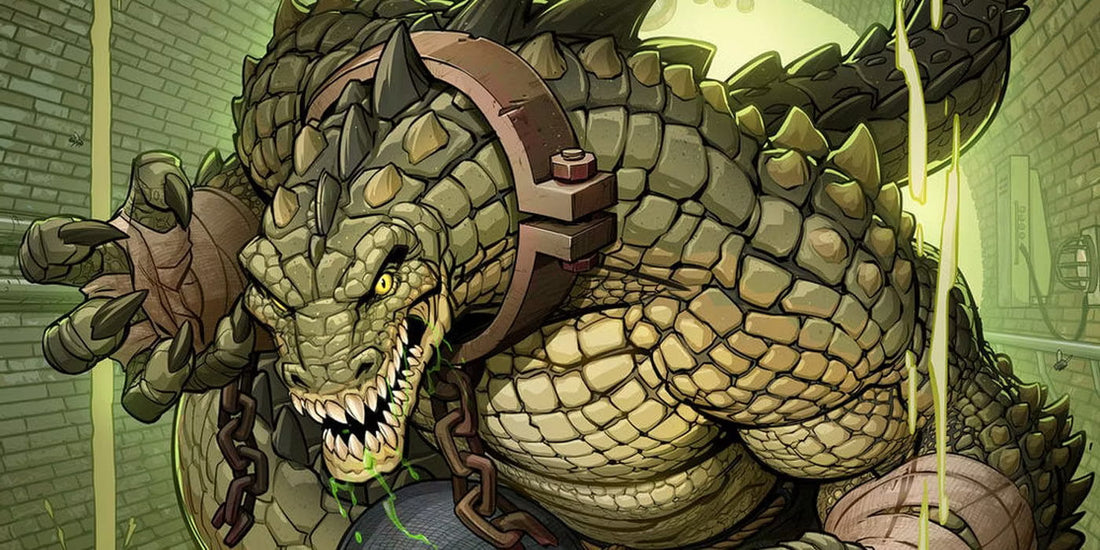
Killer Croc, whose real name is Waylon Jones, is the enemy of Batman who embodies raw strength where the Joker and the Riddler embody calculation. A rare skin condition gave him scaly skin and an extraordinary build; rejected very early on, he took refuge in the sewers of Gotham, which became his territory. Comics, the animated series, film and the Arkham video games have been replaying the same question ever since: bloodthirsty beast or victim of rejection?
Contents
Gotham reads vertically. There is the city of towers and drawing rooms, the one where people scheme in tuxedos, and there is what flows beneath it: pipes, drainage galleries, forgotten tunnels. Most criminals play their part on the surface, with an audience and a message to get across. Killer Croc occupies the other level, and he needs neither of those things to exist.
The character carries a man's name before he carries a monster's nickname: Waylon Jones. A rare skin condition, described in the stories as a form of ichthyosis, thickened and hardened his skin until it took on a reptilian look, while also giving him a build and a strength out of all proportion. The rest was the city's doing: the way others looked at him, the exclusion, then the flight toward the one place no one goes down to willingly.
His place in the gallery of the Dark Knight's adversaries is singular. The character's early years were populated with scientists in costume, like Doctor Death, the very first super-villain of Batman's career: adversaries who thought before they struck. Croc arrives much later and brings the opposite, a body. To place these figures in relation to one another, our complete guide to the legendary villains of Gotham gives the overall map; the article you are reading stops on a single square, the lowest one.
That leaves the question more than forty years of storytelling has never settled: is Croc's brutality his nature, or the product of what was done to him? The answers change with the era and the medium, and that is probably why the character still holds up. A gallery of Dark Knight figures puts that tension on display at a glance, between those who calculate and the one who crushes.
Waylon Jones: the man who existed before the beast
You have to start with the name, because everything else follows from it. Waylon Jones was not born a criminal, he was born different. The skin condition that sets him apart takes hold in childhood: the skin thickens, becomes covered in scales, resists what would wound an ordinary man. What later becomes a weapon begins as a social handicap, in a city with little patience for anything outside the frame.
What follows comes down to a simple mechanism. People point at the child, keep him at a distance, find a nickname for him, and the nickname ends up taking over completely: by dint of being called Croc, Waylon stops being called Waylon. When a man no longer has a name, he no longer has much left to protect.
That trajectory is nothing out of the ordinary in Gotham, and that is precisely the problem. The city produces its margins the way it produces its skyscrapers: in series, without looking. The philanthropic initiatives that try to mend that fabric, like the ones described in our article on the Wayne Foundation and Bruce Wayne's money, almost always arrive after the break. Croc is what remains when no one came in time.
Understanding that human part changes how every one of his confrontations reads. It is not about excusing crimes, but about recognizing that an adversary is not merely a force to be neutralized. Our overview of the complete universe of Batman characters shows how deeply this mechanism runs through the mythology: almost every villain in Gotham was someone first.
That share of humanity, on the other hand, is almost never what the imagery keeps. What sticks in people's memory, what ends up on covers and on posters devoted to the Dark Knight, is the silhouette, the jaw, the mass. The man stays in the monster's shadow, exactly as he does in the story.

★ The Dark Knight's selection
Small Batman figure
Faced with an adversary this size, the Dark Knight figure makes complete sense standing right next to it.
€22.90
View product →Gotham's sewers: from a hiding place to a territory
The sewers are often presented as Killer Croc's hideout. That is a mistake of vocabulary. A hideout is where you hide while you wait for trouble to pass. A territory is something you know, something you shape, somewhere you draw your adversary in. The galleries beneath Gotham belong to the second category: they do not protect him, they work for him.
Underground, every one of the Dark Knight's usual advantages turns against him. Darkness, his ally on the rooftops, stops being a privilege against a predator who does not need to see well to know where to strike. Water muffles footsteps but also scrambles hearing. Enclosed spaces cancel out vertical escape, Batman's favorite fallback maneuver. And the silence down there is deceptive: the echo of the pipes manufactures false directions.
This setting also says what the city would rather not see. Gotham buries what disturbs it, and not only its waste. The same logic produces other figures born of the margins, like the one we examine in our portrait of Professor Pyg, whose horror likewise comes from an intimate disorder rather than a criminal plan.
There is a visual irony in all of this. Batman's universe sells itself first through its rooftops and its stormy skies, something readily picked up by wall canvases on the theme of Gotham. Croc's world has no horizon: low ceilings, damp, no vantage point. It is a geography of confinement, not a postcard.
Finally, the only resource that really counts down there is light: a beam determines what you see and, above all, what you do not. The object has long outgrown fiction, to the point of becoming a bedroom decor classic by way of lamps in the Dark Knight's colors. In the sewers, there is nothing decorative about it: it is what separates a man from a monster he never saw coming.
Darkness
Batman's ally on the rooftops, it stops being a privilege against a predator who does not need to see well.
Water
It muffles footsteps but also scrambles hearing.
Enclosed spaces
They cancel out vertical escape, Batman's favorite fallback maneuver.
Why force isn't enough against Batman, and why it comes so close
A direct confrontation between Batman and Killer Croc has never made much sense on paper. On one side, a trained man, with no powers, whose endurance remains that of a human being. On the other, a mass able to absorb what would put anyone on the floor, protected by scaly skin that soaks up blows. The question of who hits harder is settled in advance.
What these duels are about lies elsewhere. Batman does not win by hitting: he changes the ground, he wears his opponent down, he uses the setting, the leverage points, the water, the structure itself. He turns a contest of strength into an engineering problem, and the reader knows from the first panel that the solution will not come from fists.
Gotham has already shown what happens when raw strength comes with a method. That is the whole subject of our feature on Knightfall, the saga where Bane broke Batman, and it is exactly the difference with Croc: sheer power impresses, planned power leaves marks. Croc strikes; he does not organize his adversary's downfall over several months.
These power comparisons are a popular and treacherous exercise. They work as long as you accept their rules, as in our matchup between Batman and the Mad Titan, where only preparation remains debatable. They hit their limit as soon as the adversary cannot be put out of action, as the case of a mercenary reputed to be unkillable shows. Croc sits between the two: very hard to stop, never impossible to outmaneuver.
That status explains his longevity. He is the adversary who periodically reminds the Dark Knight that he is still a man in a costume. The paradox is that the bat's iconography circulates everywhere, right down to t-shirts bearing Batman's image, while Croc's stays confined to the pages where he appears.

★ The Dark Knight's selection
Batman DC Comics t-shirt
The logo of the publisher that has been printing these villains for decades, worn without fuss.
€29.90
View product →The brute that Gotham's brains fight over
One detail comes back so often that it ends up defining the character: Killer Croc rarely works for himself. His strength is a resource, and in Gotham, resources always find a buyer. The criminals who think use him as a tool: you turn him loose somewhere, you let panic do its work, and you operate elsewhere while attention focuses on the damage.
That is the role he plays in the Hush arc, where he serves as a diversion for a plan that is not his own. The scene says a great deal about his position in the city's criminal hierarchy: he is one of the most physically formidable figures around, and yet he almost never occupies the seat of the one who decides.
This instrumentalization is consistent with the city's logic. Calculating minds prosper there because they know how to turn others into instruments, and that dynamic can be read right down to the shop windows: the Joker figures section is far better stocked than the one for creatures from the lower depths. People collect faces, not silhouettes.
There is a direct consequence to this status as a tool: when a plan collapses, he is almost always the one picked up, and almost always in the same place. We documented that return trip in our article on Arkham Asylum, Gotham's psychiatric hospital, a place that has rarely improved the condition of those it locks away.
One nuance still keeps him from being reduced to a rented weapon. Sometimes he refuses, sometimes he turns his anger on those who thought they had him, sometimes he vanishes into the tunnels. It is that remaining unpredictability that keeps him dangerous, including to his employers.
The key point
Killer Croc rarely works for himself: the criminals who think use him as a diversion, as in the Hush arc. His remaining unpredictability nevertheless keeps him dangerous, including to his employers.
From 1980s comics to today: the faces of Killer Croc
The character shows up in comics at the start of the 1980s, with a first appearance credited in Batman #357, in 1983. He arrives in an already established universe, where Gotham's gallery of villains is largely in place. His function is to fill an empty square in it: that of pure physical threat, which neither clowns nor riddlers could occupy.

The following decades give him two faces, and alternate between them depending on the writer. The first is that of a lucid criminal, able to put together an operation, to negotiate, to hold a conversation: a man who uses his strength as an argument. The second is that of a creature who loses language, bearing, then human habits, until he runs on instinct alone.
That oscillation is not an inconsistency, it is the character's engine: it allows him to be reused in urban thrillers, in horror or in social tragedy without ever betraying him. Following those variations means placing each story back in its era, which is what our complete chronology of Batman comics by era makes possible, showing how a series' general tone rubs off on its antagonists.
One thing does not change, though: his silhouette. Whatever the version, the reader identifies him by the jaw, the scales and the mass. It is a graphic signature of the same order as the bat logo scaled down onto stickers to put up anywhere: a drawing you recognize before you have looked at it.
That explains his continuous presence in the publications without his ever becoming a headliner: he fills a function rather than a leading role.

★ The Dark Knight's selection
Joaquin Phoenix Joker figure
No figure of this character exists in the catalog: here is the closest thing the section offers, from among the Arkham inmates.
€39.90
View product →Killer Croc on screen: animation, film and video games
It is probably animation that understood the character best. In Batman: The Animated Series, Croc is treated as a tragic brute, sometimes pathetic, never ridiculous. The series gives him time to exist between two confrontations, and that time is enough for the man to surface.
On film, he appears notably in Suicide Squad, in 2016, played by Adewale Akinnuoye-Agbaje. The choice made is that of a massive man with a reptilian appearance rather than a full-blown creature. The version was criticized, but it introduced the character to an audience that had never opened a Gotham comic.
This kind of adaptation always raises the same technical question, that of makeup, prosthetics and how much a human face can take before it stops being readable. We devoted an entire feature to that boundary in our complete guide to the masks of Gotham, and Croc holds a place apart in it: he has nothing to put on, it is all already on him.
Video games, for their part, have given him a lasting home. In the Arkham saga, the underground encounter in the first installment remains one of the most tense sequences in the franchise: narrow corridors, black water, blind progress, and a threat that moves faster than the player anticipates. The medium suits the character, because it places the eye at a man's height, with no way out.
The more realistic register established on film by Matt Reeves changes things for this kind of figure, while other Arkham inmates have already found their place there, starting with the Joker entrusted to Barry Keoghan. Nothing is guaranteed for Croc in that setting, and the character might gain in depth what he would lose in excess. In the meantime, his everyday territory remains that of household items, from game covers to mugs bearing Batman's image sitting on players' desks.
Animated series
Batman: The Animated Series makes him a tragic brute, sometimes pathetic, never ridiculous.
Film
In Suicide Squad in 2016, Adewale Akinnuoye-Agbaje plays a massive man with a reptilian appearance.
Video games
In the Arkham saga, the underground encounter in the first installment remains one of the most tense sequences in the franchise.
Monster or victim: what Killer Croc says about Gotham
The question raised in the introduction has no single answer, and that is what makes it interesting. Croc commits acts that no circumstance cancels out. He was also pushed aside before he had chosen anything at all. Both propositions are true at the same time, and Batman's mythology has never tried to remove one to make the other more comfortable.
The contrast with the Dark Knight is striking on one precise point. Bruce Wayne chooses his appearance: he decides to frighten, he builds an image, he can take it off. Croc chose nothing and can take nothing off. The difference between the two is not about monstrousness, but about consent. That is also what makes the Dark Knight's mask so powerful as an object: it gives physical form to a decision, where Croc's face gives form only to a sentence.
In several stories, Batman draws the consequences and tries to help him rather than neutralize him for good. Those sequences are a reminder that he defines himself first as a detective and as a moral figure, and not as a slugger.
The city, for its part, never changes its attitude. Gotham keeps producing margins and keeps acting surprised at what comes out of them. Croc is the most literal reminder of that: a man who went below the surface because the surface did not want him. You can love this universe for its aesthetic and wear it on a sweater in the bat's colors; the character is a reminder that this darkness has a narrative cost, and that it is not merely decorative.

★ The Dark Knight's selection
Classic Batman mask
The face these creatures see last: the piece that puts the reader on the right side.
€39.90
View product →Bringing Gotham home when a character has no dedicated section
Let us be blunt: Killer Croc has no dedicated section, here or anywhere else. Creatures from the lower depths are rarely turned into merchandise, for a simple reason. The merchandise market runs on instant recognition, and it favors the faces people want to run into every day. Our Batman guides and advice start from that observation rather than working around it.
That does not condemn his fans to leave empty-handed, provided they think in terms of mood rather than license. A corner devoted to Gotham's lower depths comes together very well with the Dark Knight's silhouette, the publisher's imagery and pieces that evoke the underground city. Our ultimate guide to Batman merchandise details that approach by family of objects.
The same logic applies to clothing. Our comparison of Batman t-shirts by character shows the difference in treatment between the heroes, the star villains and everyone else, Croc included. Choosing a character to wear already means taking sides in the geography of Gotham.
For small budgets and stocking-filler gifts, pocket-sized items remain a convenient way in: a Dark Knight keyring does the same signaling work as a display piece, for a fraction of the price.
And when it comes to buying for a fan whose taste for Gotham you know without knowing the details, it is better to aim wide than to aim precisely: a selection of Batman-themed gifts covers the film, comic and video game universes without forcing a choice. That avoids the trap of the overly specific gift, which targets one precise character and misses.
In short
Killer Croc has no dedicated section. So you have to think in terms of mood rather than license, with the Dark Knight's silhouette, clothing or pocket-sized items, and aim wide rather than pick an overly specific gift.
Frequently asked questions about Killer Croc
What is Killer Croc's real name?
His name is Waylon Jones. The nickname comes from a rare skin condition, presented in the stories as a form of ichthyosis, which thickened his skin until it took on a scaly, reptilian look, with a build and a strength far above average. In most versions, that human name gradually disappears from the mouths of the other characters, replaced by the nickname.
Why does Killer Croc live in Gotham's sewers?
Because he was pushed there before he found any advantage in it. Rejected very early on because of his appearance, he takes refuge below the surface, where no one goes down and no one looks at him. That refuge then becomes a hunting ground: the darkness, the water, the echo of the pipes and the absence of any vertical way out cancel out a good part of Batman's usual assets.
Is Killer Croc a dangerous opponent for Batman?
Yes, physically, and that is in fact his narrative reason for being. His scaly skin absorbs what would stop a man, and his strength makes any direct confrontation unreasonable. Batman never beats him by force: he changes the ground, wears down his endurance, exploits the setting and looks for the weak spot. Croc, on the other hand, does not put together long-term plans, which makes him formidable in the moment but rarely decisive over time.
Is Killer Croc suitable for young Batman fans?
He is one of the most frightening figures in Gotham, and both his visual treatment and his story are aimed at an audience already comfortable with horror. For younger fans, the universe offers far gentler ways in, starting with the plush companion for the little Gotham fan. On the costume side, the more colorful characters work better, as our Harley Quinn guide for children and teens explains, covering these trade-offs by age group.
Key takeaway
Killer Croc's name is Waylon Jones. A rare skin condition gives him scaly skin and a strength far above average. Batman never beats him by force: he changes the ground and looks for the weak spot.