
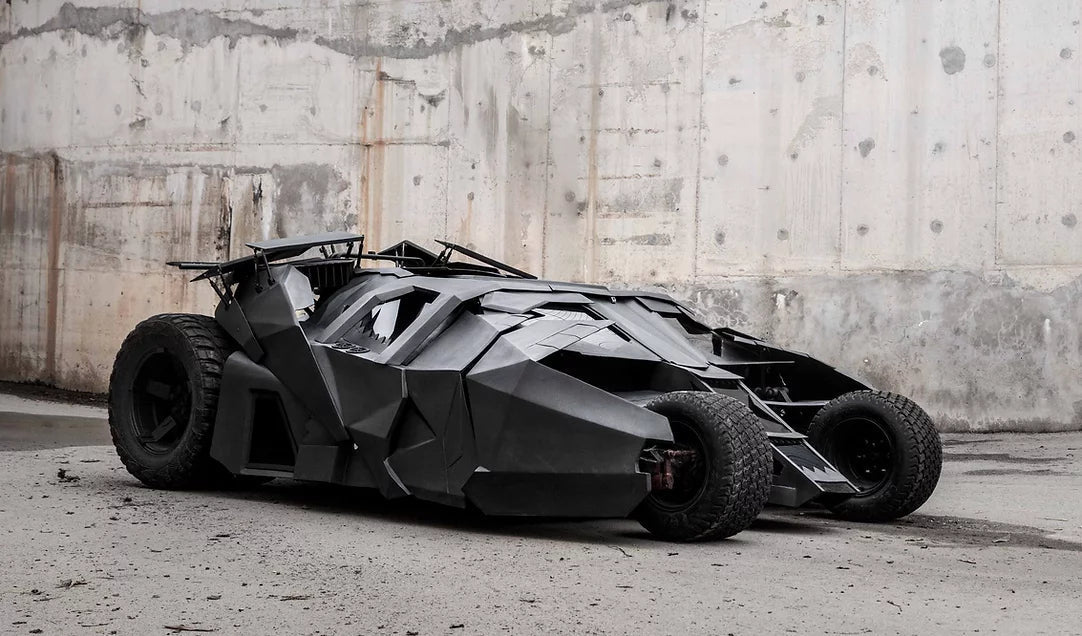
The Batmobile: The Dark Knight's Rolling Weapon
The answer in brief
It serves first to frighten, then to drive: its armor, speed, and oversized armament make it a true tank in disguise rather than a supercar. Its silhouette methodically evolves with each decade, from the retouched sports model of the 1940s to the pop icon of the 1960s television series, then to the gothic bodywork designed by Tim Burton and Joel Schumacher, before the realistic versions revealed by Christopher Nolan.
It's impossible to talk about Batman without thinking of his legendary Batmobile. A true extension of the hero, this car is not just a simple means of transport: it embodies power, fear, and technology in the service of justice. Since its first appearance in the 1939 comics, the Batmobile has evolved over the decades to become one of the most iconic vehicles in popular culture. This thread is explored in The Batboat: all of Batman's aquatic vehicles and the forgotten Gotham.
Originally, the Batmobile was just a stylized car, but it was quickly redesigned to reflect Batman's dark and strategic vision. Designed to intimidate as much as to protect, it combines speed, armor, and an arsenal worthy of a true futuristic tank. Whether it's the classic comic versions or cinematic adaptations like Christopher Nolan's trilogy, each Batmobile has left its mark on its era.
A symbol of Bruce Wayne's ingenuity, the Batmobile naturally finds its place alongside other iconic symbols like the Batcave, a true technological sanctuary. It also echoes Batman figurines that allow fans to relive its myth.
The different versions of the Batmobile
Each era of Batman has brought a new vision of his Batmobile, reflecting both the style of the time and the needs of the Dark Knight. In the 1940s comics, it looked more like a customized sports car. But from the 1960s, with the famous TV series, the Batmobile became a pop icon, recognizable among a thousand.

The 1980s and 1990s, marked by Tim Burton and Joel Schumacher's films, offered more gothic and extravagant versions, sometimes decorated with neon lights and oversized wings. Then came the era of Christopher Nolan and his Dark Knight trilogy, where the Batmobile – renamed Tumbler – took on the appearance of an armored military vehicle, combining brute power and futuristic design. Finally, in Zack Snyder's films, the Batmobile merged the tank and sport aspects, for a more aggressive and darker approach.
These multiple interpretations show that the Batmobile is not just an object: it is a reflection of Batman's personality and his evolution. This is what makes it one of the most legendary fictional cars in history, on par with the Batwing or the Batcycle.

For fans who wish to delve into these varied universes, our article on the complete timeline of Batman films offers a fascinating overview of the Batmobile's evolution in cinema.
Emblematic technologies and features
The Batmobile would not be Batman's ultimate weapon without its impressive technological arsenal. Each model has been equipped with unique features to respond to the threats of Gotham. It often includes reinforced armor, capable of withstanding bullets and explosions, as well as escape systems such as camouflage mode or pilot seat ejection.
But what distinguishes the Batmobile from simple armored vehicles are its high-tech gadgets: guided missiles, retractable machine guns, grappling hooks for climbing buildings or immobilizing an enemy, and even an autopilot mode controlled directly by the Batcave. Some models are also equipped with analysis and surveillance systems, allowing Batman to track his adversaries in real time.
These technologies make the Batmobile a true extension of the hero, just like his arsenal of gadgets or his legendary HQ, the Batcave. It is not just a means of transport, but a rolling fortress, adapted to all situations, from urban combat to spectacular chases.
To complete the immersion, you can explore our collection of Batman throws, where some versions of the Batmobile are reproduced in minute detail to relive iconic scenes.
The Batmobile as symbol and legacy
More than just a vehicle, the Batmobile has become over time a symbol of Batman mythology. Each generation of fans associates a specific design with their favorite Dark Knight: the retro comic book version, the elegant 90s car, or Christopher Nolan's Tumbler. It reflects the different eras and the evolution of the character.
The Batmobile also embodies Bruce Wayne's duality: on one hand, a billionaire capable of funding advanced technologies, on the other, a determined vigilante who transforms a simple vehicle into a weapon against crime. It is this alliance between man and machine that makes it an inseparable element of the legend.
Through its multiple versions, the Batmobile reminds us that Batman is not just a man, but a concept: that of transforming fear and pain into a tool for justice. A timeless symbol that, like Gotham City and its inhabitants, makes the heart of the Dark Knight's universe beat.
The Batmobile in popular culture and among fans
Beyond comics and films, the Batmobile has made its mark on the collective imagination to the point of becoming one of the most famous fictional vehicles of all time. It can be found in video games, animated series, but also in exhibitions and conventions where fans recreate life-size models.
Many enthusiasts collect Batman t-shirts or miniature replicas of the Batmobile, ranging from classic versions to modern models. Some collector's items even fetch impressive prices, proving the mythical aura of this powerful car.
The Batmobile is also a source of inspiration: it influences automotive design, pop culture, and even some futuristic military vehicles. It proves that Bruce Wayne's genius is not limited to Gotham, but resonates in the imagination of fans worldwide.
Whether through Batman's gadgets, the Batcave, or his mythical car, each element contributes to forging the Dark Knight's legacy. The Batmobile remains one of his most powerful symbols, a blend of power, technology, and mystery that transcends generations.