The Mad Hatter: Master of Illusions
The answer in brief
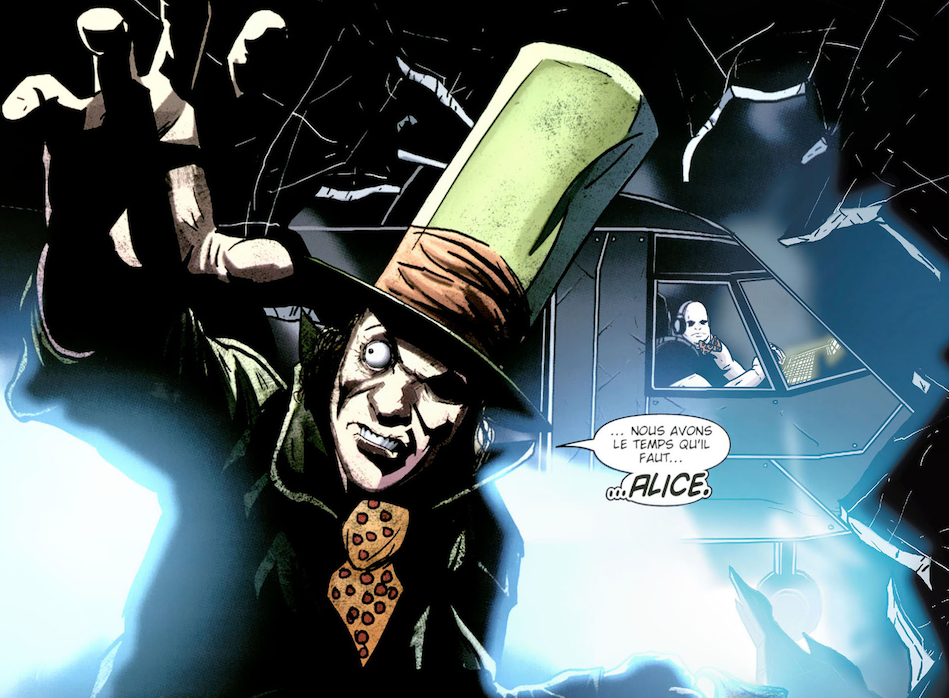
The Mad Hatter, whose real name is Jervis Tetch, is Batman's enemy who enslaves minds instead of stealing or killing out of greed. This frail scientist, obsessed with Lewis Carroll's Alice, conceals mind-control devices in rigged hats and transforms his victims into characters from his tale. Appearing in comics in 1948, over the decades he found the weapon that defines him today: mind control, never brute force.
There are two ways to lose to an enemy in Gotham. The first is noisy: you fall, you bleed, you get back up or you don't. The second makes no sound. You remain standing, you keep walking, talking, opening a door, extending a weapon, and nothing in what you feel indicates that someone else is in control. The Mad Hatter operates exclusively in this second mode, and that's what makes him so difficult to categorize among the city's criminals.
Behind the title lies Jervis Tetch, a frail, educated man, fascinated by neurosciences, and consumed by a literary obsession he has long ceased to consider a mere pastime. Where other Arkham inmates seek fortune, territory, or recognition, he desires actors for a play he endlessly restages. Gotham boasts far more notorious names, starting with the one whose tortured mind is traced in our portrait of the Joker, but few villains pose such an uncomfortable question: what remains of a victim when nothing has been taken from them but their will?
This article reintroduces the character from the ground up — the man, the obsession, the tool, his place in the gallery of the Dark Knight's adversaries, and how he has been depicted from comics to video games. It follows up on our complete guide to Gotham's mythical villains, which maps out the entire gallery; here, we focus on just one of them, the one most often underestimated because he doesn't inspire fear at first glance.
Jervis Tetch: The Frail Man Behind the Hat
Jervis Tetch is no colossus. Small, thin, with a high-pitched voice and a refined vocabulary, he resembles a distracted academic more than a wanted criminal, and this appearance is a considerable part of his effectiveness: no one guards themselves against him. His background places him in the mental sciences, which, in a city that has turned psychiatry into an industry, is never an insignificant detail. He knows how to capture attention, how to craft a suggestion, how an instruction ends up resembling a desire.
Appearing in comics in 1948, he belongs to that first wave of adversaries who gave Batman more than just robbers to fight. This longevity is itself telling: a character who is regularly brought out for decades fulfills a very specific narrative function. To contextualize this period and the shifts in tone that followed, our complete chronology of comics by era traces the major works decade by decade; the Hatter, meanwhile, traverses these eras, gradually refining the method that defines him today.
The rest of his journey is a loop. He acts, he is arrested, he returns behind the walls of Gotham's most terrifying psychiatric hospital, and he starts again as soon as he finds a workshop and a headpiece. The asylum is not a punishment for him but a parenthesis, and the article dedicated to it details what this institution truly represents in the city's balance. From this cycle emerges an immediately recognizable silhouette, one seen in fan showcases and among the Batman figurines that reconstruct the Dark Knight's universe — even if, as we will see, this specific character is not included.

★ The Dark Knight's Selection
Batman Movie Poster
The poster as an ambient object: a way to bring Gotham's gallery into a room without changing anything else.
From €9.90
View product →Alice in Wonderland: An obsession that became a method
Tetch's obsession with Alice in Wonderland is neither a mere quote nor a superficial nod. He doesn't draw inspiration from Lewis Carroll's text: he inhabits it, and he reassigns roles around him. His victims are renamed according to the cast of the tale — an Alice, a March Hare, a Cheshire Cat — and from the moment they receive this name, they cease to exist in his eyes as people. The reversal is methodical: it is reality that must conform to the book, never the other way around.
This mental functioning produces a very recognizable aesthetic, made of set tables, teapots, playing cards, and misplaced courtesies. The tea party scene, in particular, recurs constantly: it provides the character with a setting where hospitality and threat merge, and where conversation matters more than violence. The contrast is striking for a reader who associates the city with damp alleys. It is even more so when the same domestic motif is found, entirely defused, on an everyday object: a Batman mug reduces the tea ritual to a harmless wink. On the wall, the logic is identical, and Batman posters play on this familiarity to establish the universe in a room without retaining its threat.
Finally, the hat functions as a mask that doesn't hide the face. It signals identity, announces the character, and focuses attention exactly where the weapon is located — a sleight of hand that Gotham practices at all levels, among its criminals as well as its protector. Our complete guide to Gotham's masks explores this grammar of the hidden face across the entire city; for Tetch, it's enough to remember that the headwear is not a costume accessory, but the casing for his equipment.
Mind Control, the Weapon That Leaves No Trace
The Mad Hatter's technology lies in an object no one searches. He crafts miniaturized mind-control devices, conceals them in the lining of a hat, then places it on his target — or, even better, makes them wear the hat willingly. From that point on, the victim obeys without knowing they are being controlled. They walk, they respond, they recognize their loved ones; they have simply ceased to author their own intentions.
Tactically, this changes everything for an adversary like Batman. An enemy who strikes is fought; an enemy who takes control of passersby turns the entire street into a living obstacle that the Dark Knight is not allowed to harm. The balance of power is then completely reversed, because the more powerful Batman is, the more he is forced to hold back. Against a wall of muscle, the confrontation remains at least legible, as shown in our theoretical confrontation between Gotham's strategist and the Mad Titan. Against a hat, there's nothing to punch.
This weapon places Tetch in the family of villains who attack the mind rather than the body, but each operates in their own way. The Scarecrow, master of fear, relies on terror and leaves his victims free to flee, which his portrait details much better than these few lines. The Hatter, however, does not seek to frighten: he seeks to command. The nuance is decisive, because fear leaves a memory where suggestion leaves a void. It also explains why his headwear so intrigues costume enthusiasts, a terrain covered by the Batman masks in the catalog, even if the Hatter has no model under his name.

★ The Dark Knight's Selection
Harley Quinn Cartoon Figure
The Mad Hatter has no figurine in the catalog: here is the closest Arkham inmate, in the animated style that made these villains famous.
€22.90
View product →Facing Batman: A duel not won by fists
Clashes between Batman and the Mad Hatter rarely follow the classic pattern of pursuit and takedown. Tetch doesn't wait for the Dark Knight on a rooftop: he waits for him in an already set scene, with hostages who don't perceive themselves as such and a setting that obeys the logic of the tale. Batman's task is primarily to unravel what in the scene is reality and what is a script imposed on others.
This is where the character becomes invaluable to the Dark Knight's mythology, as the countermeasure is not physical but mental. Resistance to suggestion, disciplined attention, refusal to play the assigned role: Batman wins by remaining himself longer than the other can maintain control over him. He then proceeds as always, piece by piece, until the whole thing comes together. The image is not so far from the Batman puzzles that fans put together in the evening, except that here the box shows no final pattern.
This type of adversary also puts into perspective the brute force duels that readers love, where everything is settled with power and endurance, as in our comparison between Gotham's strategist and the unkillable mercenary. Finally, it reminds us that Bruce Wayne's war is not only fought at night and masked: the institutional and philanthropic side of his actions, detailed in our article on the Wayne Foundation, works on the causes while the costume addresses the consequences.
From the Animated Series to the Arkham Games: Where the Hatter Found His Face
A comic book villain truly exists for the general public only when an adaptation gives them a voice and a demeanor. For the Mad Hatter, after an initial live-action appearance in the 1960s series, the version that the public remembers is that of the 1990s animated series, which establishes him in a melancholic as well as threatening register: a lonely man, polite, desperately attached to an idea, and ready to rewrite the minds of others to retain it. This version has permanently fixed the silhouette we now associate with the character.
The Arkham video games extend this work in another direction. They utilize the character for what he technically allows: making the player themselves fall into a sequence where they no longer control the rules, with corridors that turn around and a perception that becomes disoriented. This is a particularly coherent use of the character, one where the medium makes the player undergo what Tetch inflicts on his victims. He also appears in stories centered on the asylum, such as Arkham Asylum: Living Hell, where he is just one inmate among others.
Cinema, however, has not taken him on in the foreground, even though recent productions are now exploring the asylum and its detainees: this is hinted at by the announced return of Barry Keoghan to Matt Reeves' universe, which our article details. In the meantime, it's printed media that circulates these figures the most. Batman posters remain a very direct way to install the universe on a wall, and for smaller spaces, Batman stickers provide the same service at lower cost.

★ The Dark Knight's Selection
Batman Animated T-shirt
The 1990s animated series gave these villains the silhouette we still recognize today.
€29.90
View product →His Place in Arkham's Rogues' Gallery
The city produces monsters in series, but not all in the same way. A good portion of the gallery thrives on spectacle: laughter, costumes, public declarations. The Mad Hatter belongs to the inverse category, that of discreet criminals whose dangerousness is not apparent from the outside and can only be measured after the fact, when one understands what the victims unknowingly accomplished.
In this same family of villains who unsettle rather than impress, Professor Pyg occupies a special place, and his dedicated portrait explains why his case is so difficult to fully comprehend. At the other end of the spectrum, the clown remains the obligatory point of comparison: where the Hatter wants docile actors, the other wants pure chaos. This contrast also explains the differences in merchandise representation, as the Joker figurine has its own section while Tetch has none.
For a reader discovering the universe, a good entry point remains the general mapping of Gotham's faces. Our overview of all Batman characters gathers allies, enemies, and supporting roles, allowing each to be situated in relation to the others instead of being discovered in isolation. The Hatter occupies a singular position there: never at the center, never absent, always summoned when a story needs reality to cease being reliable.
A Niche Villain: What That Actually Changes
Let's be frank: the Mad Hatter does not have the commercial power of Gotham's big names. His notoriety rests on comic readers, gamers, and fans of the animated series, not on a blockbuster that would have imposed him on everyone in one summer. This reality has a very concrete consequence for a collector: there is no section dedicated to him, and items directly representing him are rare.
This doesn't detract from the character's interest, but it changes the approach. One no longer looks for a product in his likeness, but rather for the associated atmosphere: the dim light of a room, when a Batman lamp creates the ambiance, or the sobriety of dark clothing, when a Batman sweater serves as a subtle nod rather than a statement. It's an approach based on tone, not on branding, and it applies to all secondary villains.
This is also the logic followed by our Batman Guides & Tips section, designed to help choose when the catalog does not directly meet the demand. The right question is not "is there a Mad Hatter item?", but "what, among what I can actually buy, tells the story of what I like about this character?". The answer almost always revolves around the same ingredients: the asylum setting, polite unease, the discrepancy between good manners and threat.

★ The Dark Knight's Selection
The Riddler Batman Mask
The Mad Hatter doesn't have a mask named after him. The closest to his style is this olive hood with a strap, and a plate covering the mouth: an entirely erased face, exactly what a villain who prefers enigma to observation seeks.
€39.90
View product →Extending the Mad Hatter's Universe Without His Own Merchandise
Clothing remains a flexible solution because it allows you to choose your side without disguising yourself. Our guide to Batman t-shirts by character explains how to navigate visuals depending on whether you want to display the hero, a villain, or just the symbol, and this is exactly the reasoning to apply here. The Batman t-shirt section is the natural starting point, with designs ranging from the most understated to the most verbose.
For a complete embodiment, a costume poses a different question, that of legibility: a costume must be recognized in a second, which mechanically penalizes secondary characters. The guide dedicated to Harley Quinn costume for children and teens clearly shows how this decision is made, between comfort, age, and immediate recognition. When an Arkham inmate doesn't have an available outfit, one falls back on another member of the same family, without any illusions.
Then there's the case of a gift, where the requirement isn't the same since it's about hitting the mark for someone else. The Batman gifts selection covers ranges and budgets, from small items to more significant gestures. And for an overall view of what actually exists, our ultimate guide to Batman merchandise covers the whole question: it's a solid reference point when collecting an entire universe rather than just one character.
Frequently Asked Questions About the Mad Hatter
Who is the Mad Hatter in the Batman universe?
The Mad Hatter is the criminal alias of Jervis Tetch, a Batman foe who first appeared in comics in 1948. He is a frail, cultured man, trained in mental sciences, completely obsessed with Alice in Wonderland. He acts neither out of greed nor a thirst for territory: he wants to control minds and assign the roles from Lewis Carroll's tale to those around him. A recurring inmate of Gotham Asylum, he is one of the villains who appeared in the Golden Age of comics, and has been regularly re-employed since the 1980s.
What are the Mad Hatter's powers?
He has no superhuman powers, and that's precisely what makes him interesting. His strength is technical and psychological: he designs mind-control devices that he conceals in tricked-out hats, and he supplements this arsenal with hypnosis and suggestion. Once the victim is wearing the hat, they carry out orders without knowing they are being directed. He therefore doesn't need to fight, which makes him difficult to neutralize by the Dark Knight's usual means.
Why is he obsessed with Alice in Wonderland?
The character is built around this obsession, to the point that it serves as his personality. Not all stories recount his origin in the same way, and it would be imprudent to give a single version: what remains constant from one era to another is that he reads the world through the tale, renames his victims as characters from the book, and acts as the director of a play he endlessly re-enacts.
Are there any Mad Hatter merchandise products?
The character does not have a dedicated section: the current catalog offers no figurines, masks, or clothing with his likeness, because his notoriety is that of a niche villain. Fans therefore engage with the universe that surrounds him, focusing on the atmosphere of Gotham and its asylum rather than on his effigy. For a child, the reasoning is the same with one detail different, added softness, and our guide to Batman plush toys shows how to convey this universe without going through its criminals.