
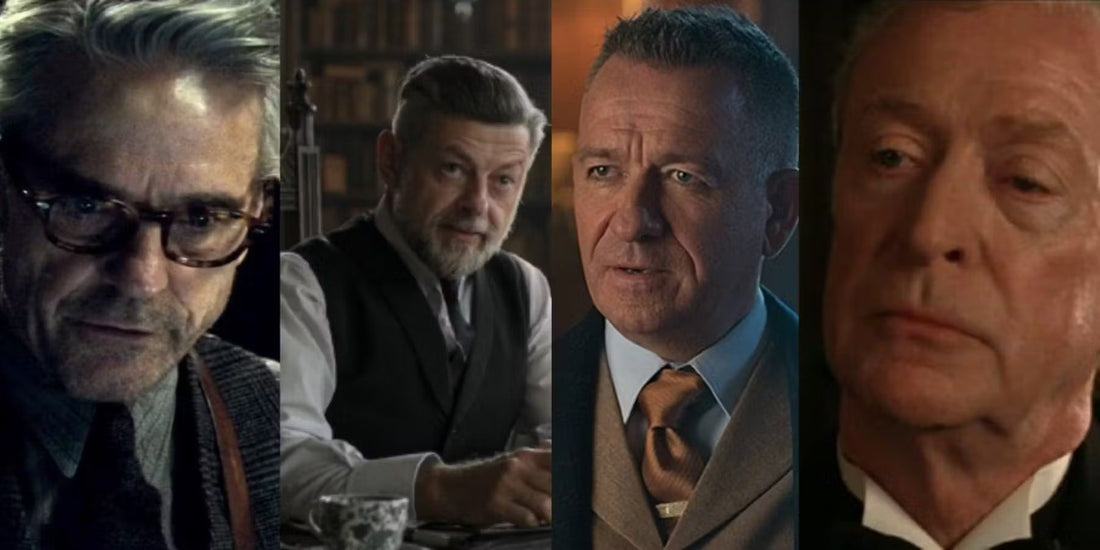
The incredible story of Alfred, Batman's faithful butler
The answer in brief
Alfred Pennyworth is the Wayne family's butler and the figure who raised Bruce Wayne after the death of his parents. Created in 1943, he first appeared portly and clumsy, before becoming the thin, phlegmatic butler we know today in the 1950s. He tends to the Dark Knight's injuries, keeps the manor and the Batcave running, covers for his employer's absences during the day and reminds him, night after night, that he is still a man.
Contents
A hero is judged by his enemies. He should also be judged by those who wait up for him when he comes home. Every night, while Gotham City counts its damage, a figure walks back down into the Batcave, exhausted, often injured, and finds someone still standing: a kit open, a lamp lit, a cup set down in the right place. That someone is called Alfred Pennyworth, and he is without a doubt the least spectacular and the hardest to replace part of the Dark Knight's entire machinery.
Butler to the Wayne family, Alfred is also the confidant, the improvised nurse, the moral advisor and, when it comes to it, the accomplice. He has neither cape nor power: he has keys, a memory and patience. The story of the night that tipped an orphaned child into the costume belongs to another chapter, the one we tell in how Bruce Wayne became Batman; what concerns us here is the man who stayed home afterwards.
His story spans several continuities and a dozen performers, from the comic household servant of the early days to the former field operative of recent versions. It deserves better than a footnote in his employer's biography, detailed on our page Bruce Wayne: all about the true face of Batman. Here are his origins, his past, his role as a father, his stewardship and what he leaves behind.
The origins of Alfred Pennyworth: 1943, an unexpected butler
Batman had been patrolling Gotham since 1939 when his butler finally made his entrance. Alfred was created in 1943 by Don Cameron and Bob Kane, and first appeared in Batman #16. The manor had therefore run for several years without him on paper, which sheds light on his particular status: he was not laid down as a piece of scenery, he was added afterwards, because something was missing in that huge empty house.
His first version surprises everyone who discovers the character through the films. In the early panels, Alfred is portly, a little bumbling, frankly comic, with a physique traced from the British actor Arthur Treacher. He trips over himself as much as he gives advice, and the comic spring wins out over the gravity we associate with him today.
The correction came quickly, and it was definitive. From the 1950s onward, Alfred slimmed down: thin, slender, a fine mustache, imperturbable composure. It is that silhouette which has crossed the decades and which serves as the reference whenever a story, a film or a cartoon needs a butler.
To follow that transformation is to follow the evolution of an entire body of work: our page chronology of Batman comics by era places these shifts in their editorial context, era by era. And the most radical rereadings keep reshuffling the deck: as soon as a series strips Bruce Wayne of the family fortune, everything orbiting the manor has to be rethought, an experiment we detail in our article devoted to Absolute Batman, the Bruce Wayne without a fortune.
The irony of that longevity: the man who opens the door stayed invisible in shop windows for a long time. You come across dozens of versions of the Dark Knight in a Batman figure collection before spotting a single depiction of his butler.


★ The Dark Knight's selection
Batman 3D Mug
The everyday object par excellence: in this house, he's the one who brings the cup.
€28.90
View product →A curriculum vitae that is anything but ordinary
Reducing Alfred to domestic service means missing what makes the character credible. Depending on the continuity, he was a military doctor or nurse, which justifies the fact that he can stitch a deep wound, immobilize a fracture and make a diagnosis at three in the morning without going through a hospital, where the slightest gunshot wound would trigger a report.
Several versions go further and credit him with a past in British intelligence, serving MI5. This is not an ornament: it explains the composure, the handling of cover stories and the fact that a secret of that magnitude has held for decades without leaking. Other stories give him a past as an actor, on the London stage, before he joined the manor: holding a role, backing up a lie in front of the police or the press, playing polite boredom at an overly curious visitor, all of that can be learned.
Depending on the era, he also takes over a post his father already held with the Waynes, which makes his service a family affair as much as an employment contract. That culture of playing a part echoes directly in his employer, who likewise maintains a complete borrowed identity, with a past, an accent and acquaintances: we devote an entire article to it, Matches Malone, Bruce Wayne's third identity.
That leaves style, which is never a detail with him. Alfred's elegance is understated and does not seek attention: a clean cut, a material that holds up, nothing that shouts. It is the spirit of a Batman sweater worn every day, where the symbol is guessed at rather than displayed.
Doctor or nurse
His military past explains why he can stitch a wound, immobilize a fracture and make a diagnosis.
British intelligence
A past with MI5 explains his composure and his handling of cover stories.
London stage actor
The stage taught him to hold a role and back up a lie in front of the police.
The surrogate father: the one who raised Bruce Wayne
If Alfred holds a place apart in readers' hearts, it is neither for his deadpan humor nor for the quality of his service. It is because, after the murder of Thomas and Martha Wayne, he becomes the only stable family figure in the life of a child orphaned in a single night. He replaces no one and does not claim to: he occupies the empty place, which is harder.
He is the one who raises Bruce, who walks through grief at his side and who keeps the house going while the heir shuts himself away first in books, then in training, then in years of absence. The role is thankless: Alfred does not always approve, he often watches helplessly a path he would have wanted to be different, and he goes on preparing meals and turning on the lights all the same. Staying is, here, the most concrete form of a father's love.
That tension between the man and the bat has been carried into comics in a chamber piece we analyze in our article on Batman: Ego, Bruce Wayne's inner duel. It also has a physical version: when the Dark Knight loses control and slips into an addiction, it is once again the butler who ends up on the front line, and that story has its own file, Batman: Venom and Bruce Wayne's addiction.
Then there is the tiny gesture that sums up the character better than any speech: the blanket laid over the shoulders of someone who has fallen asleep fully dressed in front of his screens. That is Alfred's domestic vocabulary, and a simple Batman throw blanket tossed over a sofa says far more about that bond than any fight scene.

★ The Dark Knight's selection
Bruce Wayne T-shirt
The name of the one he raised, worn without the costume — exactly the way Alfred looks at him.
€29.90
View product →The manor, the Batcave and the stewardship of the shadows
A war fought at night has a logistics chain. Wayne Manor is not just a big house: it is a cover, a warehouse, a first aid post and a hidden entrance. We tell its history and its symbolism in our file on Wayne Manor, the most famous mansion in Gotham. Alfred, for his part, keeps its records, its accounts and its schedules, which means justifying deliveries, repairs and bills without arousing curiosity.
Beneath the manor, the cave. Alfred has his workbench there, his pharmacy and his filing. He stores the evidence, maintains the equipment, archives the closed cases and cleans what nobody else wants to clean. The centerpiece of that arsenal has its own article, the Batcomputer, the Batcave's computer; the rest, the order and the continuity, rests on one man alone.
You have to picture the set of keys such a post implies: service doors, park gates, storerooms, passages that appear on no plan. In a house where every access point is a weakness, knowing what is locked is as much a matter of security as of housekeeping. A Batman keychain is a modest nod to that role of keeper of the accesses.
The kitchen is no footnote either. The tray, the teapot, the sandwich made for someone who forgot to eat: it is through these gestures that Alfred keeps up a semblance of normal life. The cup set down at the right moment is an argument, and a Batman mug on a desk extends the idea rather well.
That leaves the walls. A manor of that size fills up with portraits and frames whose upkeep is part of the job, and among them are the faces of the dead parents: a heavy symbolic load, entrusted to the man who knew them alive. At home, a Batman canvas does the same work on a bare wall.
The manor
Alfred keeps its records, its accounts and its schedules without arousing curiosity.
The Batcave
There he stores the evidence, maintains the equipment and archives the closed cases.
The kitchen
The tray, the teapot and the sandwich made in advance keep up a semblance of normal life.
Covering for Bruce Wayne during the day: the other half of the job
Alfred's work does not stop at sunrise, it changes nature. A man who spends his nights on rooftops has to exist during the day, in a calendar, in gala photographs and at the end of a phone line. Missed appointments become excused delays, absences become business trips, injuries become sports accidents. That daily fiction demands a rare consistency.
The facade has an address and a recognizable silhouette, that of the Wayne Enterprises headquarters, which we detail in our article on Wayne Tower, Bruce Wayne's public headquarters. That is where the daytime version of the character plays out, the one made of board meetings and handshakes, while the nighttime version recovers.
That fortune is not only decorative: it funds the equipment, the repairs and part of the social work carried out across Gotham. We cover that side in our file on the Wayne Foundation and its philanthropy. Another question keeps coming back among readers, that of knowing how much Bruce Wayne's fortune is really worth. The butler sits at the junction of the two: he sees the bills from both sides.
The adversaries of the day look nothing like those of the night. They wear no makeup and do not escape from an asylum: they buy out, they negotiate and they wait. One of the most formidable has his own portrait in our article on Lex Luthor, Bruce Wayne's true rival. On that ground, Alfred's weapon is not the fist, it is the calendar.

★ The Dark Knight's selection
Bruce Wayne Figure
The man without the mask, the one Alfred remembers as a child.
€39.90
View product →The moral conscience of the Dark Knight
Alfred is not an order-taker. He argues with the orders, challenges the methods and asks, year after year, the same uncomfortable question: where does the line fall between justice and revenge? Where Gotham offers nothing but corruption and violence, the butler holds on to another point of view, that of a man who knew the family before the tragedy and refuses to treat the crusade as a fate.
He is one of the very few who can say no without being pushed aside. That authority comes neither from a rank nor from a contract, it comes from seniority: he was there before the costume. When he chooses to withdraw, that departure hits harder than any threat, because it means the most patient person in the household has stopped believing in the path being taken.
His real work happens in the empty hours: waiting for the return, keeping watch while the other finally sleeps, leaving a light on in a stairwell. A Batman lamp set down in a hallway is a fairly accurate image of that discreet function, the one that consists of never switching off completely.
You also have to measure the nature of the task: putting a man back together piece by piece, evening after evening, knowing that the next day will undo part of the work. The image of the Batman puzzle spread out on a table describes rather well what the butler really does with his nights.
Key takeaway
Alfred argues with the orders and challenges the methods by asking where the line falls between justice and revenge. His authority comes neither from a rank nor from a contract: he was there before the costume.
Alfred and the Batfamily: when the manor fills up
The manor does not stay empty for long. Dick Grayson arrives, then the successive Robins, then Barbara Gordon, then Damian Wayne, and with them the meals to prepare, the uniforms to mend and the arguments to settle. Alfred moves from the status of surrogate father to that of unofficial grandfather of a household that keeps growing, without anyone ever thinking to ask his opinion on the recruiting.
His role there is twofold. He treats the wounds, obviously, and he welcomes: in a family where people come in through the window and leave in costume, he is the one who reminds everyone that there is a table you sit down at. He is also the one who absorbs the losses, since he has known every one of these young people since their first day at the manor. To place each of them within the whole, our page the complete universe of Batman characters lays out the panorama.
That is where Alfred becomes very concrete. A house full of teenagers means laundry, different sizes and birthday presents nobody else would have thought to buy. A pair of Batman socks falls exactly into that register: the modest, useful attention that only gets noticed when it is missing.
The same spirit applies to the wardrobe. A Batman t-shirt worn at home is no kind of statement: it is the clothing of an everyday life shared by people who, once night falls, lead a far less ordinary one.
The key point
With the arrival of Dick Grayson, the successive Robins, Barbara Gordon and Damian Wayne, Alfred becomes the household's unofficial grandfather: he treats the wounds, he welcomes and he absorbs the losses.
The faces of Alfred, from the 1960s TV series to contemporary cinema
Few supporting roles have been played so often, and every performer has moved the needle. In the 1960s television series, Alan Napier imposes an impeccably serious butler in the middle of a deliberately colorful universe, a contrast the show draws its charm from. Michael Gough, next, accompanies the Tim Burton era features with an almost sad gentleness, that of a man who understood before anyone else where it would all lead.
Christopher Nolan's trilogy hands the role to Michael Caine and makes him one of its emotional pillars: a father figure, tender but firm, who tries to talk Bruce Wayne out of taking on suicidal adversaries. In The Dark Knight Rises, his decision to leave the manor conveys despair more than anger. In the DCEU, Jeremy Irons offers a more pragmatic and ironic reading, that of a technical partner settled at the controls.
Recent versions pull the character back toward his field past: Andy Serkis gives a weathered image of him, closer to the former professional than to the drawing-room butler, while television has given him a full youth with the series that bears his name, and a leading role in the one devoted to Gotham's early years, where Sean Pertwee plays him as a man of action. The animated series of the 1990s, finally, fixed the character's voice for many: a mix of classic butler and formidable observer, able to bring Bruce back to reason with a single remark.
That accumulation of faces explains his place in the saga's imagery. He rarely appears on a poster, which goes to the costume and the symbol; but a Batman poster hung on a wall always tells, in negative, the story of the house whose keys he kept.

★ The Dark Knight's selection
Alfred Figure
The butler himself, rarely depicted: the piece missing from most collections.
€59.90
View product →A legacy that outlives his death
For a long time, Alfred was the guarantee that everything would eventually fall back into place. Modern comics finally took the step: the arc where Bane takes control of Gotham costs the butler his life. The scene is in no way spectacular, and that is what makes it unbearable. It is not one more ally going down, it is the house itself going dark.
What that death reveals is the scale of what he was holding up alone. Without him, nobody archives anymore, nobody stitches anymore, nobody pushes back anymore. The saga where the Joker seizes the family fortune, which we recount in our file on Joker War and the theft of the Wayne fortune, shows how far the whole structure rested on a small number of pillars, many of them human.
His legacy still stands, though, because it is methodical rather than sentimental: a demand for bearing, a way of never confusing justice with payback, an attention to the material details that make a crusade last instead of collapsing. Every character who takes over part of those tasks inherits a little of him.
That is also why he holds a place apart among collectors: depicting the butler means depicting the invisible part of the myth. Our page guide to Batman merchandise maps out the main families of items to help you find your way. And when it comes to pleasing someone who already knows the universe by heart, the Batman gifts selection remains a good starting point.
In short
In modern comics, Alfred dies during the arc where Bane takes control of Gotham. His legacy stays methodical: a demand for bearing, the refusal to confuse justice with payback, and an attention to material details.
Frequently asked questions about Alfred Pennyworth
Who is Alfred Pennyworth in the Batman universe?
Alfred Pennyworth is the butler of the Wayne family. After the murder of Thomas and Martha Wayne, he raises Bruce and becomes his only stable family figure. He keeps the manor and the Batcave running, tends to the Dark Knight's injuries, covers for his absences and acts as a moral conscience by challenging his methods. He is one of the very few characters to have known his identity from day one.
When did Alfred first appear?
The character was created in 1943 by Don Cameron and Bob Kane, and appears in Batman #16, a few years after the Dark Knight's debut. He is portly and clumsy at that point, with a physique inspired by the British actor Arthur Treacher. From the 1950s onward, he takes on the thin, distinguished look that the adaptations would later carry over.
Does Alfred really have a military or secret agent past?
It depends on the continuity. Most versions credit him with experience as a military doctor or nurse, which explains his medical skills; several others mention a spell in British intelligence, and some give him a past as an actor. None of these biographies cancels out the others: they coexist depending on the era and the story.
Which actors have played Alfred in film and on television?
Alan Napier in the 1960s series, Michael Gough in the Tim Burton era, Michael Caine in Christopher Nolan's trilogy, Jeremy Irons in the DCEU, Sean Pertwee on television and Andy Serkis in the most recent productions: the list is long and every interpretation shifts the character slightly. To read further, our Batman Guides & Tips hub gathers our files on the Dark Knight's universe.
| Actor | Context |
|---|---|
| Alan Napier | 1960s TV series |
| Michael Gough | Tim Burton era |
| Michael Caine | Christopher Nolan's trilogy |
| Jeremy Irons | DCEU |
| Sean Pertwee | Television |
| Andy Serkis | Recent productions |