Poison Ivy: Origins, Powers, and Legacy of Batman's Most Enchanting Foe
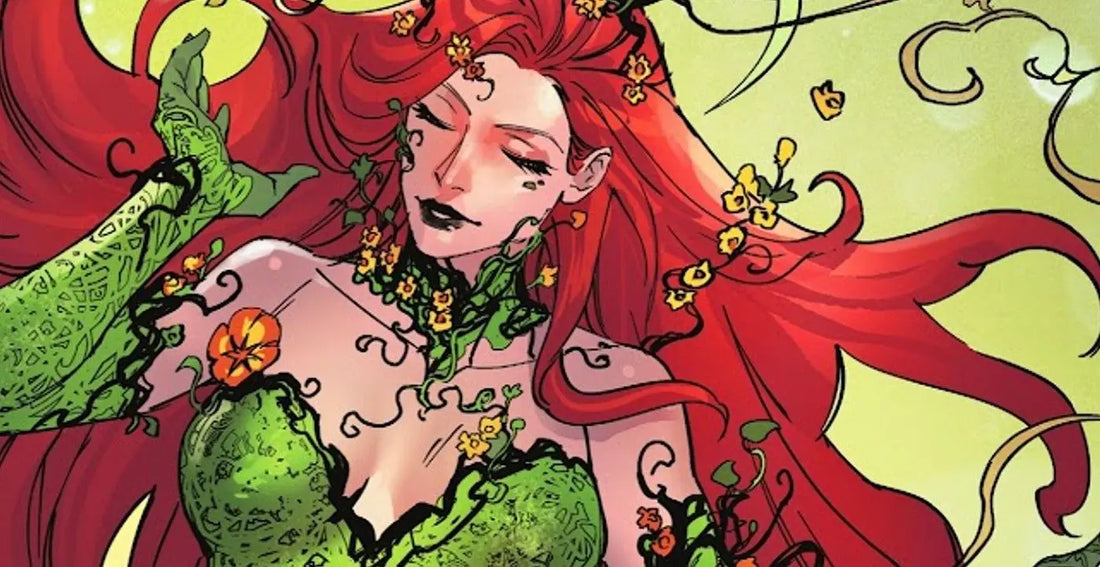
In the abundant universe of Gotham City, few of Batman's enemies are as fascinating and ambiguous as Poison Ivy. Behind this captivating pseudonym hides Pamela Isley, a brilliant scientist who became a formidable eco-terrorist. Combining hypnotic beauty with extraordinary intelligence, she can control plants and use deadly toxins to achieve her goals.
Unlike enemies such as the Joker or Two-Face, Poison Ivy does not seek chaos or power. Her true obsession is the defense of nature, even if it means sacrificing human lives to protect her "plant people". This particular motivation makes her a unique adversary in Batman's rogues' gallery, oscillating between criminal threat and misunderstood activist.
In this article, we will explore:
- The tragic origins of Pamela Isley and her transformation into Poison Ivy.
- Her extraordinary powers and their evolution through comics and adaptations.
- Her complex relationship with Batman, Catwoman, and Harley Quinn.
- Poison Ivy's cultural impact and her popularity in merchandise, costumes, and modern adaptations.
🌿 To extend the experience, discover our Batman and his enemies figurines, as well as our Gotham posters, perfect for recreating the dark and fascinating world of the Dark Knight at home.
The origins of Pamela Isley: from brilliant scientist to Poison Ivy
Before becoming Poison Ivy, Pamela Isley was a brilliant botanist passionate about the mysteries of the plant world. Her research focused on exotic plants, natural toxins, and the regenerative capabilities of the plant kingdom. But her obsession with nature and naive trust led her to cross paths with unscrupulous scientists.
In some versions of the Batman comics, Pamela becomes a guinea pig for genetic experiments that profoundly alter her body. Her blood is replaced by chlorophyll, her immune system fuses with that of plants, and she develops an extraordinary resistance to poisons and diseases. This is how she is reborn as Poison Ivy, a hybrid creature, half-woman, half-plant.
Her first steps as a criminal are not motivated by greed but by a fierce desire to defend the planet. She considers humanity a destructive plague, exploiting natural resources without regard for the consequences. Her mission becomes clear: to protect flora, even if it means opposing Batman and the authorities of Gotham.
This tragic and militant origin explains why Poison Ivy is not a simple "villain." She is one of the few figures in Gotham's rogues' gallery to embody an ideological struggle, which sometimes brings her closer to unexpected allies like Catwoman or even Harley Quinn.
🌱 To delve into this duality between beauty and danger, explore our DC costumes and disguises, perfect for embodying Gotham's iconic heroes and villains at cosplay events, conventions, or themed parties.

Poison Ivy's powers and abilities
Poison Ivy distinguishes herself from other Batman's enemies by powers directly linked to the plant kingdom. More than just a manipulator, she literally embodies nature in its most fascinating and dangerous form.
- Plant control: Ivy can accelerate vegetation growth, create vines to immobilize her enemies, or grow flowers with toxic properties. Gotham is thus regularly transformed into a jungle under her influence.
- Toxins and pheromones: Her kisses and perfumes contain substances capable of manipulating minds, poisoning, or enslaving those who fall under her charm. Even the most resistant heroes, like Superman, have sometimes been affected by her toxins.
- Unique physiology: Her hybrid body, half-woman, half-plant, grants her immunity to poisons and diseases, as well as increased longevity. She regenerates quickly in contact with sunlight or natural environments.
- Scientific intelligence: Even before her transformation, Pamela Isley was a renowned botanist. Her knowledge of biology and chemistry remains one of her primary weapons, allowing her to design serums, poisons, and antidotes.
These gifts make her a formidable adversary, but also an occasional ally when her goals align with those of the Batfamily. Ivy constantly oscillates between the role of planet protector and eco-terrorist criminal.
🌿 To embody this duality between seduction and danger, discover our Batman figurines and our Gotham throws, perfect for completing your collection and bringing a piece of Poison Ivy's universe into your home.
Poison Ivy: legacy, relationships, and cultural impact
Over the decades, Poison Ivy has become much more than just a Batman foe. She symbolizes the voice of nature in a world dominated by human corruption. Her complexity often places her on the border between hero and antagonist, making her fascinating to fans and essential in the Gotham universe.
Her relationships play a key role in her notoriety. Her bond with Harley Quinn is one of the most famous in Batman's rogues' gallery pantheon. Between complicity, deep friendship, and sometimes romance, their duo has marked comics, series, and video games. Together, they embody a rebellion against the established order, often tinged with humor and provocation.
In popular culture, Ivy has become a true feminist and ecological icon. She appears in various adaptations: from cult animated series of the 90s to Arkham games, and through The Suicide Squad. Her growing popularity places her among DC's most striking villains, alongside the Joker or Two-Face.
🍃 To extend the experience, explore our Batman masks to recreate the atmosphere of Gotham, our Batman lamps for an immersive decor. Thus, Poison Ivy remains one of the most fascinating characters in the Batman myth, a hybrid figure between seduction, danger, and activism, who continues to inspire and divide.
Why does Poison Ivy still fascinate today?
If Poison Ivy remains a cult character, it's because she embodies both the beauty, fragility, and danger of nature. Unlike other Batman enemies motivated solely by revenge or madness, she defends a universal cause: protecting the planet. Her motivations, sometimes legitimate, blur the line between heroism and criminality, which makes her profoundly human despite her powers.
Her impact is also felt in major modern adaptations. From Batman: The Animated Series to recent DC Rebirth comics, Ivy constantly evolves, gaining depth and complexity. In some stories, she even becomes a temporary ally of Batman or the Batfamily, proving that her role extends beyond that of a simple antagonist.
Finally, Poison Ivy attracts because she reflects our current concerns: ecology, feminism, and the quest for social justice. This is undoubtedly why she remains so popular in geek and cosplay culture, inspiring both comic fans and DC costume enthusiasts.
Poison Ivy is not just a villain: she is an icon. A force of nature that reminds us that sometimes, the line between good and evil depends only on perspective.