Riddler – The Mystery Man: Mysteries, Origins and Role in the Batman Universe
The answer in brief
The Riddler, alias the Prince of Puzzles, is Batman's enemy who announces his crimes with riddles. Created in 1948 by Bill Finger and Dick Sprang, Edward Nygma, sometimes called Nashton, has no powers: he relies on his logic, his memory and his taste for showmanship. His green costume sown with question marks makes him recognizable in a second, and his need to be admired is exactly what ends up handing him over to the detective.
Contents
In Gotham, most criminals try not to be seen. The Riddler does the exact opposite: he announces himself. Before he strikes, while he strikes and often long afterward, Edward Nygma leaves behind a riddle, a twisted sentence, a question mark painted where the police will eventually look. This is not the clumsiness of a talkative criminal, it is the heart of the character: a successful heist that no one understands is worth nothing in his eyes.
This mechanism gives him a place apart in the gallery of Gotham's mythical villains. Where others impose fear through force or chaos, the Riddler imposes an examination. He does not ask Batman to defeat him, he asks him to understand him, which is a far more conceited demand. And since he already knows the answer, he believes himself the winner in advance.
The result is a character so legible that he fits into a single sign, which explains why he turns up in the stories as readily as on the shelves, next to the Batman figures that fill fans' display cases. This article traces where his obsession comes from, why he always warns first, what his green costume owes to a very simple idea, what he reveals about the detective facing him, and why he still works even though Gotham has changed eras several times.
Edward Nygma: the man behind the question mark
The Riddler appeared in 1948, imagined by Bill Finger and Dick Sprang. By that date, Batman was no longer a novelty: the Dark Knight was already facing a well-established gallery of adversaries, opened years earlier by figures such as Doctor Death, the very first supervillain Batman faced. Nygma therefore arrives in a furnished set, and he has to make a place for himself there by something other than force. His find fits in one sentence: he will be neither stronger nor crazier than the others, he will be smarter.
His civilian name varies with the eras. Edward Nygma is the classic form, a transparent play on the word enigma; Edward Nashton appears in more recent reinterpretations. The substance, though, does not move. As a child, he develops an outsized passion for puzzles and logic games. A school contest gives him the chance to shine, and he wins it by cheating. That is the founding detail of the character: his superiority was first established through a fraud.
From there comes a compulsion that neither prison nor defeat corrects. Every riddle is a fresh attempt to prove what he has never proved honestly, and every victory is too short because it settles nothing. Running through the major periods gathered in the complete timeline of Batman comics, you understand why he always comes back: his goal is not reachable. A robber stops when he is rich; Nygma will only stop the day someone admits in front of witnesses that he is the smartest.
This fragility explains his taste for staging. Winning is not enough, it has to be seen. Hence the sets, the colors and the strong images he leaves behind, a sense of the visual that fans find again in the Batman posters that condense Gotham into a single composition. And hence, above all, the face: from his very first appearances, Nygma gives himself a recognizable head, because a man who wants to be admired must first be identified.

★ The Dark Knight's selection
Riddler Mask
The strapped khaki leather hood, with a plate folded down over the mouth: a face entirely erased, without a single question mark.
€39.90
View product →The enigma as a signature: why he always gives warnings
An ordinary criminal looks for impunity; the Riddler looks for an acknowledgment of receipt. The clue he leaves is not a mistake, it is a clause. He offers his opponent a real chance to stop him, and it is precisely that chance that will give value to his victory if he wins anyway. Without it, he would only be a lucky thief; with it, he becomes, in his own account, the man who beat the world's greatest detective with his weapons declared.
This logic dictates the shape of his crimes. His traps are not merely dangerous, they are solvable: mechanisms to be triggered in a precise order, locks conditioned on a correct answer, rooms designed as problems. The time constraint does the rest. Batman does not only have to understand, he has to understand fast, and failure is paid for not in pride but in human lives. It is that pressure that turns a schoolyard riddle into a serious threat.
A communication dimension is added to this. Nygma speaks to the city as much as to Batman: his messages circulate, they are commented on, they are copied out, and the fear he installs is that of a public exam to which no one has the answer key. This aesthetic of the clue wall extends easily into decoration, with Batman stickers that cover a door or a notebook like an investigation in progress.
His register nevertheless remains singular in the city. Where Professor Pyg works with disgust and physical horror, the Riddler works with intellectual humiliation. He does not only want to be feared, he wants to be recognized. The difference is obvious when you go through the complete universe of Batman characters, where each figure occupies an emotional slot of its own. His is pride.

The key point
The Riddler's clue is not a mistake but a clause: he gives Batman a real chance to stop him, which is what gives the victory its value. His traps are solvable, but always under time pressure.
Green, the cane and the question mark: iconography that spans eras
Few characters sum themselves up so well in a single sign. An acid green, a question mark, and the matter is settled: you know who it is, even without a face, even in silhouette, even on an object the size of a thumb. That is a design comfort many villains do not have, and it explains much of the Riddler's visual longevity.
The costume has nonetheless gone through several states. The historic version is a full green bodysuit sown with question marks. Another, more worldly, dresses him in a green suit and tie, a domino mask over the eyes and sometimes a hat. The cane topped with a question mark serves in turn as a scepter, a weapon and a lecturer's pointer. Modern reinterpretations have hardened the line and replaced the flashiness with something more handmade, and therefore more unsettling. Each time, the sign survives: it is the thing that is kept.
This legibility makes the character a textbook case for everything that is worn. The covered face belongs to a long tradition in Gotham, detailed in the complete guide to Batman and villains' masks. You find exactly the same logic on the side of the Batman masks, where the choice depends less on detail than on immediate recognition.
On fabric, the reasoning is identical: a flat color and a symbol are enough, with no complicated illustration. That is why villains hold up on a garment just as well as heroes, as shown by the guide to Batman t-shirts by character. In summer, this principle is worn as a Batman t-shirt with no effort. In winter, it migrates to a Batman sweater, where the green of the costume is worn as a full print rather than a detail.

★ The Dark Knight's selection
Riddler Sweater
The green and the question marks, as an everyday garment rather than a costume.
€49.90
View product →What the Riddler forces Batman to become
Many enemies force Batman to take a beating. The Riddler forces him to think under constraint, which is a test of another nature. There is nothing to dodge, nothing to hit: there is a sentence to turn over in every direction while a countdown runs. Against him, physical preparation is almost useless. It is the reasoning that is attacked, and with it the one thing Bruce Wayne takes real pride in.
That is why the Riddler's cases are settled in the Batcave as much as in the street. Cross-checking files, analyzing traces, reconstructing routes, comparing archives: the work goes through the Batcomputer, the computer that makes Batman a formidable detective. The Riddler is the adversary who justifies such a machine; without him, this investigative arsenal would look almost disproportionate.
The comparison with confrontations of pure power is enlightening. When you wonder how Gotham's strategist would hold up against an opponent as overwhelming as Thanos, the answer always runs through preparation and through terrain. Against Nygma, preparation is no longer enough: he has read the same file, anticipated the countermeasure and built his trap around it. The city becomes a board where every piece has been placed in advance, a little like a Batman puzzle whose box has been hidden.
The Batfamily is not spared. Robin, Nightwing and Batgirl have all dealt with his riddles, and Barbara Gordon, a formidable investigator and computer scientist, is among those who can follow him onto his own ground. These confrontations are a useful reminder: the Riddler does not lose because someone runs faster than he does: he loses because he gave the clue himself, and because someone across from him thinks well enough to use it.

In short
Against the Riddler, physical preparation is almost useless: it is Batman's reasoning that is attacked. The cases are therefore settled in the Batcave, with the Batcomputer, as much as in the street.
His place in Gotham's gallery of enemies
Ranking Gotham's villains by raw dangerousness rarely leads anywhere. It is more useful to rank them by what they demand of the hero. Some demand endurance, others composure. The Riddler demands lucidity, and he demands it cold, without leaving time to catch a breath.
He is often set against the Joker, and the opposition is fair, but not in the sense people think. The Joker does not need to be understood, it is enough for him that things burn. Nygma, by contrast, would be devastated if he were not understood. That is what makes the clown unpredictable and the Riddler predictable in his structure: he will always give the clue. The difference in temperament leaps out when you line the two characters up, which is exactly what the Joker figures do when placed next to a display case devoted to the Dark Knight.
Another point of comparison sheds light on his niche: the talkative opponent. An enemy who talks nonstop can throw you off by the flow itself, as the stylistic exercise Batman vs. Deadpool shows. The Riddler, for his part, does not talk to saturate: each of his sentences is meant to contain usable information. With him, the noise is always signal in disguise, and that is what makes his monologues bearable.
What remains is the end of the road, almost always the same. When the riddle closes, Nygma goes back where Gotham stores its obsessives, Arkham Asylum, from which he comes out with a new idea and the same need intact. It is also this silhouette of the elegant villain, green and smiling, that you come across every autumn at themed parties, where the Batman and villains costume remains one of the most immediate choices to take on.

★ The Dark Knight's selection
Classic Riddler Costume
The green three-piece suit sown with question marks, matching tie: the version you identify without having to explain it.
€74.90
View product →The many faces of the Riddler on screen
Every era has had the Riddler it could bear. The 1960s make him a pop, overdriven figure, popularized by Frank Gorshin, where the threat dissolves into laughter and the green costume belongs to the music hall. It is a deliberate reading, calibrated for family television, and it durably installed the character with the general public: you can recognize the question mark without ever having opened a comic.
The 1990s push the cursor to the opposite excess: neon, gadgets, scenery-chewing. The substance stays the same, a man who wants to be seen, but the packaging becomes spectacular. To situate these incarnations in relation to one another, the complete chronology of Batman films gives the reference point you need, because each version of the Riddler matches the tone of the film that hosts it.
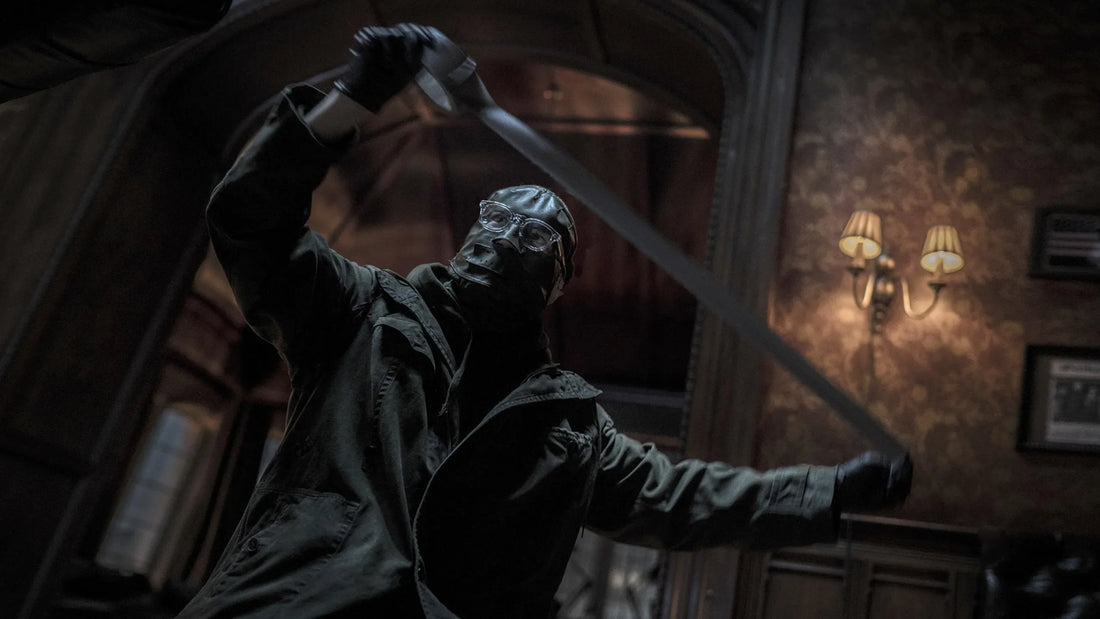
The 2022 reinterpretation changes register. It abandons the flashiness for an ordinary threat: a man with no presence, messages addressed directly to the detective, riddles that spread beyond all control once released into public space. This version is less funny and more worrying, because it resembles something familiar. The universe built around it keeps expanding, as shown by the feature devoted to Barry Keoghan as the Joker, Matt Reeves' Arkham inmate.
Animation and video games have each forged their own Riddler. The first makes him a trap designer with impeccable style, whose cold rage rises as soon as a plan fails; the second turns his taste for clues into a gameplay loop, where the player concretely experiences what Batman goes through against him. These very different images of the same man make you want to let the eras coexist on the wall, as the Batman canvases allow, fitting several eras into a single room.
1960s
A pop, overdriven figure, popularized by Frank Gorshin, where the threat dissolves into laughter.
1990s
The opposite excess, with neon, gadgets and scenery-chewing, for a man who still wants to be seen.
2022 reinterpretation
An ordinary threat, with no presence, whose riddles spread beyond all control in public space.
Collecting the Riddler: what the character offers to wear and to give
A character is all the easier to collect when he fits into a single sign. The Riddler ticks that box effortlessly: two colors, a symbol, and the object stays identifiable from ten feet away. That is a concrete advantage over villains whose visual identity needs a detailed illustration to be legible.
For anyone who wants to structure a collection rather than pile it up, the ultimate guide to Batman merchandise asks the right questions: what you display, what you wear, what you keep intact. The Riddler settles naturally into the first two categories, and into the third as soon as it is a piece placed facing his lifelong adversary.
As a gift, he has one particular advantage: he is recognizable without being overwhelming. A green object marked with a question mark amuses even people who do not read comics, which makes it a comfortable fallback when you round out the idea with Batman gifts for a fan whose level of knowledge you do not know. On the same principle, a Batman keychain brings the attachment to Gotham into daily life without demanding anything of its owner.
For the youngest, entry into the universe rarely goes through cerebral villains. It goes through familiar objects, as explained by the Batman plush guide, or through a first costume. Parents looking for a villain outfit suited to a child will find a transposable method in the Harley Quinn costume guide for children and teens: the same questions of size, comfort and how long the party lasts.
For adults, the question comes up differently. A Riddler costume can go through the green three-piece sown with question marks, immediately legible, or through the modern outfit, jacket and hood, which plays discretion instead. It all depends on the use: an evening with friends does not call for the same level of finish as a convention where you will be photographed all day.

★ The Dark Knight's selection
Modern Riddler Costume
The outfit from the modern reinterpretation: an olive hooded parka marked with a painted question mark, a leather hood and black gloves. The outfit of an ordinary man, the one that worries you because it signals nothing.
€149.90
View product →Why the Riddler never gets old
Some villains are dated by their era. The Riddler embodies an obsession that has only grown: the public demonstration of intelligence. He wants it noted that he is right, he wants an audience, an echo, a trace. That mainspring speaks to any decade, and it speaks particularly well to ours, where a riddle launched somewhere can spread faster than its solution.
Gotham also offers him the ideal ground. It is a city that lies about itself, where respectable facades often rest on something else. The Wayne family's philanthropy, described in the feature devoted to the Wayne Foundation, belongs to that landscape of official truths that a city like this one would rather not examine too closely. A man whose business is asking awkward questions is bound to find work there.
Finally, he holds up because he is the exact negative of the hero. Bruce Wayne puts his intelligence at someone else's service and refuses to take glory from it; Edward Nygma puts his at the service of his own reflection and cannot stand silence. One is after the truth, the other is after the applause. As long as Gotham has secrets, there will be someone to paint a question mark on them, and someone else, in the shadows, to take the question seriously.
A timeless obsession
He embodies the public demonstration of intelligence, a mainspring that speaks to any decade.
Ideal ground
Gotham lies about itself, and a man who asks awkward questions is bound to find work there.
The hero's negative
Bruce Wayne seeks the truth without taking glory from it; Edward Nygma seeks the applause.
Frequently asked questions about the Riddler
Does the Riddler have superpowers?
No. Edward Nygma is a human being with no supernatural ability. What people call his power is a set of skills: logic, memory, a sense of mechanical construction for his traps and a real talent for staging. That is also what makes the duel interesting, since Batman has no powers either: everything comes down to preparation and reasoning.
Edward Nygma or Edward Nashton: what is his real name?
Both circulate, depending on the continuity. Nygma is the classic form, built as a play on the word enigma. Nashton appears in more recent versions, notably on film, and gives the character a more ordinary surname, consistent with a realistic approach. Neither form cancels out the other: they belong to different versions of the same man.
Is the Riddler smarter than Batman?
On a closed problem, a riddle, a cipher or a calculation, he can take the advantage, and several stories show it. But an investigation is not limited to closed problems. Batman generally wins through his ability to connect scattered clues, to read a behavior and to last the distance. Nygma, for his part, sabotages himself: his need to be admired forces him to leave a trail behind him.
Why does the Riddler always leave a clue?
Because a crime no one understands earns him nothing. The clue turns the theft into a demonstration: it gives his opponent an official chance, which will make the victory indisputable if it comes. It is also his structural weakness, and the reason he regularly ends up locked away. The character is a prisoner of his own rule, and the most disturbing part is that he knows it.
Key takeaway
Edward Nygma has no superpowers: he counts on logic, memory, mechanical construction and staging. He always leaves a clue because a crime that no one understands earns him nothing, and that is also his weakness.