Suicide Squad: From Comic Book Creation to Film Adaptations
The answer in brief
The idea fits in one sentence: send convicted inmates to carry out the desperate operations no hero would ever accept, with an implant rigged to explode lodged in the back of their neck. Born in 1959, the team found its true identity in the 1987 relaunch created by John Ostrander, overseen by the ruthless Amanda Waller, with Harley Quinn or Deadshot among these highly expendable outcasts.
In this article
In the DC Comics universe, the Suicide Squad holds a unique place: that of a team of criminals and antiheroes forced to work for the government in exchange for reduced sentences. Far from heroic figures like Batman or Superman, the Suicide Squad embodies a gray area, where redemption collides with manipulation and where every mission could be the last.
Created in the 1950s but popularized mainly from 1987 onward by John Ostrander, the team stands out as an original concept: sending hardened criminals on secret and often suicidal missions that traditional heroes could not or would not take on. This innovative approach gave rise to some of the darkest and most complex stories in DC history.

The first incarnations in the comics
The first version of the Suicide Squad appeared in 1959 in The Brave and the Bold #25, but at the time it was a conventional military team. It was really with the 1987 relaunch that the concept took the shape we know today: a group of supervillains sent on missions by Amanda Waller, an iron-willed woman at the head of the government program. She embodies the cold logic of the state, using fear and explosive implants to keep the criminals under control.
Among its iconic members are Gotham enemies such as Harley Quinn, Deadshot, Captain Boomerang and Killer Croc, each bringing their own skills and psychological flaws. This diversity makes it an unpredictable team, where internal tension is as strong as the dangers outside.
👉 To better understand the villains of Gotham, also check out our pillar page on Batman's enemies, which presents essential figures such as the Joker and Poison Ivy.
The early days in the comics
A team in constant evolution
From the late '80s onward, the Suicide Squad became a central part of the DC universe. Each mission highlights the fragility of its members, often closer to forced redemption than to genuine heroism. The concept rests on a powerful idea: no one is irreplaceable. As a result, many characters die on missions, reinforcing the team's unpredictable nature.
Some members, however, stand out for their longevity and complexity. Deadshot, a marksman haunted by his past, became one of the group's iconic figures. Harley Quinn, for her part, brings an explosive and unpredictable energy, swinging between destructive madness and a quest for independence from the Joker. Their recurring presence helped the Suicide Squad win over a wider audience and grow in popularity.
The key point
The concept rests on a powerful idea: no one is irreplaceable. Many members die on missions, while Deadshot and Harley Quinn, recurring presences, helped the team win over a wider audience.
The strong link with Gotham City
Although the Suicide Squad is not tied exclusively to Gotham, a large share of its members come from the Dark Knight's universe. This anchors the group firmly in the city's dark and tormented imagination. Characters like Killer Croc and Two-Face perfectly illustrate this link between Gotham's criminal underworld and the operations of Task Force X.
This connection to Gotham also highlights Batman's moral dilemmas, as he faces the fact that some of his enemies occasionally work with the government. It enriches the overall mythology of the Dark Knight on the big screen and in the comics.
👉 To keep reading, also explore our article on Mr. Freeze, another tragic villain of Gotham.
In short
A large share of Task Force X members come from the Dark Knight's universe, such as Killer Croc and Two-Face. Batman must therefore accept that some of his enemies occasionally work with the government.
The movie adaptations
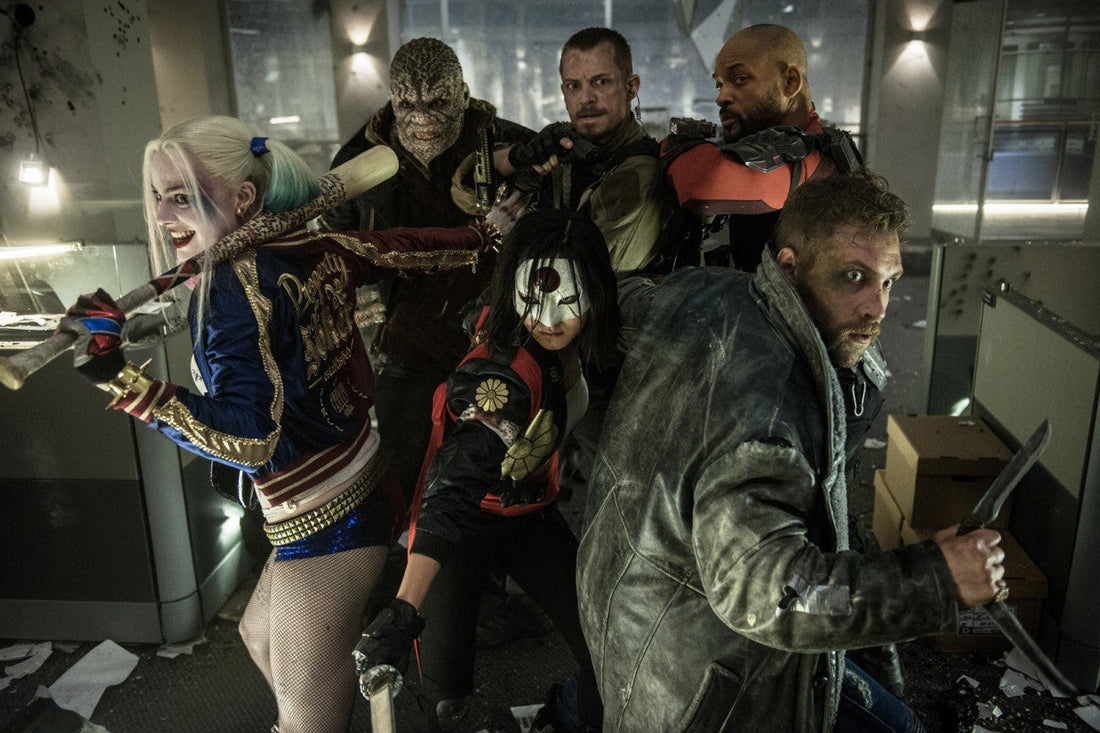
The Suicide Squad quickly left the pages of the comics to be adapted for the big screen. In 2016, David Ayer's Suicide Squad hit theaters, bringing together colorful characters like Deadshot (Will Smith), Harley Quinn (Margot Robbie) and the Joker played by Jared Leto. Although the film was a huge commercial success, it was criticized for its muddled plot and chaotic editing. Nevertheless, it marked the Suicide Squad's entry into mainstream popular culture.

In 2021, James Gunn (director of Guardians of the Galaxy) offered a bolder take with The Suicide Squad. Here, the tone is more violent, irreverent and wild. New characters like Bloodsport, Peacemaker and King Shark join the team, delivering an explosive mix of action and dark humor. The film was better received by critics and revived interest in Task Force X.
Two films at a glance
A unique place in the DCEU
These adaptations show that the Suicide Squad holds a singular place in the DCEU. Unlike Batman, Superman or Wonder Woman, the members of Task Force X are not selfless heroes but criminals forced to cooperate. This ambiguity appeals to an audience hungry for darker, more nuanced stories.
👉 To dig deeper, also check out our article on Batman vs Superman, which explores another ideological clash at the heart of the DCEU.
And if you want to extend the experience at home, explore our collection of Batman figures and his enemies to recreate your favorite scenes from the films.
Key takeaway
Unlike Batman, Superman or Wonder Woman, the members of Task Force X are not selfless heroes but criminals forced to cooperate. This ambiguity appeals to an audience hungry for dark, nuanced stories.
A lasting legacy and iconic figures
Beyond its suicidal missions, the Suicide Squad has left a deep mark on pop culture. It introduced the general public to secondary characters who became true icons, starting with Harley Quinn, now essential in the DC universe. Her evolution, from the Joker's mere sidekick to nonconformist heroine, illustrates the richness of Task Force X.
In the same way, the Joker took advantage of the team's fame to return to the spotlight, reinforcing his eternal rivalry with Batman. Other members, such as Deadshot, Captain Boomerang and Killer Croc, also found a new lease on life thanks to this media exposure.
Harley Quinn
From the Joker's sidekick to nonconformist heroine, she has become essential in the DC universe.
The Joker
He took advantage of the team's fame to return to the spotlight against Batman.
The other members
Deadshot, Captain Boomerang and Killer Croc found a new lease on life thanks to this media exposure.
The Suicide Squad and Gotham: an unbreakable bond
Most Task Force X missions are directly or indirectly tied to Gotham, a corrupt city ruled by chaos and full of opportunities for Amanda Waller. This is also what makes the team unique: it constantly orbits the Dark Knight's universe without ever being fully part of the Batfamily.
🎭 To extend the experience, explore our Batman costumes and outfits, perfect for Halloween and cosplay, as well as our selection of throw blankets to relive the Squad's greatest missions.
In short
Most Task Force X missions are tied to Gotham. The team constantly orbits the Dark Knight's universe without ever being fully part of the Batfamily.
Conclusion: a team like no other
The Suicide Squad is not just a team of recycled supervillains: it embodies the blurred line between good and evil. Far from being perfect heroes, its members are driven by personal interests yet, despite themselves, take part in causes greater than themselves. It is this ambivalence that captivates audiences and secures Task Force X a unique place in the DC universe.
Key takeaway
The Suicide Squad embodies the blurred line between good and evil. Its members act out of self-interest, yet despite themselves serve causes greater than themselves, and this ambivalence captivates audiences.