
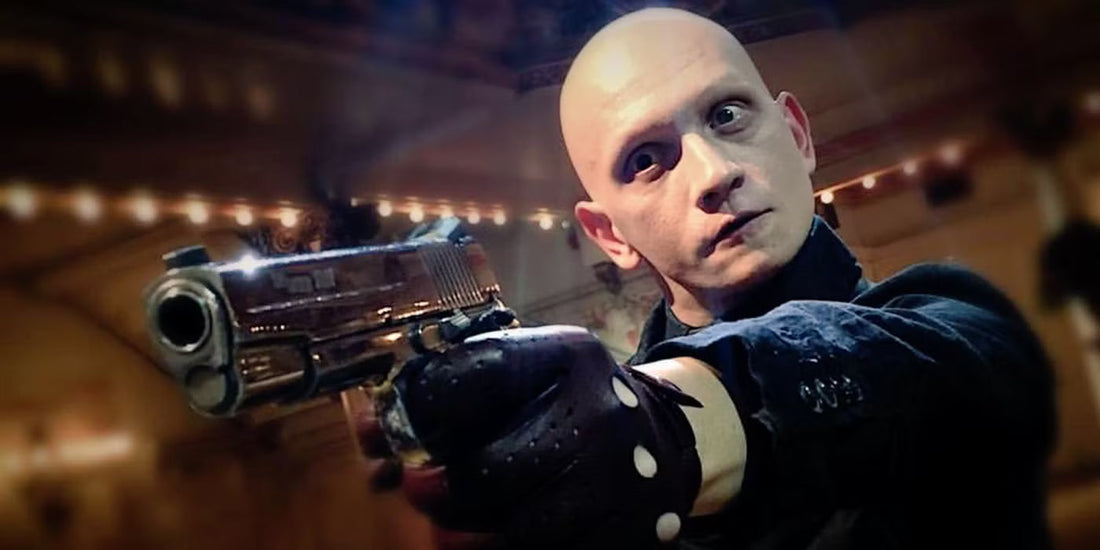
Victor Zsasz: Gotham's Scarred Killer
The answer in brief
Victor Zsasz is a Gotham serial killer who carves a tally mark into his own skin after every murder, turning his body into a count of his victims. An heir who gambled away his fortune after his parents' death, he kills at random and expects nothing in return, convinced that his victims are already nothing but empty shells. Created by Alan Grant and Norm Breyfogle, he first appeared in 1992: with no powers and no gadgets, his threat is entirely human.
In this article
Gotham's rogues' gallery runs on showmanship. There are riddles, toxins, costumes, criminal manifestos: every great adversary of the Dark Knight arrives with a theme, a grammar, a way of signing his crimes. Victor Zsasz brings none of that. No gadget, no doctrine, no plan to foil. His only signature is one more cut on his own skin, and it is precisely this emptiness that makes him unbearable.
In the gallery of Gotham's legendary villains, he holds a place of his own: that of the strictly human threat. Zsasz does not want to take over the city, humiliate Batman or prove anything at all. He kills, he counts, he starts again. Where Professor Pyg pushes unease all the way to obsession, Zsasz settles for a naked compulsion, with no theory and no staging. And while the Scarecrow methodically manufactures fear the way one builds a weapon, he needs no tool at all: he moves forward, he chooses, he cuts.
This portrait looks back at what we know about him: where the wealthy heir turned predator comes from, what his ritual of scars really means, why he poses a very particular kind of problem for Batman and the Gotham police alike, and how he has made his way through comics, film, TV series and video games without ever becoming an icon.
The heir who stopped believing in anything
Before the scars, Victor Zsasz was a rich and respected man. Heir to a large fortune, he lived a high-society life, on the side of Gotham that dines out and never crosses paths with the underworld. His fall comes from no chemical accident, no failed experiment and no revenge: after his parents die in a boating accident, he goes under, gambles away his entire fortune against the Penguin, then kills the man who tries to rob him that same night. Depression hollows him out, then a conviction sets in and never leaves him: that existence has no meaning and that the people around him are nothing but empty shells.
From that conviction comes the inversion that explains the whole character. Zsasz does not see himself as a murderer but as a liberator: by taking a life, he believes he is freeing his victims from an existence he considers fake. It is a logic sealed in on itself, impossible to negotiate with. You can bargain with a blackmailer, scare a henchman, argue with an ideologue; you have no hold whatsoever on someone who has decided that nothing has any value, starting with himself.
The parallel with Bruce Wayne is dizzying, and the Batman universe makes no secret of it. Two heirs, two fortunes, two lives cut short by the death of their parents. One turns grief into discipline and into an institution, as told in the story of the Wayne Foundation and the philanthropy that funds his war. The other turns the same void into compulsion. Placed within the complete universe of Batman characters, Zsasz is not just one more criminal: he is what grief can produce when nothing is built on top of it.
That closeness also explains why the character disturbs more than he impresses. Gotham's great criminal figures lend themselves to posters: they have colors, a silhouette, a catchphrase. You find them on collectors' walls, in the Batman posters that line up the city, the bat and its most recognizable adversaries. Zsasz, on the other hand, has never had anything to put on display: no logo, no color palette, no pose. His iconography is his own body.

★ The Dark Knight's selection
Batman comic book poster
The look of the comic book pages where these characters were born, before they ever reached the screen.
From €9.90
View product →The ritual of the cuts: a ledger carved into the skin
The gesture that defines Victor Zsasz is chillingly simple: after each murder, he carves a cut into his own skin. One victim, one mark. Over time, his body becomes a surface saturated with scars, a ledger kept directly on the flesh. It is not a signature left at the crime scene to taunt investigators, as so many other Gotham criminals do: it is a private ledger that he carries on himself and keeps, first and foremost, for himself.
That nuance changes everything. A killer who signs his work is looking for an audience; Zsasz is looking for a tally. The ritual is not meant to communicate, it is meant to forget nothing, and no doubt to prove to himself that he still exists. Each mark is irreversible. Each mark he inflicts on himself is irreversible, and that is exactly what sets it apart from any sign of belonging: a fan sticks whatever they like on a notebook or a laptop, such as Batman stickers, while Zsasz inscribes his marks permanently, with no way ever to go back.
The marked body is a rare motif, and it almost always points to pain endured rather than pain inflicted: that is the case of the mercenary with the ravaged body found in the duel between Gotham's strategist and the unkillable mercenary. With Zsasz, the mechanism is reversed. His marks do not tell what he has taken in, but what he has taken. It is an accumulation, not a survival.
Finally, it is worth measuring what this ritual means for Batman. Every new cut is visible proof of a failure, not of a plan foiled too late, but of a life that was not protected. Zsasz's body works like an exposed counter, impossible to ignore when the two men come face to face. Few adversaries force the Dark Knight to read the tally of his own delays right on the skin of the man he has just arrested.
Key takeaway
After each murder, Victor Zsasz carves a cut into his own skin. It is not a signature for investigators but a private ledger, and for Batman every mark is proof of a life that was not protected.
A killer with no motive against a vigilante with no lethal weapon
Batman's method rests on two pillars: deduction and fear. Deduction assumes a motive, since the point is to work back from a crime to an intention, then from an intention to a man. Fear assumes someone who has something to lose. Victor Zsasz defuses both. He targets no one in particular and seeks no gain, even when he happens to set a trap or work for someone else. And he fears nothing, because he cares about nothing, not even his own survival.
That is why he works as a particularly uncomfortable mirror of the Dark Knight. Batman forbids himself to kill, and that rule is the bedrock of everything he is; Zsasz has made murder the only thing that gives his days structure. Both men hold their line with the same stubborn consistency. One holds it to preserve, the other to destroy, and no conversation is possible between those two positions.
The mask crystallizes the opposition. Batman hides his face to become a symbol, and Gotham has no shortage of criminals who make the same calculation, so much so that the subject fills a complete guide to Gotham's masks on its own. Zsasz hides nothing. He walks around barefaced, and that face already bears his marks: his skin serves as his costume. He has no secret identity to protect, so there is nothing to unmask, and he has no organization to dismantle and no reputation to ruin.
This lack of gear also explains why he remains a character for stories rather than for display cases. Batman masks work because they reproduce a shape that reads instantly, a pointed ear, a silhouette you recognize from behind. The same logic applies to Batman t-shirts, where the emblem alone says which side you are on. Zsasz offers no shape to reproduce, and that is perfectly consistent with who he is.

★ The Dark Knight's selection
Small Catwoman figure
Victor Zsasz has never had a figure; among the Gotham figures actually available, Catwoman remains one of the most recognizable silhouettes in a display case.
€22.90
View product →Arkham, the revolving door
Like most Gotham criminals found not responsible for their actions, Victor Zsasz ends up in Arkham. The institution is the mandatory stop for everyone the city can neither cure nor lock up for good, and its history deserves a full treatment of its own: that is the whole subject of our portrait of Gotham's most terrifying psychiatric hospital.
What matters here fits in one sentence: Arkham does not hold Zsasz. His very first story already shows him on the loose, and the pattern keeps repeating. Every commitment is an interlude, never an ending. For Batman, that means victory does not really exist in this case: all he can do is shorten the gap between two killing sprees, without ever being able to close the file.
That revolving door feeds an entire part of the universe, right up to the most recent productions, where the asylum has become a central setting. You can see it in the treatment given to the Arkham inmate played by Barry Keoghan in Matt Reeves' films. Zsasz belongs to that same population, the one that makes the institution more unsettling than its star inmates alone.
Those inmates are among the most collected figures in the universe: Joker figures fill an entire section on their own. Zsasz is not among them, and the gap is telling, because the villains who get turned into merchandise are the ones who can be drawn in three strokes.
Then there is the atmosphere, which matters as much as the characters. In the popular imagination, Arkham is a dimly lit corridor where the light never reaches the corners. That is exactly the mood created by a Batman lamp switched on in a dark room: a single source, a halo, and everything else left in shadow.
The key point
Arkham does not hold Zsasz: every commitment is an interlude, never an ending. For Batman, victory does not really exist in this case, all he can do is shorten the gap between two killing sprees.
The GCPD against a predator with no logic
A criminal investigation moves forward by looking for a connection: between the victims, between the locations, between the times. Victor Zsasz erases that connection. He chooses at random, does not stalk his targets and seeks no gain. For Gotham's detectives, such a case becomes almost impossible to work with the usual methods, since it offers no victim profile, no readable pattern and no demand to negotiate.
The city's police force is not equipped for this kind of case, and not only for lack of resources: its history is riddled with internal problems that cannot be summed up in two lines, as our article on the GCPD, between corruption and heroism shows. Against a killer with no motive, these structural weaknesses weigh heavily, because such an adversary demands exactly what the Gotham police struggle most to provide: continuity, time and coordination.
Then there is the daily grind of the job, made up of stakeouts, case files read over and over, and whole nights spent waiting for a call. It is a fairly accurate picture of police work in this city, and it is on that desk, rather than in a display case, that a Batman mug belongs.
The same spirit applies to the things you carry with you. A Batman keychain fits in a pocket and comes out every time you open a door, like a discreet badge. It is these small markers, more than the big pieces, that connect the universe to everyday life, the very life the GCPD spends its nights protecting.

★ The Dark Knight's selection
Batman 1989 t-shirt
The emblem of the era that tipped Gotham over to the dark side on the big screen.
€29.90
View product →Zsasz in the comics: a quiet entrance, a lasting presence
Victor Zsasz first appears in Batman: Shadow of the Bat #1, in 1992, written by Alan Grant and penciled by Norm Breyfogle. The story gives him a central role right away: in "The Last Arkham," Batman has himself committed to expose him, while Zsasz escapes through tunnels he had bought himself. That opening nonetheless sets his lasting status, that of a background threat who will never again need a full arc to come back.
That status is what explains his longevity. The great villains need an event to return; Zsasz needs nothing. He can reappear in a single panel, ratchet up the tension of a scene, then vanish without the story having to revolve around him. Writers are happy to use him as a reminder of the stakes: as long as he is out there, the counter keeps running. To place these appearances in their era, the overview of Batman comics by era provides the chronological landmarks you need.

It is also worth seeing what the character brings by contrast. The Batman universe loves outsized showdowns, all the way to crossover duels with other universes, like the recurring question of whether Gotham's strategist could beat the Mad Titan. Zsasz stands at the exact opposite end of that scale: one man, one blade, one street. And yet he remains one of the hardest adversaries to put away for good, because there is nothing about him to dismantle.
That comic-panel aesthetic, built on deep blacks and hard contrasts, also carries over beautifully to a living room wall. That is the whole point of a Batman canvas: bringing the stark light and sharp shadows of the pages where these characters were born back onto the wall.
His comics debut
Victor Zsasz on screen and controller in hand
Film picked up the character fairly early. In Batman Begins, he appears as a criminal brought before the court, played by Tim Booth: barely a few minutes, but enough to plant the idea of a city that lets its predators go. To place this appearance in the long history of adaptations, the complete timeline of Batman movies shows how each era handled these supporting roles.
He comes back far more visibly in Birds of Prey, in 2020, played by Chris Messina. The film makes him Black Mask's right-hand man and keeps the essentials: the calm, the methodical coldness, the marks. This version drops him into a very colorful story, the polar opposite of his usual restraint, a contrast found in everything the film left behind in pop culture, starting with Harley Quinn's look, which has become a classic costume for kids and teens.
Television has not been left behind. The series Gotham gives him a place in the city's criminal landscape, with that mix of cold blood and murderous madness that works especially well in a long format, where he can resurface across the seasons without anyone having to explain again who he is.
Finally, video games are the medium that has given him the most playable room. In Batman: Arkham City, Zsasz puts the player under pressure with hostages and a countdown: the hunt turns into a race, and failure comes at an immediate cost. The cold voice, the timer mechanic, the total absence of gadgets, everything is true to the comic book character. For a fan of these adaptations, the Batman gift ideas offer an easy way in to extend the universe beyond the screen.

★ The Dark Knight's selection
Harley Quinn figure
Since there is no Zsasz figure, Harley Quinn holds down the Arkham inmates' section, with a silhouette that is instantly recognizable in a display case.
€35.90
View product →Why Zsasz remains a ghost of the display case
Let's be blunt: Victor Zsasz does not exist on store shelves, and no figure of him appears in the catalog. This is not an oversight, it is the direct consequence of what makes the character. A collectible needs a silhouette you can recognize from a distance. Zsasz has no cape, no hat, no mask and no color: he is a man covered in lines. Shrunk down to a few inches, he would say nothing at all.
Collectors therefore turn to the figures that hold up. Batman figures form a natural foundation for a display case, and everything else can be arranged around them. The Batman merchandise guide walks through that collecting logic, from the very first item to more ambitious pieces.
For villains, clothing is often the most convenient compromise, since it lets you show where your loyalties lie without depending on a figure. That is exactly the purpose of our guide to Batman t-shirts by character, which explains how to wear your Gotham hero, or villain. When the weather turns, Batman sweaters take over with the same idea.
One last clarification is in order, because parents ask about it often: Zsasz is not a character for young children, and nothing in the way he is portrayed is suited to them. When the way into Gotham's universe is made at a child's level, it goes through very different items, starting with a well-chosen Batman plush, which keeps the bat and leaves the darkest side of the city outside.
Key takeaway
There is no Victor Zsasz figure in the catalog: with no cape, hat, mask or color, he cannot be recognized from a distance. Collectors turn to Batman figures or clothing instead, and the character is not suitable for young children.
Frequently asked questions about Victor Zsasz
Who is Victor Zsasz in the Batman universe?
Victor Zsasz is a Gotham City serial killer who first appeared in Batman: Shadow of the Bat #1 in 1992, created by Alan Grant and Norm Breyfogle. An heir who gambled away his fortune after his parents' death, he snapped on the night of his first murder and has killed at random ever since, expecting nothing in return. He is regularly sent back to Arkham, but these commitments never stop his path for long.
Why does Victor Zsasz scar himself?
Each cut stands for one victim. The ritual lets him keep an exact count of his murders, on his own body rather than in a notebook. It is not a signature meant for investigators but a ledger he keeps first and foremost for himself, which is why his marks end up covering his entire skin and, on their own, make up his whole appearance.
Does Victor Zsasz have superpowers?
No, and that is actually the core of the character: he has no superhuman strength, no gadgets and no special resources. His danger comes from the absence of any intended gain and of any fear, which makes his actions unpredictable and strips Batman of his two usual tools, deduction and intimidation. He embodies a strictly human, completely stripped-down threat, whereas the other Gotham criminals always show up with a theme and a full kit.
Which movies, TV series and video games feature Victor Zsasz?
On the big screen, he appears briefly in Batman Begins, played by Tim Booth, then in a far more developed role in Birds of Prey in 2020, where Chris Messina plays him alongside Black Mask. The series Gotham also gives him a place in the city's criminal underworld. On the video game side, Batman: Arkham City offers his most memorable sequence, a hunt against the clock with hostages.
| Medium | Title | Details |
|---|---|---|
| Comics | Batman: Shadow of the Bat #1 | 1992, Alan Grant and Norm Breyfogle |
| Film | Batman Begins | Played by Tim Booth |
| Film | Birds of Prey | 2020, played by Chris Messina |
| TV series | Gotham | A place in the criminal underworld |
| Video game | Batman: Arkham City | A hunt against the clock with hostages |