Batman's Most Unsung Enemies Only True Fans Know
The answer in brief
Ten forgotten figures, each built on a singular obsession. The surgeon Professor Pyg imposes a delusional aesthetic perfection on his prey; Calendar Man times his crimes to holidays and symbolic dates; Killer Moth, conceived as an inverted adversary, turned grotesque before being rehabilitated; Maxie Zeus believes he is a deity. These trajectories reveal a more inward, more experimental side of the masked hero.
Contents
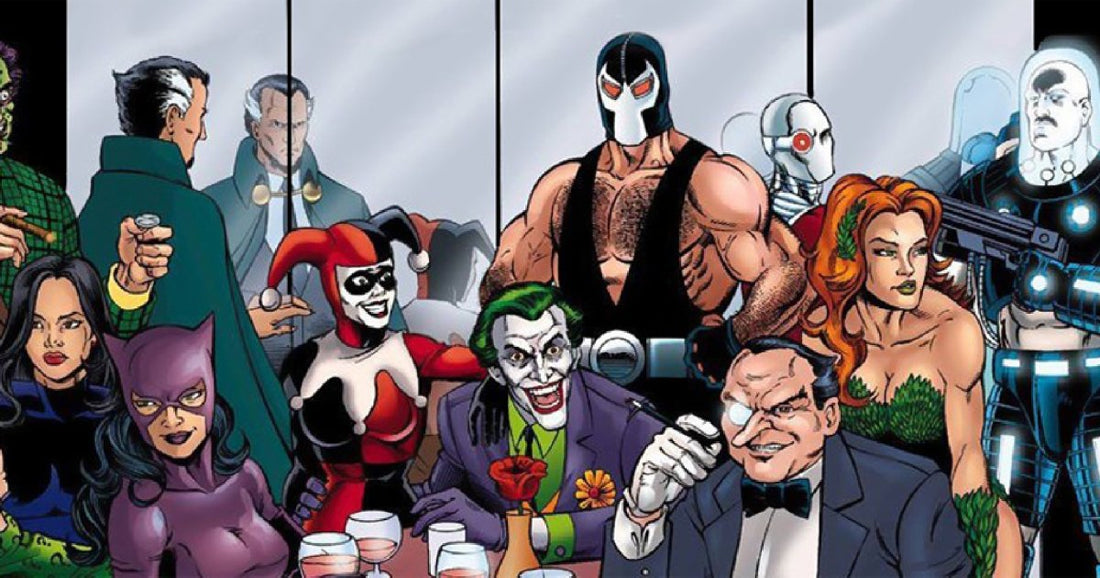
Everyone knows the Joker, Two-Face or the Penguin. These villains haunt blockbusters, populate the best-selling comics, and have fascinated fans for decades. But the Batman universe, one of the richest at DC Comics, is full of villains who are forgotten, neglected or little known to the general public. And yet some of them offer stories as dark, as complex and as disturbing as those of the great classic antagonists. These second-tier figures of Gotham City deserve a closer look, because they reveal a more intimate, more experimental, sometimes more radical dimension of the Dark Knight. Here is a selection of ten obscure but fascinating villains that only true fans really know. You'll come across mad surgeons, cannibalistic hitmen, criminals obsessed with children's nursery rhymes, and a few figures who left an indelible mark on Arkham Asylum without ever reaching the Hollywood spotlight.
🦹 Professor Pyg, the surgeon obsessed with perfection
Created by Grant Morrison during his iconic run on Batman, Professor Pyg is a mad surgeon obsessed with aesthetic perfection. He turns his victims into Dollotrons, dehumanized humanoids whose faces are frozen behind melted porcelain masks, in a ceremony as grotesque as it is meticulous. The character embodies a very particular kind of horror: not the pure chaos of the Joker, but that of twisted order, of forced beauty, of the desire to standardize the human body through surgery. His appearance in the game Batman: Arkham Knight helped popularize him with a wider audience, but in the comics he remains one of the most disturbing antagonists in the Batman gallery.
The key point
Created by Grant Morrison, Professor Pyg is a mad surgeon who turns his victims into Dollotrons. His appearance in Batman: Arkham Knight made him known to a wider audience.
📅 Calendar Man, the criminal paced by holidays
Julian Day, alias Calendar Man, commits his crimes according to a precise calendar: religious holidays, symbolic days, anniversaries of historical disasters. His obsession with time makes him unpredictable and formidably methodical. He plays a central role in the cult comic The Long Halloween, where his figure takes on an almost mystical dimension. Calendar Man is a reminder that in Gotham, even time itself can become a weapon in the hands of the right madman. His presence also underlines the literary depth of the Batman saga, where every villain embodies a singular obsession.
The key point
Julian Day, alias Calendar Man, commits his crimes according to a precise calendar of holidays and symbolic days. He plays a central role in the comic The Long Halloween.
🦋 Killer Moth, the anti-Batman turned to ridicule
Killer Moth is a fascinating case. Originally conceived as an anti-Batman, a kind of mercenary paid to help Gotham's criminals the way Batman helps law enforcement, he was meant to embody the inverted counterpart of the Dark Knight. But his extravagant look and his limited technical means quickly turned him into a comic, almost ridiculous character. Some modern versions have nevertheless rehabilitated Killer Moth by giving him a darker psychological dimension, even a monstrous one after his transformation into a mutant moth. He is a reminder that a character's editorial fate can swing from the sublime to the grotesque depending on the era and the writers.
The key point
Conceived as an anti-Batman working for Gotham's criminals, Killer Moth quickly became a comic character. Some modern versions have given him back a darker dimension, right down to the mutant moth.
⚡ Maxie Zeus, the professor who thinks he's a god
Maximilian Zeus is a former history professor who sank into madness after convincing himself that he was the reincarnation of the Greek god of thunder. He considers himself the rightful king of Gotham and uses weapons inspired by ancient mythology to impose his imaginary reign. His megalomaniacal madness makes him as tragic as he is threatening, and his obsession with Olympus contrasts with the very urban darkness of classic Batman mythology. Maxie Zeus is regularly committed to Arkham Asylum, where he rubs shoulders with other figures who fill the institution's darkest cells.
The key point
Maximilian Zeus, a former history professor, believes he is the reincarnation of the Greek god of thunder. He considers himself the rightful king of Gotham and is regularly committed to Arkham Asylum.
🦩 Flamingo, the cannibalistic hitman
Flamboyant, ultra-violent and deeply disturbed, Flamingo is a hitman with an extravagant look who literally eats the faces of his victims after gunning them down. Yes, it is exactly as disturbing as it sounds. Also introduced in Grant Morrison's run, Flamingo embodies a particular kind of horror: that of the killer stripped of all psychology, reduced to cannibalistic impulses and a pink wardrobe. His apparent visual frivolity clashes violently with the brutality of his acts, creating a unique unease among Batman's villains.

🎭 The Ventriloquist and Scarface, the criminal duo
Picture a shy, almost self-effacing criminal who can only express his violence through a mobster puppet named Scarface. That is exactly what Arnold Wesker, alias The Ventriloquist, embodies. The contrast between the man paralyzed by his own cowardice and the uninhibited brutality of his dummy creates an unsettling psychological dynamic that recalls the best split-personality stories. The Ventriloquist appeared in several cult animated series, notably Batman: The Animated Series, where he left his mark on a generation of fans who discovered a villain capable of inspiring as much pity as fear.
The key point
Arnold Wesker, alias The Ventriloquist, only expresses his violence through Scarface, a mobster puppet. He left his mark on a generation of fans in Batman: The Animated Series.
🥚 Humpty Dumpty, the broken nursery rhyme criminal
Drawn directly from the English nursery rhyme, Humphrey Dumpler is an obese criminal obsessed with repairing broken things, which he paradoxically achieves by destroying everything in his path. His twisted logic, his childlike appearance and the almost palpable suffering that shows through in each of his actions make him a genuinely tragic villain. Often seen as harmless at first glance, Humpty Dumpty embodies the nuance that Gotham's best villains know how to capture: the blurred line between victim and tormentor, between illness and deliberate cruelty. His regular place at Arkham puts him close to figures such as Man-Bat, a creature likewise torn between lost humanity and inflicted monstrosity.
The key point
Humphrey Dumpler, drawn from the English nursery rhyme, is obsessed with repairing broken things, which he achieves by destroying everything. He embodies the blurred line between victim and tormentor.
☢️ Doctor Phosphorus, the man who burns from within
Alexander Sartorius was a brilliant scientist before a nuclear experiment turned him into a radioactive being who burns continuously. His condition drives him to hate Gotham and to take revenge on those who left him for dead, in a vengeful logic that recalls the darkest origins of the Marvel universe. Doctor Phosphorus has regularly crossed paths with Batman, and his striking appearance, that luminescent skeleton giving off heat and radiation, makes him a visually unforgettable figure. For collectors who appreciate these villains rarely adapted to the screen, the Batman figure collection offers several pieces drawn from the Gotham gallery.
The key point
Alexander Sartorius, a brilliant scientist, became a radioactive being who burns continuously after a nuclear experiment. He seeks revenge on Gotham and on those who left him for dead.
😱 Cornelius Stirk, the predator of fear
Cornelius Stirk has a terrifying power: he can manipulate people's perception and literally feed on their fear. Where the Scarecrow uses hallucinogenic gases, Stirk works through direct contact, in an almost sensual intimacy with his victims. This rawer, more organic version of the psychological predator concept makes him one of the most disturbing villains in the Batman pantheon, and yet one of the most overlooked by film adaptations. He is a reminder that fear, in the Batman universe, is not only a narrative tool but a genuine raw material that certain characters know how to capture, manipulate and turn into a weapon.
The key point
Cornelius Stirk manipulates people's perception and feeds on their fear. Where the Scarecrow uses hallucinogenic gases, Stirk works through direct contact with his victims.
🎭 Jane Doe, the identity thief
Jane Doe has no face. Or rather, she has as many as she takes from her victims. An absolute master of costume and behavioral manipulation, she kills, studies her prey's body, then literally takes her place in that person's life. This obsession with stolen identity resonates deeply with Batman's central themes: the duality of Bruce Wayne and his alter ego, the loss of the face behind a mask, the fundamental question of who we really are when no one is watching. Jane Doe appears rarely, but every time she resurfaces she leaves a lasting mark on readers' minds, much like the Birds of Prey who haunt the margins of Gotham.
The key point
Jane Doe kills her prey, studies the body, then takes her place in that person's life. This obsession with stolen identity echoes the duality between Bruce Wayne and his alter ego.
🌃 Why these little-known enemies are essential to the Batman universe
These characters reinforce the psychological and social richness of Gotham. They embody precise and often intimate fears: the loss of identity, manic madness, pathological obsession, devouring loneliness, the shame that pushes a man to hide behind a puppet. Where the Joker symbolizes pure chaos and Two-Face embodies moral duality, these villains represent subtler pathologies, sometimes more human ones, that resonate with the reader's everyday fragilities. They also remind us that Batman is a hero of the night, facing enemies who are troubling, unhealthy, and often far removed from simple physical confrontation. And that is precisely what makes his stories unique in the landscape of superhero comics.
Understanding this gallery of supporting players also casts new light on the very strategy of the Dark Knight, who fights not only criminals but distorted reflections of the human psyche. The complete guide to Batman's enemies offers an exhaustive map of this universe, from the major villains to second-tier figures like the ones covered here. To go further still, the pillar on the complete universe of Batman characters maps out the whole galaxy, allies and antagonists alike.
These little-known villains also invite us to reconsider our relationship with Killer Croc, with Black Mask, with Catwoman, who together form the border between first-rank villains and figures of the shadows. This gradation is not hierarchical but narrative: each character fills a unique function in Gotham's ecosystem, and their accumulation is what we now call the depth of Batman lore, one of the densest in the history of comics.

🦇 How to bring these villains into your fan universe
For the collector, little-known villains are a fascinating playground. They make it possible to step off the beaten track of mainstream merchandising and build a more personal, more knowledgeable collection, one that earns more respect from other fans. The Joker figure collection is obviously essential, but it extends naturally into the Harley Quinn collection that touches on the villain-ally ecosystem. For rarer figures and collector's pieces, the ultimate guide to the Joker figures worth collecting offers a valuable framework for identifying the pieces worth investing in.
For the cosplayer, these secondary characters are a rare chance to stand out. Where everyone else dresses up as the Joker or Harley Quinn, playing Calendar Man, The Ventriloquist or even Maxie Zeus guarantees a surprise effect at conventions. The Joker costumes and the Harley Quinn costumes often serve as a base for inspiration, completed by custom accessories to reproduce the look of the more obscure villains. The complete guide to Batman costumes and cosplays details techniques that apply to every character in the universe, heroes and villains alike.
For the curious reader who wants to dig into the works featuring these characters, several runs and story arcs stand out. The Long Halloween for Calendar Man, the Morrison run on Batman for Professor Pyg and Flamingo, the episodes of Batman: The Animated Series for The Ventriloquist. Every little-known villain belongs to a specific work worth reading or watching, one that casts new light on the overall coherence of the Batman universe. To understand Gotham's darkest periods, the article on Batman No Man's Land is a valuable entry point, and the one on Azrael explores the side of Gotham where the line between hero and villain blurs dangerously.
The role of the Gotham police should not be underestimated in this criminal gallery either. The GCPD and its commissioner James Gordon form the first line of defense against these villains, major and secondary alike. Understanding how the GCPD deals with Killer Moth, how it negotiates with The Ventriloquist, how it handles Doctor Phosphorus, also means understanding how the cursed city works in all its institutional complexity.
The collector
He steps away from mainstream merchandising and extends the Joker figures into the Harley Quinn collection.
The costume
Dressing up as Calendar Man, The Ventriloquist or Maxie Zeus guarantees a surprise effect at conventions.
The curious reader
The Long Halloween for Calendar Man, the Morrison run for Professor Pyg and Flamingo, Batman: The Animated Series for The Ventriloquist.
🦇 Verdict: between cult status and masterpiece, these villains deserve your curiosity
These ten little-known villains will never replace the Joker or the Penguin in the collective imagination. But they considerably enrich the experience of the informed fan who wants to go beyond the surface of the myth. They prove that Gotham's depth is also measured at its margins, in its dustiest Arkham cells, in its figures left behind by editorial fashions but rehabilitated by the most inspired writers. To explore this gallery beyond this article, several resources extend the reading naturally. The Batman figures and the Batman Gifts collection offer pieces to give or to collect. The Batman masks and the Batman Costumes and Outfits collection open the door to cosplay. And the pillar on Batman merchandise offers a complete map of the items to bring into your fan universe. Enjoy exploring the depths of Gotham, and may your next reads reveal still more forgotten figures.
Worth remembering
These ten little-known villains will not replace the Joker or the Penguin in the collective imagination. They nevertheless enrich the experience of the informed fan and show that Gotham's depth is also measured at its margins.