
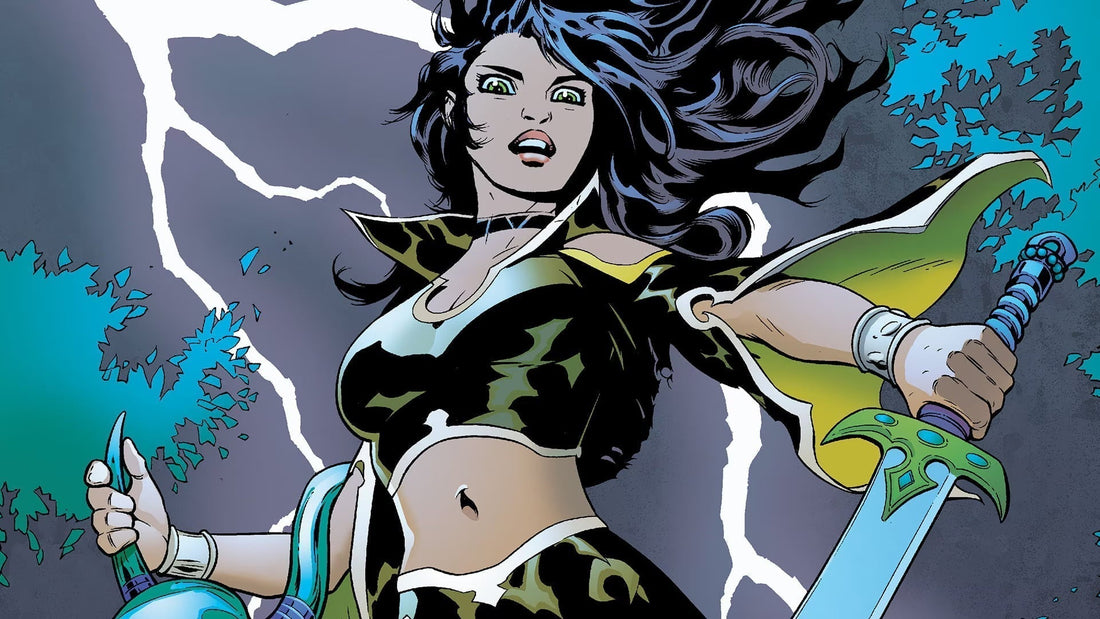
Talia al Ghul: History, Role in the League of Assassins and Connection to Batman
In the complex gallery of Batman's loves and enemies, Talia al Ghul occupies a truly unique position. Neither a true hero nor a true villain, she embodies a rare gray area in DC mythology. Daughter of Ra's al Ghul, heir to the League of Assassins, she falls in love with Bruce Wayne despite everything that separates them. From this irresolvable tension arise forty years of major story arcs, and one of the most striking children in the DC universe: Damian Wayne.
This article traces Talia's complete history — her origins, her upbringing within the League, her stormy relationship with Bruce, her role as a mother, and her impact on modern mythology. To place this character within the broader ecosystem, a detour through the Batfamily and all of Batman's allies is essential — Talia is paradoxically both outside this clan and connected to it by ties of blood.
Talia al Ghul: Between Family Loyalty and Forbidden Love
Talia first appeared in Detective Comics #411 in 1971, shortly after her father Ra's. She is immediately defined by a duality: League upbringing on one side, fascination with Bruce Wayne on the other. This tension will never be resolved, and that is precisely what makes the character so enduring. Forty-five years later, she is still torn between these two poles.
Her education is exceptional. Raised from childhood in the League's fortresses, trained in the most advanced martial arts, instructed in multiple languages, military strategy, political philosophy. As an adult, she is probably as capable as Bruce technically — perhaps more so, in some respects. This extreme competence makes her Batman's equal, which radically changes their relationship: it's not a master-student duel, it's a dialogue between two combat experts.
Talia's costume varies with the eras. In classic versions, she wears an elegant Arabic princess dress (Ra's is of Middle Eastern origin). In modern versions, she adopts more tactical outfits — black jumpsuits, hoods, technical gloves. This visual evolution accompanies her maturation: the romantic princess gradually becomes a military strategist. To compare this aesthetic with other dangerous female figures in Gotham, a detour through Catwoman, the icon who shares this ambivalence is enlightening.
Bruce and Talia: A Relationship Impossible to Categorize
The love story between Talia and Bruce spans decades in various forms. There are moments of complete complicity (notably in Batman: Son of the Demon), moments of absolute betrayal (when Talia openly opposes Bruce in certain arcs), and moments of passionate tension halfway in between. This plurality makes the relationship one of the richest in the DC universe.
What distinguishes this relationship from Bruce's other love stories is the civilizational stakes. Talia does not ask Bruce to become a domestic husband — she asks him to lead the League, thus to accept an apocalyptic vision of the world. This offer is impossible to accept (Bruce cannot betray his moral code) and impossible to refuse without pain (to refuse Talia is to refuse a part of himself). To delve into this dimension, a detour through why Batman doesn't kill is essential — Bruce's resistance to Talia is the direct application of his code.
The other crucial dimension is the question of control. Talia deceives Bruce in certain arcs (notably during Damian's conception, which she allegedly achieved through chemical manipulation according to some versions). This ambiguity surrounding consent remains one of the most disturbing aspects of the character, and some modern writers have tried to nuance it. Today, the canonical version presents a more complex Talia — manipulative but also deeply in love, capable of cruelty but also real tenderness.

The archetype of the dark female
Complete Cosplay Costume - Catwoman
Talia shares with Catwoman a dangerous femme fatale silhouette. This premium Catwoman cosplay reproduces the dark and feminine aesthetic that Talia also embodies — for conventions, an absolute statement, or a high-end cosplay collection.
€799.90
View the cosplay →Damian, The Child Who Changes Everything
Talia's pregnancy and the birth of Damian Wayne mark a major turning point in the character's history. For the first time, Talia is no longer just Bruce's dangerous woman — she is the mother of his son. This maternal dimension profoundly transforms the character, without, however, bringing him back to moral good.
Talia raises Damian alone for his first ten years, without informing Bruce. This decision is calculated: she wants to produce the perfect heir to Bruce and Ra's, without interference from the biological father. The education she inflicts on Damian is inhumane — military training from three years old, first murder at eight years old, absolute emotional rigor. This dimension makes Talia a highly controversial maternal figure in DC mythology.
The most moving arc of this relationship remains the one where Talia, pressed by circumstances, delivers Damian to Bruce. This forced separation is probably the moment where Talia reaches her greatest psychological complexity: she loses her child to save him, knowing that under Bruce's education, Damian could become a better person — but also a lesser weapon. To delve into this parental dimension in DC figures, a detour through James Gordon and the classic paternal figure offers an interesting contrast.

The one resurrected by Talia
Red Hood Figure
Jason Todd, a former Robin killed by the Joker, is brought back to life by Talia al Ghul in a Lazarus Pit. As Red Hood, he embodies Talia's other great influence on the Batfamily. This figure captures all the complexity of the character.
€79.90
View the Red Hood figure →Talia in Comics, Movies, and Video Games
In cinema, Talia long remained in the background. The major exception is Christopher Nolan's Dark Knight trilogy, where she appears in The Dark Knight Rises (2012) under the identity of Miranda Tate, aka Talia. Marion Cotillard embodies the character with memorable icy elegance. The final revelation of her identity — that she is Ra's' true daughter, not Bane — remains one of the trilogy's great twists.
In animation, Talia is very well served. The film Son of Batman (2014) recounts Damian's birth and Talia's role as a mother. Batman: Bad Blood (2016) extends with a more political Talia. Batman vs. Robin (2015) explores the tensions between Talia, Bruce, and their son. This animated trilogy probably remains the best cinematic representation of the character.
In video games, Talia appears in Batman: Arkham City (2011) where she plays a major dramatic role. Her death in the game (killed by the Joker) profoundly impacts players, and remains one of the most moving moments of the entire video game saga. To measure the impact of this adaptation on fans, a detour through Arkham Asylum, the setting of the video game saga is enlightening.
Talia's Legacy: Why the Character Remains Central
Three structural reasons explain the character's longevity. First reason: her absolute ambivalence. Talia is neither an angel nor a demon. She loves Bruce and yet tries to destroy him. She protects Damian and yet raises him as a killer. This duality produces unique narrative arcs, impossible with simpler characters.
Second reason: her influence on the Batfamily. Beyond Damian, Talia is also responsible for the resurrection of Jason Todd in a Lazarus Pit, an event that creates Red Hood. This double motherhood — biological for Damian, symbolic for Jason — makes her a structuring figure for the entire new Batfamily generation. To delve into this dimension, a detour through Nightwing, Red Hood, and Robin and their differences is essential.
Third reason: her political modernity. Talia embodies a rare figure in American comics — a powerful, intelligent, autonomous Middle Eastern woman. This representation has long suffered from stereotypes, but recent writers (notably Greg Rucka and Tom King) have worked to nuance it. Today, Talia is probably one of the best-written female characters in the DC universe. To compare with other prominent female figures, a detour through Barbara Gordon, the heroine in Batman's shadow provides a useful counterpoint.

Tactical seduction as an accessory
Catwoman Leather Mask
Talia's aesthetic blends sensuality and danger — codes shared by the Catwoman leather mask. This premium piece allows for materializing the archetype of Gotham's dangerous woman, applicable to both Catwoman and Talia.
€49.90
View the leather mask →Conclusion: Talia, The Love That Never Resolves
Talia al Ghul is probably the most complex female character ever introduced into Batman mythology. Not the most powerful, not the most combative, but the most impossible to categorize. No other DC figure combines so many contradictory roles — princess, assassin, lover, traitor, mother, rebellious daughter. This plurality makes her an authentic literary creation, not just a comic book silhouette.
To extend the exploration, several essential avenues. First, read Batman: Son of the Demon — the arc that establishes the Bruce/Talia relationship. Then, watch The Dark Knight Rises keeping in mind the Miranda Tate twist. Finally, explore recent Damian Wayne arcs, where Talia continues to appear as an ambivalent presence. To materialize this passion in a collection, the Batman figurine collection, the poster collection and the t-shirt collection offer visual hooks to the entire Gotham ecosystem.
One thing is certain: as long as Batman exists, Talia will exist around him. Not as a mere enemy, not as a mere lover — but as the other. The one who could have been his wife in a world without the League, the one who could have been his ally in a world without Ra's, the one who will remain, in the world as it is, the unresolved love of the Dark Knight. And that is probably what makes her tragic beauty: Bruce can never truly love her without betraying himself, and Talia can never truly forget him without betraying herself either.
🃏 To go further: place this character in Gotham's complete criminal ecosystem by consulting the mapping of the Dark Knight's adversaries by category, which gathers 36 villains classified by tier of narrative importance.