The Batfamily: All of Batman's allies explained, between legacy, drama and justice
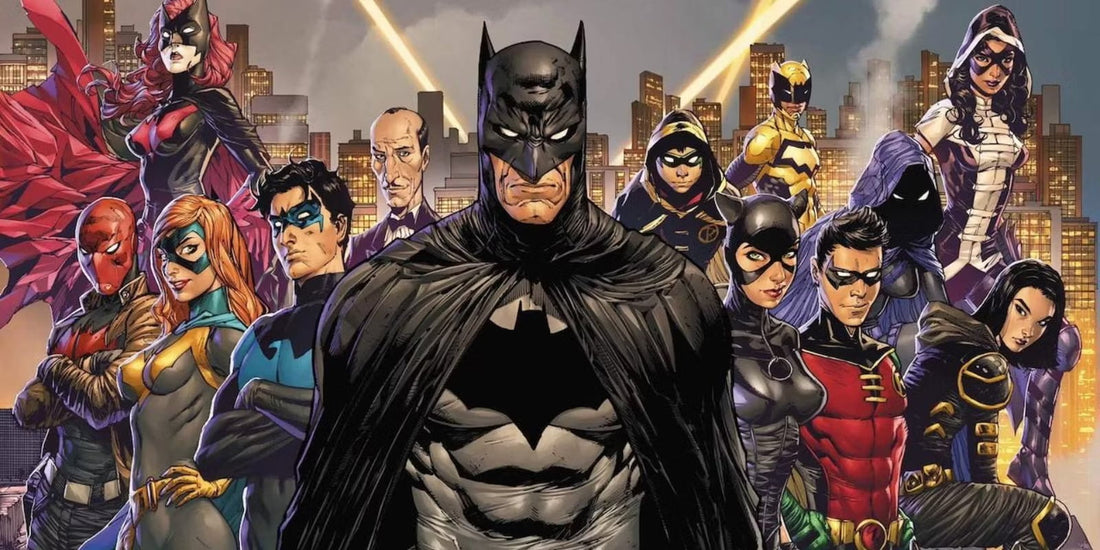
Batman has never been alone. Behind the solitary image of the Dark Knight haunting Gotham's rooftops lies one of the most complex and moving extended families in the DC Universe. The Batfamily is the collective term for the allies, heirs, former students, and parental figures who gravitate around Bruce Wayne — each with their own pain, their own version of justice, and their own interpretation of the hero. This family network is probably what best distinguishes Batman from other superheroes: where Superman has the Justice League and Spider-Man has his Avengers, Bruce has a family — in the strongest sense of the word.
This article offers a complete tour of the Batfamily, member by member, with their stories, their dramas, and their narrative roles. We distinguish the pillars (Alfred, Robin, Nightwing, Batgirl) from the more secondary but essential figures (Oracle, Red Hood, Damian Wayne, Spoiler). To contextualize this ecosystem within the broader Batman mythology, a detour through the trajectory that made Bruce Wayne the Dark Knight and the Batcave, a secret sanctuary provides the essential framework — the Batfamily is only conceivable from the hero's original isolation. To delve deeper into this topic, also see Death of the Family (2012-2013): the Joker's return that traumatized the entire Batfamily. To delve deeper into this topic, also see Tim Drake: the third Robin, the detective who uncovered Batman's identity.
Alfred Pennyworth: The Father Who Never Asked to Be One
No member of the Batfamily is more central than Alfred Pennyworth. Butler to the Wayne family since before Bruce's birth, Alfred becomes his legal guardian after the murder of Thomas and Martha Wayne in the alley that never stopped creating Batman. This position as a makeshift educator transforms a servant into a surrogate father figure. Without Alfred, there would be no functional adult Bruce Wayne — and therefore no Batman.
Alfred's role far exceeds that of a mere domestic. He is the medic who stitches wounds, the confidant who listens, the voice of reason who reminds Bruce he is not immortal, and the only human being before whom Batman can be vulnerable. This multiplicity of roles is what makes the character so touching. To explore his influence on the entire clan, a detour through the Wayne orphanage, between humanitarian aid and corruption is enlightening — Alfred is one of the few who knows all the ramifications of Wayne's work.
In modern versions, Alfred has even donned a costume: Alfred the Outsider. This late transformation of the character into an auxiliary vigilante shows how much the mythology recognizes his importance. But the most beloved version remains classic: an aging, ironic, unfailingly loyal Englishman who knows that a smile is worth a thousand rebukes.

The silent father in collection
Alfred Batman Figurine
This official Alfred Pennyworth figurine captures the quiet dignity of the butler — impeccable suit, upright posture, benevolent gaze. For collectors who want to materialize the discreet pillar of the entire Batfamily.
€59.90
View Alfred figurine →The Robin Lineage: Four Generations of Apprentices
In Batman mythology, the title of Robin is probably the most shared costume. Four young teenagers have worn it in turn, each bringing a different dimension to the myth.
Dick Grayson: The First and Most Beloved
Dick Grayson, a former circus acrobat orphaned after the death of his parents during a performance, is the very first Robin (1940). He embodies the most joyful version of the role — agile, bright, capable of defusing Bruce's darkness. It is Dick who eventually flies on his own to become Nightwing, one of the most popular DC superheroes.
Jason Todd: The Foundational Drama
Jason Todd replaces Dick in the mid-80s. More rebellious, more violent, he is ultimately murdered by the Joker in the A Death in the Family (1988) arc. This death deeply affects Bruce and becomes one of the Dark Knight's greatest traumas. To delve into this arc, a detour through why Batman doesn't kill is essential — Jason's death constantly tests this moral code. Jason later returns as Red Hood, an anti-hero who directly challenges Bruce's ethics.
Tim Drake: The Detective
Tim Drake, the third Robin, is probably the most intelligent. He is the one who discovers Batman's identity through pure deduction, even before becoming his apprentice. This cerebral dimension makes Tim a different Robin — less acrobatic, more strategic. He later becomes Red Robin, a more mature identity.
Damian Wayne: The Son
Damian Wayne, Batman's son, is the fourth Robin. Born from the union between Bruce and Talia al Ghul (a member of the League of Assassins), Damian brings a genetic dimension to the role that none of his predecessors had: he is literally the biological heir. His relationship with Bruce is tense, conflictual, but deeply touching.
Nightwing, Batgirl, Red Hood: The Independent Heirs
Over the decades, several former Robins and Batgirls have left Batman's direct orbit to develop their own heroic identities.
Dick Grayson becomes Nightwing in the 80s. His blue and black costume visually distinguishes him from Batman, while retaining the martial arts signature. For many fans, Nightwing is even superior to Bruce in some aspects — more agile, more social, better supported. To gauge this stature, a detour through Azrael, when Gotham almost replaced Batman is useful — Dick is the other natural candidate for succession.
Barbara Gordon, Commissioner Gordon's daughter, becomes the first Batgirl. Paralyzed by the Joker in The Killing Joke, she reinvents herself as Oracle, the Batfamily's computer genius. This transformation from a physical heroine to a mental heroine is one of the most beautiful feminist arcs in the DC universe. To delve into the character, a detour through Barbara Gordon, Gotham's heroine in Batman's shadow provides the complete framework.
Jason Todd, resurrected after his death, becomes Red Hood. His interpretation of justice is antithetical to Bruce's: Jason kills without hesitation. This ethical rupture makes him both a member of the Batfamily and an occasional adversary — the tension he carries is one of the most interesting in the entire mythology. Nightwing, Red Hood, and Robin, their history and differences explores this dynamic in depth.

The Bat's Heiress
Batman Animated Series Figurine - Batgirl
Batgirl embodies the female version of the myth — agile, determined, independent. This Batman Animated Series figurine reproduces Bruce Timm's iconic design — for fans who want to complete their Batfamily collection with a cult design.
€89.90
View Batgirl figurine →Secondary but Essential Figures
Beyond the core, the Batfamily includes several secondary figures whose narrative importance is considerable. Cassandra Cain in the Batgirl lineage, the second Batgirl, is probably the most skilled fighter in the entire DC universe. Raised by an assassin without ever learning to speak, she communicates solely through martial arts. Her silent silhouette terrifies Gotham's criminals.
Stephanie Brown, alias Spoiler and then briefly Robin, brings a dimension of rebellious outsider. She breaks into the Batfamily without an invitation, and eventually imposes herself through her own tenacity. This dynamic is typical of the Wayne clan: one never enters by decree, always by merit.
Helena Bertinelli, alias Huntress, brings the Italian-mafia dimension. Daughter of a New York mob boss, she hunts the mafia with methods that sometimes horrify Bruce. This tension between ruthless justice and classic moral code makes her one of the most ambivalent characters in the clan. And then there's Catwoman, whose status oscillates between occasional ally and intermittent lover. Catwoman and her iconic impact details this relationship.
Ace and Bat-Cow: The Unexpected Companions
The Batfamily also includes non-human companions. Ace the Bat-Hound, Bruce's dog in some versions, shares the Dark Knight's missions. More recently, Bat-Cow — yes, a cow — made a memorable appearance in Grant Morrison's comics, saved by Damian Wayne. These burlesque winks remind us that the Batfamily, despite its darkness, retains a playful dimension.
More seriously, the most mysterious companion remains Azrael, Jean-Paul Valley. Raised by the Order of St. Dumas to become a sacred assassin, he becomes an ally of Bruce before almost replacing him as Batman during the Knightfall arc. This tension between ally and replacement makes Azrael fascinating.
The Batfamily Facing Tragedies: A Clan Forged by Crime
What truly defines the Batfamily is the shared experience of trauma. All its members have lost loved ones to violence. All have chosen to transform this pain into a mission. This community of wounds makes the Wayne clan something deeper than a team — it's a therapeutic family.
Several major arcs have put this dimension to the test. No Man's Land, where Gotham is left to fend for itself forces the entire Batfamily to organize without hierarchy. Hush, which gathers all the villains threatens the entire clan by exposing every flaw. And Frank Miller's Year One shows the exact moment Bruce understands he will need help to bear his cross.
This communal dimension is probably what prevents Batman from completely descending into madness. The proximity of Alfred, Dick, Tim, and the others constantly reminds Bruce that there is still a world beyond the mission. Without them, he would probably have become another resident of Arkham Asylum. The Batfamily is thus as much a tactical tool as it is a group therapy.

The iconic duo in your wardrobe
Nightwing and Batman T-Shirt
The Nightwing and Batman t-shirt celebrates one of the most beloved duos of the Batfamily — the symbolic father and son, mentor and student. For fans who want to wear the spirit of this family forged by dramas.
€34.90
View t-shirt →The Batfamily in Film and Television
Film adaptations of the Batfamily have varied greatly. Nolan's Dark Knight trilogy made the radical choice to remove Robin from the landscape, retaining only Alfred and Commissioner Gordon. This narrative simplification allowed Bale to portray a quasi-solitary Batman — a choice criticized by fans but commercially victorious.
Animated adaptations have been much more generous. Batman: The Animated Series, Young Justice, Teen Titans Go: all largely integrate the Batfamily. The result is paradoxical: it is in animation that Bruce's heirs have received the most love. To delve into the animated dimension, a detour through creating a Gotham City atmosphere at home is interesting by comparison — animation allows itself the experiments that live-action refuses.
Recently, Matt Reeves' The Batman (2022) hinted at a future Batfamily. The casting suggests the probable arrival of a Robin in the sequel, and rumors about Damian Wayne are multiplying. This anticipated renaissance suggests that the studios have finally understood what comic fans have known for eighty years: Batman alone is only half the story.
Conclusion: The Family Forged by Night
The Batfamily is probably the greatest narrative success in the DC universe after Bruce Wayne himself. No other superhero has such a dense, traumatic, and coherent family ecosystem. Where the Justice League is a professional team and the X-Men are a school, the Batfamily is the closest thing to a real family — with its joys, its dramas, its accumulated resentments.
To extend the exploration, several essential paths. First, read or re-read Battle for the Cowl, the arc that follows Bruce's temporary death and forces all Batfamily members to choose their position. Then, explore the Robin Eternal and Batman & Robin Eternal arcs, which delve into the relationships between members. Finally, watch the Bruce Timm episodes of the Batman Animated Series — an absolute reference. To materialize this passion into a collection, the Batman figurine collection and Batman posters offer direct visual links to all members of the clan.
One thing is certain: as long as Bruce Wayne exists, the Batfamily will exist around him. Not as a team, not as an organization, but as the only family he has ever truly built — that of the night, of dried blood, and of shared vows.