
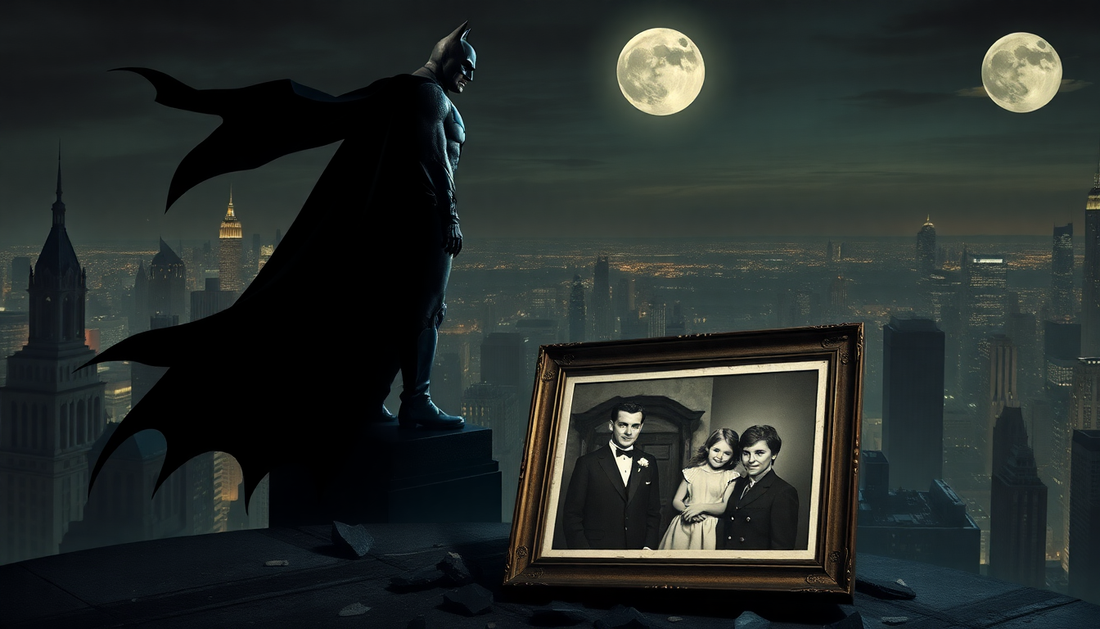
Why is Batman an orphan?
The answer in brief
November 1939, Detective Comics 33: Eight-year-old Wayne heir leaves Park Row Theater after a screening of The Mark of Zorro. In the alley soon dubbed Crime Alley, an armed mugger demands a wallet and necklace, then fires two shots. This foundational event, endlessly repeated and rewritten since, creates the hero. The shooter, anonymous at the time, would be named Joe Chill by Bill Finger in 1948.
Among all the questions posed by Batman mythology, that of Bruce Wayne's orphanhood is probably the most fundamental. Not because it is the most dramatic — although it is — but because it structures everything else. Without the death of Thomas and Martha Wayne before their son's eyes, there is no Dark Knight. And without a Dark Knight, there is no mythology. This article explores the origins, narrative dimension, and psychological impact of this founding event.
To place this trauma in the hero's complete trajectory, a detour through the complete genesis of the Dark Knight is essential — orphanhood is only the first stage of a journey that will take years to build.
The origin of Batman: Crime Alley, 1939
The story begins in Detective Comics #33 in November 1939. Bruce Wayne, then eight years old, leaves the Park Row Theater with his parents after a screening of the film The Mark of Zorro. The family takes an alleyway home — one that would become known in mythology as Crime Alley, the alley that never stopped making Batman.
An armed man appears, demanding Thomas Wayne's wallet and Martha's necklace. Thomas tries to protect his wife. The thief shoots. Two bullets. Thomas and Martha collapse. Bruce, a direct witness, is left alone in the middle of the alley, next to his parents' bodies. This scene, recounted and reinvented dozens of times since 1939, remains the hero's canonical origin.
The killer's identity has varied over the arcs. Initially anonymous, the criminal was renamed Joe Chill by Bill Finger in 1948. This identification gives Bruce a face to chase, but also a psychological knot to untangle — can he forgive? Can he forget? Several major arcs explore this tension, notably Frank Miller's Year One, which places the trauma in the context of an adult Bruce returning to Gotham.

The modern heir to tragedy
Batman 2022 Figurine
This figurine reproduces Matt Reeves' 2022 Batman — a version that directly explores the hero's orphaned dimension. Robert Pattinson portrays a young Bruce Wayne still marked by grief, which makes this figurine particularly significant for fans of this era.
€79.90
See the 2022 figurine →The quest for vengeance: from grief to mission
The transition from orphanhood to vigilantism is not immediate. Bruce first goes through a long period of grief and wandering. During his adolescence and early adulthood, he leaves Gotham, travels the world, studies with masters of martial arts, criminologists, and psychologists. This period of learning transforms trauma into method.
It is during these travels that Bruce encounters, according to some continuities, the League of Assassins. This encounter teaches him discipline but also exposes him to a radical vision of justice — one that he will refuse to reproduce by adopting his unwavering moral code. This opposition between Bruce and Ra's al Ghul is one of the deepest in mythology, as it poses the question: does vengeance justify everything?
When Bruce returns to Gotham, he has transformed his pain into a project. The oath he makes at his parents' grave is explicit: to protect other families from the same injustice. This mission defines him. But it does not heal him. The trauma remains, under the costume, under the cape, under the mask. Bruce remains, forever, the little boy from Crime Alley.
The impact of orphanhood on the hero's psychology
Bruce's orphanhood is not just a narrative motivation — it is a psychological matrix that infiltrates every decision the hero makes. Several character traits stem directly from it. First, the inability to form stable relationships. Bruce never marries enduringly. His partnerships — with Selina Kyle, Talia al Ghul, Vicki Vale — always end up failing. This difficulty is explored head-on in Hush, the saga that brought all the villains together where Bruce temporarily tries to have a stable private life.
Secondly, the compulsive need to protect other orphans. Bruce successively adopts several grieving children — Dick Grayson, Jason Todd, Tim Drake — forming what is called the Batfamily, the hero's allies clan. This chosen filiation partially compensates for the lost family, without ever completely replacing it. The tragedies that strike this family (notably the death of Jason Todd) are experienced by Bruce as painful repetitions of his own original trauma.
Thirdly, hidden fear. Bruce becomes Batman because he is afraid of bats — a fear he turns into a weapon against criminals. This psychological dimension is explored in Batman Begins (2005) with rare precision. To delve deeper into this cinematic adaptation, a detour through the Dark Knight trilogy is indispensable.

The tragic soul of Gotham on a poster
Batman Comic Book Poster
The Batman comic book poster captures the psychological dimension of the hero — dark silhouette, anxious presence, permanent shadow. For fans who want to materialize the melancholy that has haunted Bruce Wayne since Crime Alley.
€19.90
See the poster →Batman's legacy: transforming loss into mission
Beyond Bruce himself, orphanhood permeates the entire mythology. A significant number of DC heroes are also orphans — Superman, Spider-Man (in Marvel), Wonder Woman in some respects. But none embodies as deeply the mythology of the wounded child who becomes a protective adult. This is probably what makes Batman so universal: everyone has, at one time or another, experienced loss. Bruce is just the extreme extrapolation of this common experience.
Bruce's orphanhood also inspired the Wayne family's philanthropy. The Wayne Orphanage, between humanitarian aid and corruption in Gotham explores how Bruce indirectly tries to alleviate the suffering of other children through donations. This charitable dimension is rarely highlighted in films but remains central in modern comics.
The other inherited dimension is the transmission of trauma. Damian Wayne, Batman's son, grows up knowing that his father is an orphan. This knowledge deeply marks him. Recent arcs explore how this family history crosses generations — each Batman child carries the weight of Crime Alley, even without having directly experienced it.

The mask that transforms pain
Classic Batman Mask
The classic Batman mask embodies the precise moment Bruce Wayne chooses to transform his trauma into a mission. It is the central symbolic object of mythology — the fabric that separates the little boy from Crime Alley from the adult Dark Knight.
€39.90€49.90
See the classic mask →Why orphanhood remains central in 2026
Eighty-five years after Detective Comics #33, Bruce's orphanhood continues to fascinate. Three structural reasons explain this longevity. First reason: its narrative simplicity. No need to explain Krypton, no need for a radioactive bite, no need for genetic mutation. A mundane crime in an ordinary alley, and the hero is born. This accessibility makes Batman the easiest superhero to explain to a new reader.
Second reason: its emotional resonance. Everyone understands what it's like to lose a loved one. This emotional universality makes Bruce Wayne a character who speaks to all generations, all cultures, all social contexts. Young readers identify with the child. Adult readers identify with the survivor who transforms pain into action.
Third reason: its psychological modernity. In an era where questions of mental health, grief, and resilience dominate public debate, Bruce's story resonates with new relevance. The hero is no longer just a vigilante — he is a clinical case of trauma transformed into a mission. To explore this dimension in its full extent, a detour through Arkham Asylum is enlightening — Bruce constantly walks the line between hero and madman.
Conclusion: the child who never stopped running
Bruce Wayne is, in his essence, a wounded child who never stopped running. Every night, when he puts on the costume, he returns to Crime Alley. Every criminal he neutralizes is, symbolically, Joe Chill. This obsessive repetition is neither a narrative flaw nor a psychological weakness — it is the very dynamic that makes the Dark Knight an indestructible character.
To extend the exploration, several essential avenues. First, read Frank Miller's Year One — the arc that modernizes the origin. Then, watch Batman Begins (2005) — the film adaptation most faithful to the original psychology. Finally, explore No Man's Land and Gotham left to fend for itself — an arc where Bruce's trauma extends to the entire city. To materialize this passion into a collection, the Batman figurine collection and the t-shirt collection offer visual hooks.
One thing is certain: as long as humans experience loss, Bruce's orphanhood will remain the most beautiful metaphor for transforming grief into action. And that is probably, ultimately, the greatest lesson Batman mythology has ever offered: what breaks you does not define you — it is what you choose to do with it that defines you.