Which Batman was the most successful?
The answer in brief
No single version wins in every category, because the criteria considered diverge: ticket admissions, press accolades, lasting imprint on memory. At least seven actors have succeeded one another on the big screen, from Adam West to Christian Bale, Ben Affleck, and Robert Pattinson. The Nolan era remains the preferred benchmark for specialists, a reference against which every recent reinterpretation is measured.
Table of contents
The question has been debated by fans for forty years. Which Batman was truly the most successful? The answer depends on what is meant by success — box office, critical ratings, long-term cultural impact, or simply personal preference. Each definition yields a different ranking. This article analyzes these dimensions one by one to provide the most comprehensive reading possible.
To place this question within the broader Batman mythology, it is essential to consider which Batman was most loved by the public — commercial success and emotional success are not the same thing, and this distinction underpins the entire discussion that follows.
The different versions of Batman in cinema
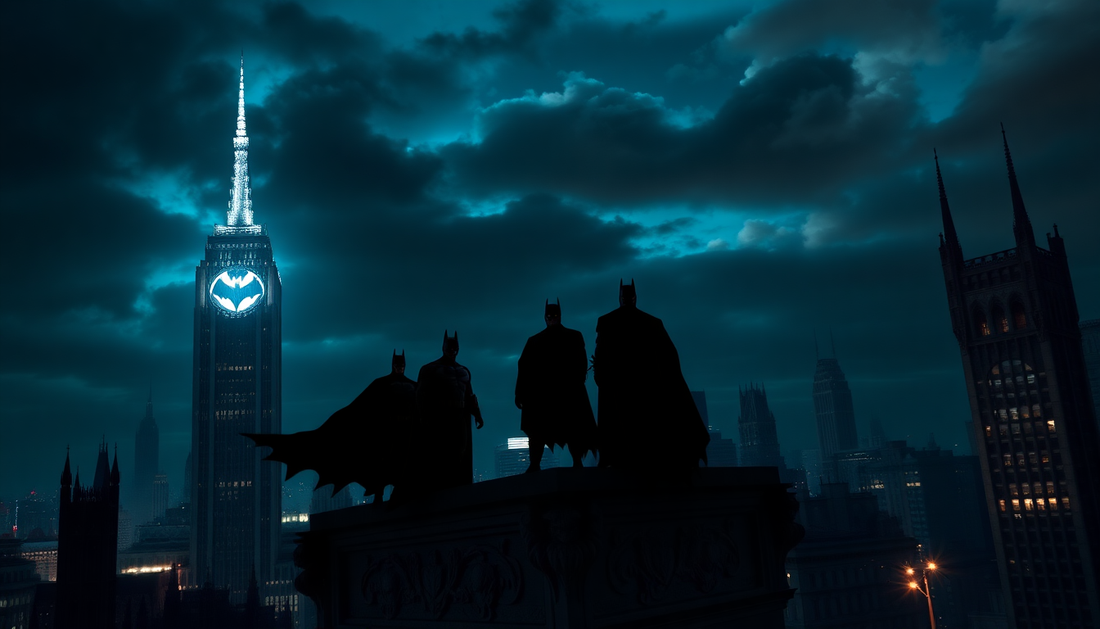
Before ranking successes, one must know the contenders. Since 1966, more than seven actors have worn the cape on the big screen: Adam West (1966), Michael Keaton (1989-1992), Val Kilmer (1995), George Clooney (1997), Christian Bale (2005-2012), Ben Affleck (2016-2023), Robert Pattinson (2022-). Each incarnation has its own visual signature, its own narrative choices, its own acting style.
To delve into each period, a look at Christopher Nolan's Dark Knight trilogy is particularly insightful — Nolan remains the absolute benchmark against which all other adaptations are measured. But the other eras have their own successes, their own limitations, and their own loyal fan bases.
For fans who want a panoramic chronological view, a look at the trajectory that made Bruce Wayne the Dark Knight provides the referential framework — each film adaptation reinterprets the elements of this original mythology in its own way.

Batman Begins as a premium poster
Batman Begins Poster
The Batman Begins poster captures the aesthetic of the Nolan era — understated, serious, dark. A premium piece for fans of the trilogy that redefined the superhero genre in cinema. High-end format for a display case or a statement wall.
€52.90
The Batmen of the big screen
The most popular Batman: quantified analyses
If we talk strictly about cumulative box office, the ranking is clear. The Dark Knight (2008) with Christian Bale reached $1.005 billion in worldwide revenue. The Dark Knight Rises (2012) followed with $1.084 billion. These two films largely dominate Batman's revenue. No other incarnation has reached this level.
But absolute numbers are misleading. Batman (1989) with Michael Keaton grossed $411 million at the time — a considerable amount given inflation and the size of the blockbuster market in 1989. Adjusted to 2024 values, that would be equivalent to more than $1 billion today. So Burton/Keaton is also a big box office winner, simply in a different era.
In terms of critical success, Heath Ledger won a posthumous Oscar for his portrayal of the Joker in The Dark Knight (2008). This Oscar remains to this day the only one awarded for a role in a superhero film. It definitively consolidates Bale's status as the Batman with the best supporting antagonists. To delve deeper into this dimension, a look at Joker 2019 and its historic success is illuminating — Joaquin Phoenix would in turn receive an Oscar for his Joker.
Box office and awards
Robert Pattinson's success: the new wave
More recently, Matt Reeves' The Batman (2022) starring Robert Pattinson marked the character's return to grace after several mixed DCEU years. The film reached $770 million at the box office — a solid performance given post-COVID conditions, and high critical ratings with a Metascore of 72 and an 85% on Rotten Tomatoes.
Pattinson brought a new dimension to the character. Younger than Bale, more vulnerable than Affleck, more introspective than Keaton, he appealed to a generation of fans who had not grown up with the other incarnations. This generational dimension is crucial to understanding the success — Pattinson did not replace Bale, he completed the gallery.
The other dimension of Pattinson's success is the emotional depth of his interpretation. To explore how this dimension fits into the overall mythology, a look at why Batman doesn't kill is essential — The Batman 2022 brings the character back to his foundational ethics.

The iconic 1989 logo
Batman 1989 T-Shirt
The Batman 1989 t-shirt reproduces the iconic logo of the Burton/Keaton era — the silhouette that relaunched Batman in cinema. For fans who want to wear the legacy of the Dark Knight's first major cinematic success.
€29.90
The Batman (2022) in numbers
Beyond cinema: TV, games, animation
Restricting the question of success to cinema alone would be reductive. Several Batman incarnations have achieved massive success in other media. The Batman: Arkham saga (video game 2009-2015) sold more than 30 million copies combined and remains one of the absolute benchmarks of superhero gaming. To delve deeper into this dimension, a look at Arkham Asylum, the setting of the video game saga is enlightening.
In animation, Batman: The Animated Series (1992-1995) remains for many the best adaptation ever produced — across all forms. The series won four Emmys, launched the careers of several writers, and defined the character's canonical voice (that of Kevin Conroy) for several generations. This animated dimension has probably left a greater mark on pop culture than some of the minor live-action films.
More recently, series like Pennyworth (about the butler Alfred) or Gotham (about Commissioner James Gordon before Batman) have extended the mythology to television with varying degrees of success. None has equaled the cinematic successes, but all have helped keep the franchise alive between big-screen releases.
Successes beyond cinema
The criterion of personal preference: a generational success
Beyond the numbers, success also depends on the viewer's generation. For fans who grew up in the 60s and 70s, Adam West remains irreplaceable — not for the quality of his performance, but for the nostalgia he evokes. For those who discovered Batman in cinema in the 90s, Michael Keaton definitively embodies the Dark Knight. Millennials identify with Christian Bale. Generation Z chooses Robert Pattinson.
This generational dimension explains why the question has no universal answer. No other superhero franchise boasts so many legitimate incarnations at the same time. Where Spider-Man has three (Maguire, Garfield, Holland), Batman has seven, at least four of which have active fan bases. This plurality is probably the franchise's greatest success — it has managed to reinvent itself without betraying itself.
For fans who want to explore this generational dimension further, a look at the Batfamily and its allies across generations is enlightening — each era brings its own Robins, its own Batgirls, its own Jokers.

The statement hero in large format
Batman 30cm Figure
The 30cm Batman figure is the ultimate statement piece for serious collectors. Imposing format, premium finish, extreme detail — it is the collector's incarnation that transcends cinematic eras to become an absolute fan object, across all generations.
€239.90
| Generation | Reference Batman |
|---|---|
| 1960s-1970s | Adam West |
| 1990s | Michael Keaton |
| Millennials | Christian Bale |
| Generation Z | Robert Pattinson |
Why Batman's success surpasses all his competitors
To conclude the question, we must accept that there is not one winning Batman — there is a winning franchise. No other superhero franchise has experienced this plurality of commercially viable incarnations. None has produced a trilogy as acclaimed as Nolan's. None has maintained an uninterrupted cinematic presence for thirty-five years (1989-2024).
This franchise success is due to several structural reasons. First reason: the simplicity of the origin. No need for Krypton or a radioactive bite — a crime in an alley, and the hero is born. Second reason: visual flexibility. The black and gray costume can be reinvented without losing its identity. Third reason: psychological depth. Bruce Wayne is never a simple hero — he is always conflicted, tormented, ambiguous.
For fans who want to extend the comparison, a look at Batman and Green Arrow, two faces of the same justice is interesting — Green Arrow embodies what Batman could have been without franchise success, and the contrast illuminates the choices that propelled the Dark Knight.
Simple origin
No need for Krypton or a radioactive bite: a crime in an alley is enough to give birth to the hero.
Visual flexibility
The black and gray costume can be reinvented without losing its identity.
Psychological depth
Bruce Wayne is never a simple hero: he is always conflicted, tormented, ambiguous.
Conclusion: shared success
Which Batman was the most successful? The honest answer: all of them, in their own time. Christian Bale dominates the modern box office. Michael Keaton dominates boomer nostalgia. Robert Pattinson dominates the new generation. Adam West dominates pop humor. Each has their place, each has their audience, each has contributed to making Batman the most enduring superhero franchise in history.
To materialize this passion into a collection, the Batman figures collection, the posters collection, the t-shirts collection and the masks collection offer references to each era of the Dark Knight.
One thing is certain: as long as there is cinema, there will be a Batman. And every generation will have its own. This is probably the character's greatest success — not belonging to a single era, but to all of them at once.
In short
Each Batman succeeded in his own era: Christian Bale dominates the modern box office, Michael Keaton nostalgia, Robert Pattinson the new generation, and Adam West pop humor.