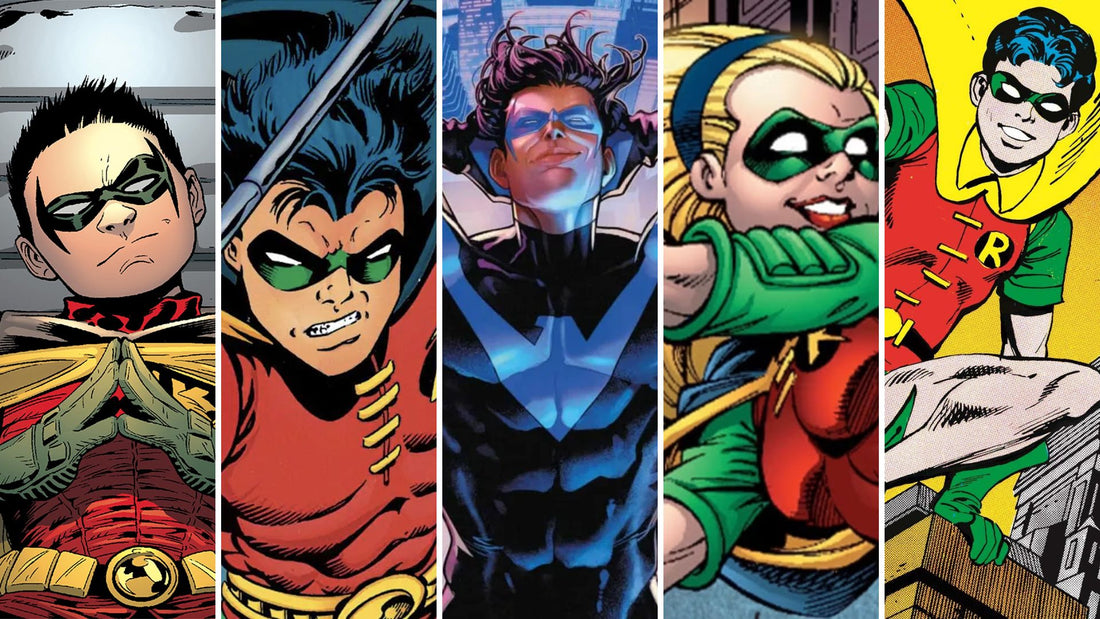
All the Robins in the Batman universe
The answer in brief
Five designated heirs take turns under the same cowl. The eldest, Dick Grayson, introduced in April 1940 in Detective Comics #38, is a trapeze artist plunged into mourning by premeditated sabotage; he is followed by Jason Todd, Tim Drake, Stephanie Brown, and Damian Wayne. Far from being a decorative sidekick, this relay represents the true emotional core of the household united behind the vigilante.
🦅 All the Robins in the Batman Universe: The Complete Lineage of the Dark Knight's Proteges
Batman is a loner. That's one of the first things you learn about the character. And yet, since 1940, the Dark Knight has almost never fought alone. By his side, a succession of young heroes has worn the same codename, the same red and yellow costume, the same cape: Robin. This paradox — the loner who constantly trains apprentices — is at the heart of Bruce Wayne's psychology. Each Robin is an attempt to mend the foundational trauma: to prevent another child from suffering what Bruce suffered in Crime Alley. But each Robin is also a risk — that of leading a young person into a war that could kill them, as tragically demonstrated by A Death in the Family.
This article traces the entire Robin lineage, from Dick Grayson in 1940 to modern versions, including Jason Todd, Tim Drake, Stephanie Brown, and Damian Wayne. For each Robin, you will discover their origins, personality, narrative arc, and destiny. You will also understand why the role of Robin is so fundamental in Batman mythology — not just a simple sidekick, but the emotional heart of the entire Batfamily. To place these characters in the complete ecosystem, a detour through the guide to Batman characters provides a global map of Gotham.
🎪 Dick Grayson: The First Robin, The Circus Kid
It all began in April 1940, in Detective Comics #38. Dick Grayson is a young acrobat from Haly's Circus, a member of a trapeze family called the Flying Graysons. During a performance, his parents fall and die—their trapeze was sabotaged by a gangster the family refused to pay. Bruce Wayne, present in the audience, immediately recognized the same emptiness he had known as a child in the young orphan's eyes. He took him in, trained him, and made him the first Robin. This parallel between the two orphans is the emotional foundation of the entire Batman-Robin relationship. To learn more on this topic, see also Batman: Dark Victory — the gang war that gave birth to Robin.
Dick Grayson is, for many fans, the definitive Robin. An exceptional acrobat, charismatic, optimistic where Bruce is dark, he brings a lightness that balances the Dark Knight's grimness. Over the decades, Dick grew up and eventually emancipated himself from Batman's tutelage to become a hero in his own right: Nightwing. This transition from Robin to Nightwing is one of the most successful growth arcs in comics—a sidekick who becomes an equal. Dick even took on the role of Batman himself on several occasions, notably during Bruce's recovery, demonstrating that he was worthy of wearing the master's cowl. This versatility makes Dick Grayson the cornerstone of the Batfamily.
Dick Grayson's Legacy
Dick Grayson embodies the success of the Robin project: an orphan saved from trauma, trained, balanced, who became an accomplished and independent hero. He represents the bright version of what Batman's guidance can produce. His importance goes beyond just being the first Robin—he is the relational glue of the entire Batfamily, the older brother who maintains cohesion among all of Bruce's successive proteges. When things go wrong between family members, it's often Dick who mends things. This dimension of a natural leader sets him apart from all other Robins.

💀 Jason Todd: The Tragic Robin Who Became Red Hood
The second Robin is probably the most controversial and tragic of the entire lineage. Jason Todd first appeared in 1983 as a replacement for Dick Grayson, who had left to become Nightwing. But Jason is radically different from his predecessor. Where Dick was bright and disciplined, Jason is hot-headed, impulsive, marked by a childhood on the streets. Coming from the poorest neighborhoods of Gotham City, the son of a criminal and a drug-addicted mother, Jason carries a rage that Bruce never fully manages to channel.
Jason Todd's fate was decided by the readers themselves. In 1988, DC organized a phone vote to decide whether Jason should survive a confrontation with the Joker. Readers voted against it. In A Death in the Family, the Joker beats Jason to death with a crowbar then blows him up. This death deeply affected Bruce Wayne—it became his greatest guilt, living (then dead) proof that his Robin project could kill. For years, Jason's costume remained displayed in the Batcave as a memorial and a warning.
The Return as Red Hood
But in 2005, in the "Under the Red Hood" arc, Jason Todd returns. Resurrected by the Lazarus Pits, he returns transformed into Red Hood—a violent anti-hero who rejects Batman's moral code. Where Bruce refuses to kill, Jason executes criminals. This philosophical opposition between father and resurrected son is one of the most powerful dynamics in modern Batman mythology. Jason reproaches Batman for not avenging his death by killing the Joker—he embodies the temptation Bruce has always refused. This tension between Batman's moral code and Jason's thirst for justice structures many recent arcs. To understand the difference between Jason and the other sidekicks, the article dedicated to Nightwing, Red Hood, and Robin delves into these dynamics. To go further on this topic, see also Batman: Under the Red Hood—the return of Jason Todd, the dead Robin who comes back to judge Batman.
🧠 Tim Drake: The Detective Robin
The third Robin is perhaps the smartest of them all. Tim Drake appears in 1989, shortly after Jason Todd's death. His particularity is extraordinary: Tim deduced Batman's and Nightwing's secret identities on his own, recognizing Dick Grayson's acrobatic signature. This deductive ability makes Tim the closest to Batman in terms of detective talent—the quality that truly defines the Dark Knight beyond his muscles and gadgets.
Tim Drake becomes Robin not out of personal tragedy (like Dick and Jason) but out of conviction. He understands that Batman, devastated by Jason's death, is becoming dangerously violent and needs a Robin to stay balanced. Tim therefore offers his services through logical reasoning: Batman needs Robin, not the other way around. This inversion of the usual logic makes Tim a unique character. He represents the Robin chosen by reason rather than by fate. Over the years, Tim becomes Red Robin, develops his own identity, and remains one of the brightest minds in the Batfamily. His relationship with Bruce is less filial than Dick's, more intellectual, almost that of two detective colleagues. This dimension makes Tim the favorite Robin of fans who value Batman's detective dimension. This thread is found in Bruce Wayne: Murderer? / Fugitive (2002): the saga where Batman was accused of murder.

🎯 Stephanie Brown: The Ephemeral and Forgotten Robin
Often overlooked in mainstream narratives, Stephanie Brown nonetheless holds an important place in the Robin lineage. Daughter of the minor villain Cluemaster, she began as the heroine Spoiler before briefly becoming the fourth official Robin—and the first woman to wear that codename in mainstream continuity. Her time as Robin was short and marked by tragedy, but it opened an important breach: it proved that the role of Robin was not reserved for boys.
Stephanie Brown would later become Batgirl, extending her heroic journey beyond her ephemeral stint as Robin. Her story is documented in the article dedicated to Stephanie Brown, the forgotten heroine of Gotham. Her symbolic importance transcends her time in the role: she embodies the progressive diversification of the Batfamily, opening up to increasingly varied profiles. This openness paves the way for major female heroines of Gotham like Batgirl Barbara Gordon and the entire galaxy of vigilantes in Birds of Prey.
⚔️ Damian Wayne: Batman's Biological Son
The fifth Robin is unique in the entire lineage: he is Bruce Wayne's biological son. Damian Wayne is the result of the relationship between Bruce and Talia al Ghul, Ra's al Ghul's daughter. Raised by the League of Assassins, Damian was trained from childhood to be an elite killer. When he arrives in Bruce's life, he is an arrogant, violent child, convinced of his superiority, who considers murder a normal solution. He is the perfect antithesis of Batman's moral code.
Damian's arc is one of gradual redemption. Under Bruce's guidance, and especially under Dick Grayson's (who becomes his mentor during a period when Dick is Batman and Damian is Robin), the child assassin slowly learns the value of life and restraint. This transformation from a killer to a hero is one of the most moving arcs in modern comics. Damian embodies a fundamental philosophical question: can one escape their upbringing? Can one become good when they have been shaped for evil? His tense but profound relationship with his father Bruce adds an unprecedented emotional dimension to the role of Robin—for the first time, the bond between Batman and Robin is literally that of a father and son. This dynamic redefined the Batfamily for the 2010s and continues to fuel contemporary arcs.
Damian in Cinema and the Future DCU
Damian Wayne will take on major importance in future Batman cinema. James Gunn has announced that Batman: The Brave and the Bold, the first Batman film of the new DCU, will feature the relationship between Bruce Wayne and his son Damian. This upcoming adaptation is expected to significantly increase the character's notoriety with the general public. Damian represents the future of the Robin lineage — the Robin who literally carries the blood of the Waynes and who could, one day, inherit the mantle of Batman himself.

🧬 Why Robin's role is essential to Batman
Beyond the individual characters, the very concept of Robin is fundamental to understanding Batman. Robin is not a mere foil meant to make comics more accessible to young readers (although that was his original function in 1940). Robin is the psychological mechanism that prevents Batman from falling into darkness. Without Robin, Bruce Wayne progressively becomes darker, more violent, more isolated. The presence of a young protégé forces him to remain a role model, to control his rage, to embody hope rather than just vengeance.
This function is explicitly recognized in the comics. Several writers have penned arcs where Batman, deprived of Robin, comes dangerously close to crossing the line he swore never to cross. Tim Drake best articulates this truth: "Batman needs a Robin." The protégé is not there to help Batman fight — he is there to prevent Batman from becoming a monster. This dimension makes the Robin lineage the true emotional heart of the entire mythology. To understand how this dynamic fits into Bruce's entire family, a detour to the complete Batfamily provides the context for all relationships, and the article on Alfred Pennyworth completes the portrait of the father figure in the ecosystem.
The Robin lineage facing Gotham's enemies
Each Robin has faced Gotham's great villains, and several have been directly marked by them. Jason Todd was killed by the Joker. The Robins have all had to contend with the gallery of psychopaths populating Gotham's mythical villains gallery. This permanent confrontation with mortal danger is what makes the role of Robin so heavy: these are not children playing heroes, they are young people risking their lives every night alongside the Dark Knight. This gravity is what distinguishes the best Robin stories from the lighter, more childish versions of the early days.
🦇 All the faces of Robin: a lineage of hope
In conclusion, the Robin lineage tells a story that Batman alone could never tell: that of transmission. Dick Grayson, the first, bright and accomplished, who became Nightwing and sometimes Batman himself. Jason Todd, the tragic one, dead then resurrected as the vengeful Red Hood. Tim Drake, the detective, chosen by reason. Stephanie Brown, the ephemeral female pioneer. Damian Wayne, the redeemed biological son of his assassin upbringing. Each represents a different facet of what it means to be trained by Batman — and each, in their own way, carried the hope that the Dark Knight embodies despite his darkness. To learn more on this topic, also see Tim Drake: the third Robin, the detective who uncovered Batman's identity. To delve deeper into this subject, also see Batman allies figurines: the Bat-family and Gotham heroes to collect.
This diversity of destinies makes the Robin lineage one of the richest elements of the entire Batman mythology. Far from being mere assistants, the Robins are Bruce Wayne's heirs, children, and mirrors. They are proof that even the most solitary man in Gotham needs a family — and that he has built one, generation after generation. To explore the universe of these characters further, the dedicated analyses of Nightwing, Red Hood, and Robin, Batman's son Damian Wayne, and Batgirl provide the full depth of the Batfamily. And to place these characters in the grand history of comics, the overview of Batman comics by era offers a complete mapping of the mythology in which all Robins are inscribed.