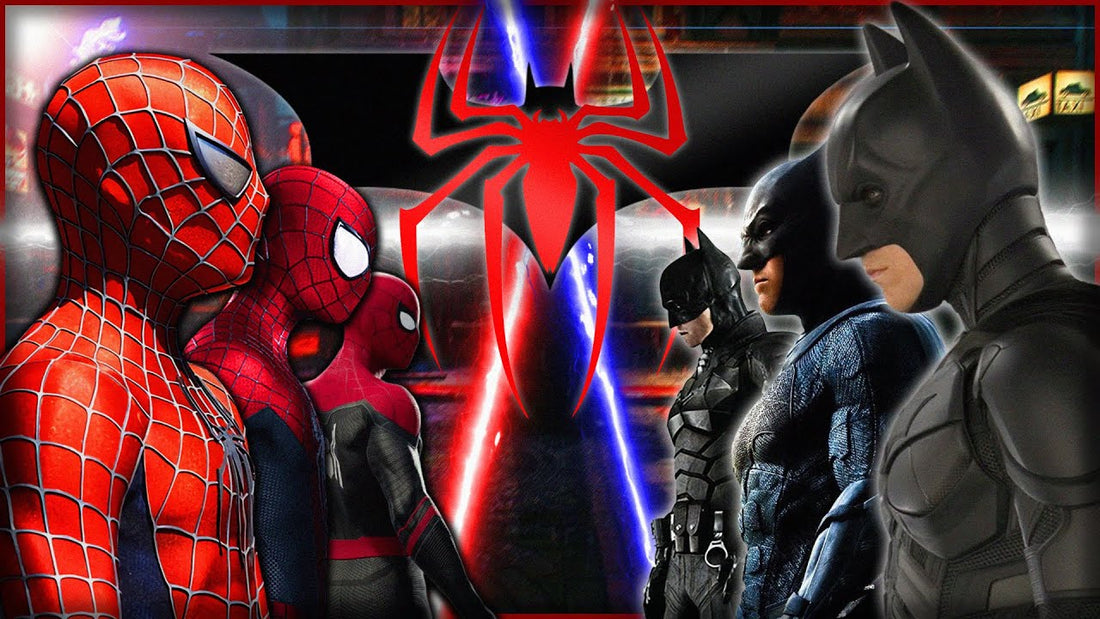
DC vs Marvel: Why are Spider-Man and Batman so fascinating?
The short answer
The two heroes appeal for opposite reasons. The Dark Knight impresses because he deliberately chose his crusade: no serum, no bite, only a will forged by an early loss and decades of training. The web-slinger, on the other hand, looks like his reader, a teenager knocked around by everyday reality. An unreachable model on one side, an immediate reflection on the other: two answers to the same desire.
Contents
For more than 80 years, two giants have dominated the superhero world: DC Comics and Marvel. And at the top of these two empires, two emblematic figures stand out: Batman and Spider-Man. One moves through the shadows of Gotham and its entire universe, the other swings between the skyscrapers of New York. One keeps watch from the Batcave dug beneath the family manor, the other takes the subway and does his homework. But what makes these two heroes so universally popular, and why does a committed fan of the Dark Knight still respect the web-slinger?
The question is anything but trivial. It touches on what we fundamentally expect from a superhero: a mirror, a model, or a catharsis? And the answer, as is often the case when you dig into the Batman universe, is more nuanced than it seems.
🦇 Batman: the vigilante without powers
Batman has neither superhuman strength nor a spider-sense, but he has something else: an iron will, a brilliant mind, and an unshakable moral code. He embodies the fight against inner evil, revenge, justice, and sacrifice. His dark universe, his deep enemies, and his inimitable style make him a legend of the comics world, adored by fans of all ages.
What radically sets Bruce Wayne apart is that he chose his crusade. Nobody injected him with a serum, nobody bit him, no cosmic ray transformed him. The founding tragedy of the orphaned child in a Gotham alley triggered an absolute discipline in him, which translated into decades of physical, intellectual, and tactical training. Our feature on Bruce Wayne and the true face of Batman breaks down the psychology of a man who builds himself.
This absence of superhuman power is paradoxically what makes the character so symbolically powerful. When the Dark Knight's silhouette stands out against the Gotham sky from Wayne Manor, the viewer knows that behind the mask there is a man who sacrificed everything to become that shadow. Not a god, not a mutant: a human. That is exactly what makes the Batmobile or the Bat-Signal so evocative: they are human tools, not divine gifts.
In short
Batman has no superhuman power: no serum, no bite, no cosmic ray. The tragedy he lived through as a child in a Gotham alley triggered decades of physical, intellectual, and tactical training.
🕷️ Spider-Man: the hero of the people
At the other end of the spectrum, Spider-Man is the hero of everyday life. A shy, geeky, clumsy teenager who becomes a symbol of courage and resilience. He lives with his mistakes, his losses, his responsibilities. It is precisely this humanity that makes Peter Parker such an endearing and universal character.
The big difference with Batman lies in the trajectory. Peter Parker starts out as an ordinary teenager, becomes a hero by accident, and learns to handle his powers at the same time as he discovers what it means to be responsible. Bruce Wayne, by contrast, starts out as the heir to an immeasurable fortune, loses everything emotionally at ten years old, and then spends twenty years methodically transforming himself. One grows up making public mistakes; the other rebuilds himself in silence before he even appears.
The key point
Peter Parker becomes a hero by accident and grows up making public mistakes. Bruce Wayne loses everything emotionally at ten years old, then spends twenty years methodically transforming himself, in silence.
🎥 Two myths in cinema
Batman has had countless adaptations, from Tim Burton to Christopher Nolan, including the dark The Batman. For his part, Spider-Man took over the screens with Tobey Maguire, Andrew Garfield, and Tom Holland, not to mention animated films like Into the Spider-Verse.
On the cinema front, the Dark Knight holds a place of his own. Tim Burton's Batman 1989 redefined what a superhero blockbuster could be, imposing a gothic aesthetic that marked an entire generation of moviegoers. A few years later, Batman: The Animated Series pushed visual consistency even further, creating a visual canon that still inspires every contemporary iteration. Our feature on all the Batman movies in chronological order offers an overview for anyone who wants to explore the complete saga. For fans of the modern interpretation, our analysis of all of Ben Affleck's Batman appearances details the DCEU's aesthetic choices.
And for those who want to explore the cinematic evolution of the web-slinger, we recommend this complete page devoted to the Spider-Man movies. A real chronological guide, rich and illustrated, to dive into all the web-slinger's universes.
Burton's Batman 1989
Tim Burton's film imposes a gothic aesthetic that marked an entire generation of moviegoers.
Batman: The Animated Series
The series pushes visual consistency further and creates a canon that still inspires contemporary versions.
Spider-Man on screen
Tobey Maguire, Andrew Garfield, and Tom Holland have played the hero, not to mention animation with Into the Spider-Verse.
👑 Who is more popular?
Spider-Man is often the most searched superhero in the world, with a huge fan community, especially among young people. But Batman keeps a loyal, passionate, and multigenerational base. In truth, these two figures are complementary. One acts in the shadows, the other shines in the light. And both inspire millions of people around the world.
The loyalty of Batman fans also shows in the iconography they bring into their daily lives. From the Batman t-shirt worn at the office to the Batman pajamas for the evening, by way of socks with a bat pattern and matching slippers at home, the seasoned fan builds a coherent clothing ecosystem. This level of investment, which goes far beyond the occasional t-shirt, speaks to a niche loyalty that few characters manage to inspire.

🧠 Two approaches to superheroism
Where Batman relies on strategy, fear, and extreme preparation, Spider-Man improvises, learns from his mistakes, and constantly evolves. The Dark Knight acts out of duty, eaten away by the loss of his parents. Peter Parker, for his part, acts out of guilt and moral sense, after the death of his Uncle Ben. These two tragic origins forge very different but complementary personalities.
In the comics, fans love these contrasts: while Batman works out complex plans in the shadows, Spider-Man cracks a joke in the middle of an aerial fight. One stands for rigor, the other for spontaneity. And both embody, in their own way, what it means to be a hero. But it is precisely this rigor of the Dark Knight that captivates adult readers, as shown by cult sagas such as Knightfall, where Bane breaks Batman, The Long Halloween, Gotham's ultimate crime story, or Batman: Prey, which explores his psyche. These stories could not exist around a sunnier hero.
This psychological dimension carries over into the enemies. Gotham's villain gallery is unique in the entire medium: Joker, the Penguin, Two-Face, the Riddler, all figures that have become archetypes in their own right. Our complete guide to Gotham's legendary villains details the mechanics of every major antagonist, and our study of the Penguin, crime boss of Gotham illustrates a depth of writing that no other superhero universe truly reaches.
The key point
Batman relies on strategy, fear, and preparation, eaten away by the loss of his parents. Peter Parker improvises and learns from his mistakes, driven by guilt after the death of his Uncle Ben.
🛍️ Two universes of cult products
Whether with DC or Marvel, merchandise is everywhere. Fans can show their passion through costumes, t-shirts, figures, or even wall decor. Spider-Man, for example, has a huge variety of designs: classic red suit, black symbiote, Miles Morales version. On the DC side, the Batman ecosystem has also been built up over decades, with a depth that competes without any complex.
For fans who want to bring the myth into their daily lives, the available range covers absolutely every use. On the clothing side, Batman t-shirts, Batman sweaters and hoodies, Batman pajamas, and Batman beanies make it possible to sign your fan identity in every season. On the accessories side, Batman caps, wallets with a bat pattern, Batman mugs, and Batman bags and backpacks shape a complete daily routine. For pure collectors, Batman figures, by version and scale offer an inexhaustible playground, and the Batman poster guide shapes the wall decor of the discerning fan.

🧒 A different generational target
Batman generally reaches a more adult audience, sensitive to themes of darkness, moral justice, and trauma. Spider-Man, for his part, strongly appeals to children, teenagers, and young adults thanks to his energy, his youth, and his everyday dilemmas. He is often the gateway into the superhero world.
But what is fascinating is that both characters evolve with their audience. Recent comics, video games like Arkham or Spider-Man PS5, and the movies show just how much Batman and Spider-Man keep inspiring, despite changing eras. Our Batman pajamas guide by age and our Batman costume collection for kids illustrate this cross-generational reach: the myth is designed to travel across ages rather than be confined to one demographic bracket. And for parents who want to organize an event, our Batman birthday checklist by age carries out that generational handover in concrete terms.
Worth remembering
Batman tends to reach an adult audience, sensitive to darkness and trauma. Spider-Man appeals to children, teenagers, and young adults. Both characters evolve with their audience, in the comics, the video games, and the movies.
🦹 An incomparable universe of villains
If one fundamental difference had to be pointed out between the two myths, it would probably be this one: Batman has produced the most memorable villain gallery in the entire history of comics. From Black Mask, emperor of crime to Killer Croc, beast of the sewers, by way of Victor Zsasz, the killer with the scars or Solomon Grundy, the immortal creature, every enemy of the Dark Knight occupies a psychological place of its own. This density of gallery is what allows Batman to hold up for 80 years without running out of steam.
On the allies side, the ecosystem is just as rich: Oracle, the former Batgirl turned voice of Gotham, the Birds of Prey, Renee Montoya, from the GCPD to The Question: all figures who populate Gotham and give the Batman universe its narrative density. At the other extreme, radical anti-heroes like Anarky, the ideological terrorist or Azrael, when Gotham almost replaced Batman remind us that the Dark Knight is never untouchable.
The villains
Black Mask, Killer Croc, Victor Zsasz, and Solomon Grundy each occupy a psychological place of their own.
The allies
Oracle, the Birds of Prey, and Renee Montoya populate Gotham and give the universe its narrative density.
The anti-heroes
Anarky and Azrael remind us that the Dark Knight is never untouchable.
🎯 Conclusion: why the Dark Knight remains incomparable
Whether you are a fan of Batman's dark, tactical style or of Spider-Man's humor and agility, you are bound to be touched by their humanity. These two heroes prove that you can be strong without being perfect, and that great power always comes with great responsibility, or great vengeance. But for those who have truly picked a side, the Batman universe offers a narrative depth, a gallery of antagonists, and an ecosystem of cult objects that goes far beyond anything the superhero medium has produced elsewhere.
To explore the myth and all its everyday extensions in more depth, our ultimate guide to Batman merchandise and our premium Batman gift guide for collectors open every door you need. Because in the end, choosing Batman is not just preferring a character, it is embracing an entire universe.
Worth remembering
Batman and Spider-Man touch us through their humanity: you can be strong without being perfect. For those who have chosen Batman, his universe offers a narrative depth, a gallery of antagonists, and an ecosystem of cult objects.