Ra's al Ghul: Between Immortality and Demonic Legacy
🦇 Ra's al Ghul, Gotham's Demonic Strategist
Among Batman's many enemies, Ra's al Ghul holds a special place. Neither a simple criminal nor a mutated monster, he is at once a strategist, an ideologue, the leader of an ancient organization, and a symbol of refined fanaticism. His name, which means "Head of the Demon" in Arabic, speaks volumes about his ambition: to purify the world by eradicating its corruption... even if it means destroying it to rebuild it better. To grasp his uniqueness, one only needs to place him in the gallery of Gotham's mythical enemies, where he reigns as a strategist while others are mere chaos.
First appearing in 1971 under the pen of Dennis O'Neil and Neal Adams, Ra's al Ghul is a character at the crossroads of genres: an immortal lord, inspired by oriental tales and classic villains of gothic literature. Unlike more impulsive adversaries like the Joker or Bane in his duel against Batman, he operates with a cold, calculated, almost religious logic. He doesn't just want to defeat Batman; he wants to make him his heir.
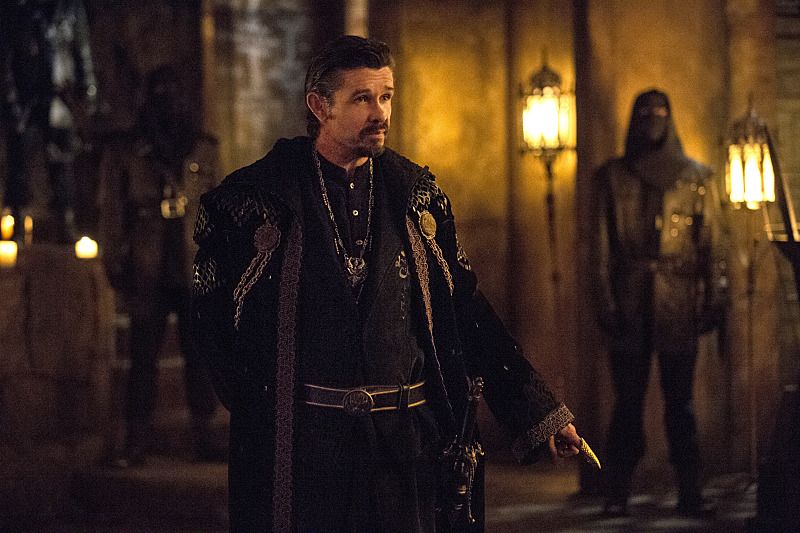
His appearance varies across eras: sometimes depicted as a bearded warlord with alchemist-like qualities, sometimes as a charismatic leader of the League of Shadows, also known as the League of Assassins. But his objective remains the same: to impose a form of world order through purifying chaos. A vision he defends in comics, but also in cinema, where Liam Neeson masterfully embodied this role in Batman Begins, a milestone chronicled in our chronology of all Batman films.
To extend the encounter, you can find the spirit of the League of Shadows in our Batman figurine collection, or adorn your walls with an iconic Gotham poster. And to explore the lesser-known antagonists, our feature on Batman's most overlooked enemies ideally complements this portrait.

⏳ The Lazarus Pit: between occult science and corrupted eternity
One of the most fascinating and unsettling aspects of Ra's al Ghul is his immortality. Unlike most of Batman's enemies, he doesn't truly age. He spans centuries thanks to the legendary Lazarus Pit, a mystical source capable of regenerating cells, healing wounds, and even resurrecting the dead. This defiance of death links him to other figures obsessed with survival, like Mr. Freeze, the scientist turned criminal.
But this power comes at a price. Each immersion in the pit makes Ra's more unstable, more violent, more unpredictable. Immortality is not a blessing; it's a curse in disguise. He doesn't just become eternal; he also becomes increasingly dangerous. The side effects accumulate with each resurrection: a loss of emotional control leading to uncontrollable fits of rage or euphoria, mental instability characterized by paranoia, megalomania, and hallucinations, and above all, total dependence, to the point where Ra's eventually becomes a slave to his own immortality. It's this slow, insidious madness that makes him a more symbolic than physical threat.
In comics as in the Batman Begins film, the Lazarus Pit is as much a legend as a dramatic catalyst. It raises profound moral questions: should one live eternally to guide the world, or should one know how to die to make way for something better? Ra's, for his part, has already chosen. He will live to impose his vision, whatever the cost. This philosophy directly opposes Bruce Wayne's code, which we detail in our article on the profound reasons why Batman doesn't kill.
This quest for eternity resonates with the great mysteries of the universe, from the secret societies described in The Court of Owls that controls Gotham from the shadows to the hero's most intimate sanctuaries, starting with the Batcave, the Dark Knight's secret sanctuary. A fan of this esoteric dimension? Explore our selection of Batman lamps or dark artwork inspired by Gotham and the League of Shadows.
🃏 Ra's al Ghul and Batman: Enemies or Spiritual Father?
While Ra's al Ghul is one of the Dark Knight's most formidable enemies, their relationship extends far beyond a simple confrontation between hero and villain. It is complex, ambivalent, almost familial. For Ra's doesn't just seek to destroy Batman: he wants to make him his heir. To fully understand the man he covets, nothing beats our portrait of Bruce Wayne and the true face behind the mask.
In many stories, particularly in the Batman: Son of the Demon saga, he considers Bruce Wayne the only being worthy of leading the League of Shadows. He admires his determination, his discipline, his sense of justice, while rejecting his compassion and his refusal to kill. It is this respect mixed with contempt that makes their antagonism so singular in the entire universe of Batman characters.
This bond is strengthened by Batman's relationship with Talia al Ghul, Ra's's daughter. Their love gives birth to Damian Wayne, Batman's son raised in blood and war. This lineage forever binds Bruce to the demon's heritage, whether he wants it or not. Ra's sees in him an ideological successor; Talia tries to rally him to their cause, out of love as much as manipulation; and Damian embodies the permanent conflict between two worldviews, justice versus revenge. This fractured legacy resonates with the great dynasties of the Batfamily, all of Batman's allies explained, and even more so with the lineage of Robin in the Batman universe.

⚔️ An ideological legacy as seductive as it is dangerous
What makes Ra's al Ghul so striking in the Batman universe is that he is not a mere megalomaniacal criminal. He represents an intellectual temptation, a moral vertigo. He embodies a disturbing question: what if chaos could only be stopped by total control? And what if, to eradicate corruption, one had to dare to become merciless? This authoritarian temptation echoes within the city itself, this Gotham City, cursed city at the heart of the Batman universe whose corruption fuels the demon's discourse.
This discourse finds a powerful resonance in the contemporary world. Ra's does not content himself with sowing fear: he preaches a radical order, an authoritarian vision of good, which fascinates as much as it worries. And therein lies the character's strength: he is credible. He could exist in our reality, as a cult leader, a political strategist, a fanatic leader with an unyielding ideology. This credibility distinguishes him from other attempts to replace or corrupt the Dark Knight, such as in the saga Azrael, when Gotham almost replaced Batman, or against the behemoth of Knightfall, the saga where Bane broke Batman.
For Bruce Wayne, Ra's is a distorted mirror, a permanent "what if…". And it is this philosophical opposition, even more than their physical battles, that makes their confrontations so intense. Where Batman believes in redemption, Ra's believes in sacrifice. Where Bruce saves Gotham, Ra's wants to burn it to purify it. This relentless logic is reminiscent of the very birth of the vigilante in Crime Alley, the alley that never stopped creating Batman.
To further the discussion, also read our article on why Batman is considered the ultimate detective, because understanding his enemies is also what makes him so formidable. And to place Ra's in the hierarchy of great confrontations, our debate Batman vs Superman: who is the greater hero illuminates what distinguishes a vigilante from an ideologue. You can also find this arc in our LEGO Batman sets inspired by the Nolan trilogy, or complete your gear with the Batman Costume and Disguise collection.
Ra's al Ghul is not just an adversary: he is the embodiment of what Batman could have become if he had crossed the line. And that is precisely why he is never forgotten.