
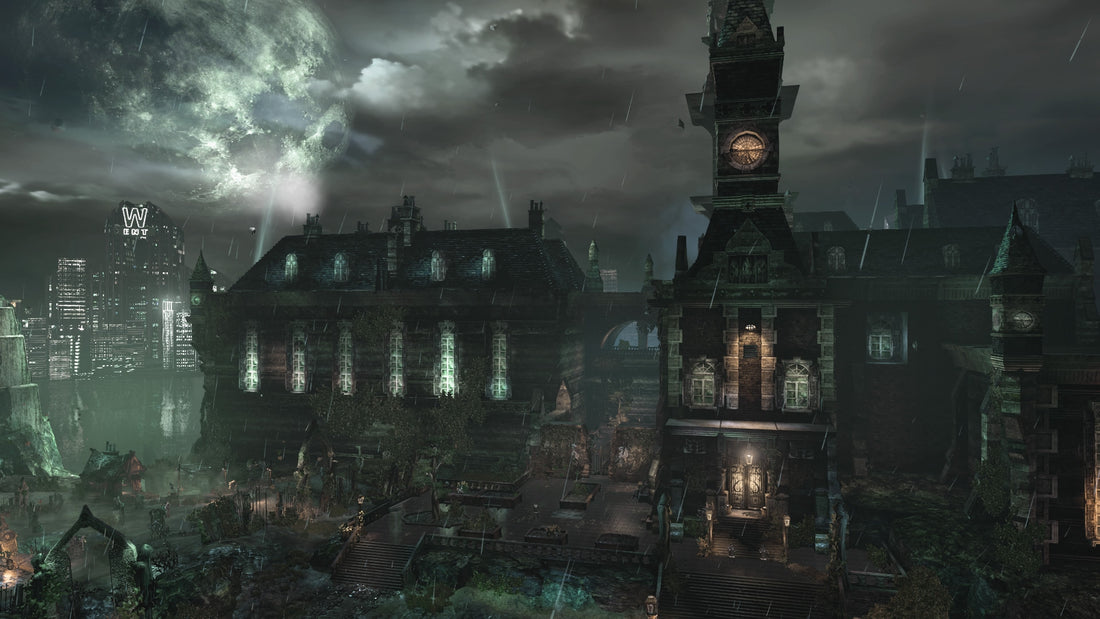
Arkham Asylum: Gotham's Most Terrifying Mental Hospital
Among all the iconic locations in the Batman universe, Arkham Asylum holds a special place. It's not just the building where Bruce Wayne sends his defeated enemies—it's a character in its own right, a silent actor in every major tragedy of Gotham City. Where other stories use the asylum as a mere backdrop, Batman makes it a psychological mirror of his own journey. If Gotham produces lunatics, Arkham houses them; and even more unsettling, it also creates them.
This article traces the complete history of Arkham Asylum—its origin, its most terrifying patients, its unique narrative role, and its impact on the mythology of the Dark Knight. We also look at why this place has fascinated readers for forty years, and what it reveals about the city's collective psychology. The detour through the trajectory that made Bruce Wayne the masked hero provides the essential framework: without Arkham, the Batman myth cannot stand.
A Cursed Place from its Foundation
Arkham didn't have to be an asylum to carry a curse. The original mansion, built by the Arkham family in the 19th century, was already the scene of psychiatric dramas even before its institutional transformation. Amadeus Arkham, son of the founding psychiatrist, loses his mother in troubled circumstances, then tries to heal the sick minds of Gotham with noble intentions—and gradually descends into the madness he claimed to fight. This is the paradoxical origin of the place: an asylum founded by a man who would end up interned in his own institution.
This dual dimension—care and corruption—inhabits every Arkham story. The Victorian building, its dark walls, its labyrinthine corridors, its unsettling basements: everything about it suggests an architecture that doesn't heal, but absorbs. To grasp the broader atmosphere in which Arkham is set, the detour through creating a Gotham City ambiance at home and through Batman posters inspired by Arkham's dark scenes provides a tangible aesthetic reference.
The other crucial dimension is geographical isolation. Arkham is deliberately located away from the heart of Gotham, on marshy land that residents have avoided for generations. This physical distance reinforces the psychological distance: what is locked away in Arkham, one prefers not to think about anymore. And it is precisely this collective denial that allows the asylum to become, over the decades, the secret reservoir of the city's darkness.
The Patients Who Made Arkham's Legend
Arkham would never have achieved its mythical status without the gallery of patients it houses. Every major Batman foe has spent time there. Each entered at a moment of their decline, and each left—often by escape—more dangerous than when they arrived.
The Joker: The Eternal Resident
The Joker is the absolute unconscious of Arkham. No other patient has returned there as often. No other has spent as many hours conversing with therapists who eventually lose their own minds. The Killing Joke directly explores this dynamic: Arkham doesn't imprison the Joker, it preserves him. And each escape (there have been dozens) strengthens his legend. To gauge the magnitude of this figure in Batman's mythology, a detour through Joaquin Phoenix's 2019 Joker provides a contemporary framework—the asylum still plays a structural role, even in cinema.
Harley Quinn: From Psychiatrist to Patient
Harley Quinn's case is perhaps the most telling of Arkham's corrupted nature. Harleen Quinzel arrives as a brilliant young psychiatrist, tasked with treating the Joker. Over the course of their sessions, she is the one who breaks. Harleen's trajectory to Harley reveals what no one in Gotham wants to see: the asylum can turn the caregiver into a patient. This radical inversion makes Arkham a place where the line between medicine and madness no longer exists.
Scarecrow, Two-Face, Riddler: The Triad of Broken Minds
Scarecrow, master of fear, is another former medical staff member turned patient—Jonathan Crane was a psychology professor before becoming Gotham's terrorist. Two-Face, a respected former district attorney, also ends up in Arkham, as does the Riddler, the enigma whose obsession eventually overflows into pathology. These three patients share a common point: they were brilliant minds before they broke. Arkham doesn't create madness, but it crystallizes it.
Bane, Mr. Freeze, Killer Croc: Physical Darkness
Beyond troubled minds, Arkham also houses physically extraordinary criminals. Bane briefly stays there before breaking Batman's back in Knightfall. Killer Croc is treated there as a medical anomaly as much as a criminal. This biomedical dimension adds another layer to Arkham's mythology: the place doesn't just heal broken souls, it also claims to heal mutant bodies.

Enter the Arkham aesthetic
Batman Arkham Knight Blue Mask
From the Arkham video game saga, this collector's mask perfectly captures the dark atmosphere of the asylum and the arc's central enemy. A premium piece for high-end cosplay, collection, or an absolute statement.
349,90 €
View this mask →Arkham's Other Side: Staff Also Descend into Madness
The most chilling element of Arkham's mythology isn't the gallery of patients—it's the fragility of the staff. Several Arkham psychiatrists, guards, and nurses eventually lose their own minds. Harleen Quinzel is just the most visible example. Other caregivers fall into addiction, depression, or pure corruption.
Professor Milo embodies this deviation of medical science applied to criminal ends. His presence at Arkham is ambiguous: he works there while conducting experiments on patients, transforming the place of care into an ethically terrifying laboratory. This gray area between legitimate medicine and illegal experimentation runs through Arkham's entire history.
This staff fragility is not a narrative accident—it's a philosophical thesis of Batman's mythology. The authors wanted to suggest that the line between caregiver and cared for is thinner than one might believe, and that institutions are never stronger than the humans who populate them. To delve into this moral dimension, a detour through why Batman doesn't kill is essential: if the hero is so attached to his code, it's partly because he knows how unstable this line is, and that he himself could cross it.
Arkham in Film, Television, and Video Games
Arkham Asylum has seen dozens of adaptations on screen. Christopher Nolan's Dark Knight trilogy offers a modern, almost realistic version in Begins and The Dark Knight. The series Gotham dedicates entire seasons to the institution. But it is probably in the video game Batman: Arkham Asylum (2009) that the location gains its greatest contemporary visibility—a success so massive that it triggers an entire video game saga.
This Arkham saga (Asylum, City, Knight, Origins) redefines how fans imagine the asylum. The sanitized corridors give way to Gothic halls, the transparent cells are replaced by dizzying vertical architectures. This video game aesthetic has been so influential that recent comics now incorporate visual elements directly borrowed from the game—proof of a rare case where the adaptation influences the source.
In cinema, Arkham also appears in more recent versions of Batman. Matt Reeves' The Batman (2022) alludes to the institution without showing it in detail, suggesting future development in the saga. For fans who want a Gotham atmosphere at home, the Arkham aesthetic remains one of the most recognizable—grey hoods, blue neon, a perpetual storm atmosphere.

The Eternal Resident in Collection
Joker Figurine "Batman The Killing Joke"
This collector's figurine captures the Joker from The Killing Joke—the exact moment when the asylum and the Clown Prince of Crime merge. A premium piece for display case, studio statement, or collector's gift.
199,90 €
View this figurine →Arkham as Batman's Psychological Mirror
The deepest reading of Arkham is that it functions as a psychological mirror of the Dark Knight himself. Several major authors—Grant Morrison foremost among them with his masterpiece Arkham Asylum: A Serious House on Serious Earth (1989)—have argued that Bruce Wayne and Arkham's inmates belong to the same psychological spectrum. They descended into crime, he descended into vigilantism—but all carry the same original wounds.
This thesis is not merely academic. It resonates in every major modern Batman arc. Frank Miller's Year One shows a Bruce on the verge of breaking. No Man's Land reveals a hero whose moral resistance hangs by a thread. Hush directly explores the character's obsessive dimension. In each of these stories, Arkham is never far—like a possible horizon that Batman flees every night.
This Batman-Arkham kinship also explains why the hero brings his enemies there rather than killing them. To kill would be to acknowledge that there is nothing left to save. Internment means there is still hope. To delve into this ethic of care, a detour through the Batfamily and its moral dramas provides a useful counterpoint: around Bruce, several vigilantes have other conceptions of justice, and the asylum remains the epicenter of the debate.
Why Arkham Still Fascinates in 2026
Forty years after its first striking appearances, Arkham Asylum continues to fascinate. Three structural reasons explain this longevity.
First reason: its symbolic richness. Arkham is not just a fictional place; it's a metaphor—for collective denial, imperfect care, the fragile boundary between reason and madness. This polysemy allows each era to project its own anxieties onto it. The 80s saw the failure of psychiatric institutions. The 2010s read modern burnout into it. The 2020s see the collapse of medical certainties.
Second reason: its visual quality. Gothic architecture, chilling medical neon lights, the contrast between clinical sterilization and profound corruption: everything in Arkham's design has become iconic. This aesthetic now influences other works far beyond the DC Universe—series, video games, horror films, even interior design. To embody this aesthetic in real life, Batman t-shirts and the Batman action figure collection offer concrete inspirations.
Third reason: its continued narrative relevance. Marvel constantly rewrites the asylum. The Batman Who Laughs introduced a terrifying new facet—a Batman corrupted by the Joker in a parallel Arkham. Blackgate Prison, another place of incarceration in Gotham, complements the carceral ecosystem and mirrors the asylum. This constant updating prevents Arkham from becoming a relic.

The Symbol of the Shift
Harley Quinn Suicide Squad Figurine
Harley Quinn embodies better than anyone the fragility of the boundary between caregiver and cared for in the asylum. This articulated figurine captures the moment Harleen Quinzel becomes Harley—an essential piece for any Arkham collection.
49,90 €
View this figure →Arkham and Gotham's Other Cursed Places
Arkham isn't the only dark place in Gotham, but it is the most central. To understand its place in the city's symbolic topography, two other locations deserve mention. Crime Alley is where Bruce Wayne loses his parents—this is where the hero is born. The Batcave is the secret sanctuary where he prepares his missions. Arkham, on the other hand, is the final destination for his enemies—the place where the mission ends.
This trilogy of locations—Crime Alley for genesis, Batcave for preparation, Arkham for conclusion—structures the entire Batman mythology. Every major adventure of the hero passes through these three poles. Without Arkham, there is no loop. Without the loop, the hero has no cycle, and therefore no story.
The other essential complementary location is Wayne Manor—the home by day, as opposed to the Batcave by night and Arkham of nightmares. The Wayne family is part of the same psychological geography. To gauge this dimension, a detour to the Wayne orphanage, between humanitarian aid and corruption is illuminating—Bruce Wayne fights on two fronts simultaneously, medical and criminal, and the orphanage is the charitable flip side of the carceral asylum.
Conclusion: Arkham, the character you never see but who decides everything
Arkham Asylum is probably the most enduring creation of the Batman mythology after the hero himself. Not a character with a face, but a character with a function: to absorb, catalog, and archive the city's madness. Without it, Batman's enemies would disappear into thin air. With it, they acquire narrative coherence—a before, during, and after each fall.
For fans who want to explore further, two final leads. First, read or re-read Arkham Asylum: A Serious House on Serious Earth, Grant Morrison's graphic novel, which remains the absolute reference on the subject to this day. Then, explore derivative works—the Arkham video game saga and recent comic arcs that adopt its aesthetic. To materialize this passion, the complete collection of Batman figures and Batman posters offer direct visual hooks.
One thing is certain: as long as Batman exists, Arkham will exist. As long as Arkham exists, the border between reason and madness will remain uncertain. And it is precisely this uncertainty that has kept the mythology alive for forty years—and will likely keep it going for the next forty. Arkham Asylum is not a setting. It is a character. And it is undoubtedly the most disturbing character DC Comics has ever produced.
🃏 To go further: locate this character within Gotham's complete criminal ecosystem by consulting the stratified guide to Gotham's mythical enemies, which gathers 36 villains ranked by tier of narrative importance.