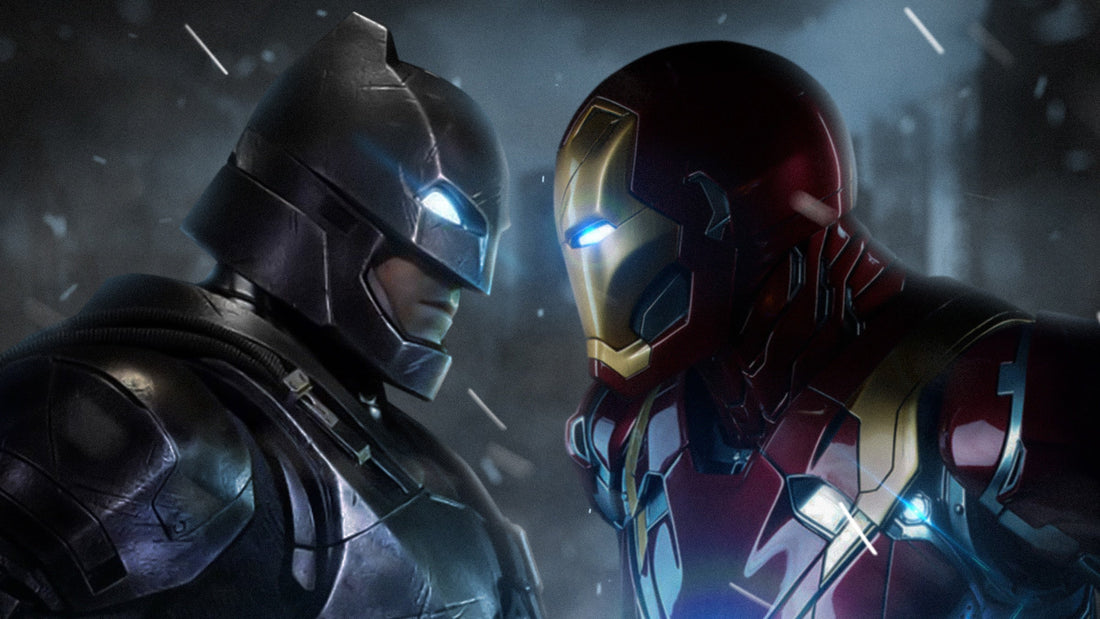
Batman vs. Iron Man: The Clash of the Billionaire Vigilantes
The answer in brief
Two wealthy heirs, no innate powers: the kinship stops there. Bruce reacts to an intimate wound, the murder of his parents, and develops an almost monastic discipline paired with a categorical refusal to kill. Tony, for his part, responds to captivity and serious injuries, then transforms that distress into a spectacular suit of armor, displayed in broad daylight. On the outcome of a duel, the answer resists clear-cut verdicts.
Contents
One is the obsessive guardian of Gotham City, the other the incandescent genius of Stark Industries. Batman (DC Comics) and Iron Man (Marvel) are arguably the two most compared billionaire-vigilante figures in all of modern popular culture. Both heirs to industrial empires, both without superpowers in the strict sense, both dependent on a technology they master from end to end, they embody two opposing visions of the same archetype. One moves through the shadows, methodical, haunted, almost silent. The other shines in broad daylight, sarcastic, media-savvy, almost insolent. This clash of styles has fascinated people for decades: who would win a duel thought through seriously? The answer is never as simple as it looks, and that is what we propose to examine here in seven decisive passages.
🦇 Origins and motivations — two traumas, two philosophies
To understand Batman, you have to go back to an alley, a rainy night, two gunshots. Bruce Wayne witnesses the murder of his parents as a child and chooses, from that instant on, to devote his entire life to preventing that tragedy from happening to anyone else. His motivation is not political, nor economic, nor philosophical in the classical sense. It is visceral. It is rooted in an original pain that neither his immense fortune nor Alfred's affection will ever be able to fill. The Dark Knight acts with monastic discipline. He refuses to kill, controls his fear, turns his pain into method. His tone is dark, his gesture precise, his quest endless.
Tony Stark, for his part, is born into another narrative universe. Captured and gravely wounded during a military operation, he designs his first armor in a cave in order to escape. The lesson he draws from it is diametrically opposed to Bruce Wayne's: rather than dig into grief, he chooses public redemption. Iron Man does not advance in the shadows, he steps onto the stage. He owns his fortune, his sarcasm, his celebrity. His motivation is mixed — a little atonement, a lot of ambition, a dose of uncontrollable genius. Where Batman imposes an almost religious rigor on himself, Iron Man improvises, and that improvisation becomes his trademark. This philosophical opposition shapes everything that follows. It weighs even on the way the two heroes conduct their personal confrontations with their most emblematic rivals — the Joker for one, Thanos or Obadiah Stane for the other.
| Criterion | Batman | Iron Man |
|---|---|---|
| Origin | Murder of his parents | Captured, wounded, armor designed in a cave |
| Response | Monastic discipline | Public redemption |
| Ground | In the shadows | On stage |
| Method | Almost religious rigor | Improvisation |
| Rivals | The Joker | Thanos, Obadiah Stane |
🧠 Intelligence and strategy — the detective versus the engineer
No serious comparison between Bruce Wayne and Tony Stark can sidestep the question of intelligence. Both rank among the most brilliant minds of their respective universes, but they are brilliant in fundamentally different ways. Bruce Wayne is first and foremost a detective. His thinking is lateral, anticipatory, almost obsessive. His Batcave is less a laboratory than a strategy room: it holds files on every villain in Gotham's rogues gallery, from the Penguin to the Riddler, along with several detailed plans to neutralize, if need be, the most powerful members of the Justice League — Superman included.
Tony Stark is an engineer. His thinking is vertical, experimental, ultra-fast. Where Bruce plans for months, Tony improvises a solution in a few minutes in the middle of an aerial fight. The artificial intelligence he develops — J.A.R.V.I.S., then F.R.I.D.A.Y. — is an integral part of his mental process. Stark thinks in a continuous stream, plugged into sensors, satellites, and databases he queries in real time. This cognitive difference is essential for evaluating a duel: Wayne takes the advantage if the preparation time is long; Stark dominates if the confrontation is immediate and requires on-the-fly hardware adaptation. In a city like Gotham, where the Dark Knight faces minds as destabilizing as the Scarecrow or Two-Face, Bruce's analytical patience is his most formidable weapon.
| Criterion | Bruce Wayne | Tony Stark |
|---|---|---|
| Profile | Detective | Engineer |
| Thinking | Lateral, anticipatory | Vertical, experimental, ultra-fast |
| Tools | Batcave and files on every villain | J.A.R.V.I.S., then F.R.I.D.A.Y. |
| Advantage | Long preparation | Immediate confrontation |
⚙️ Technology and equipment — Wayne Enterprises versus Stark Industries
On purely technological ground, the advantage is numerically on Iron Man's side, and that has to be acknowledged honestly. The Stark suits are engineering masterpieces: repulsor cannons, powered flight, onboard artificial intelligence, nanoparticle deployment, near-infinite modularity. Stark can literally reconfigure his equipment mid-fight. This technological ecosystem has no equivalent in the DC universe, with the possible exception of Cyborg.
Batman, by contrast, does not chase innovation for its own sake. He uses technology as a tool in the service of a pre-planned strategy. The Batmobile, the belt gadgets, the armored suits, the anti-Superman armor, and the Dark Knight's iconic gadgets are all designed to answer an identified threat. Wayne Enterprises gives him near-unlimited access to the best military engineers in the world, but Batman, unlike Stark, never wears his technology as a showcase. He hides it, deliberately underuses it, and deploys it only when no other option is possible. This difference in approach is not a weakness: it is a philosophy. For those who want to give shape to that discreet aesthetic, the Batman universe figures capture the Dark Knight's technological restraint beautifully.

🥋 Physical training and close combat
If there is one area where the gap between the two heroes is massive, it is bare-handed combat. Bruce Wayne spent an entire decade traveling the world to learn from the best martial arts masters, from Henri Ducard to Kirigi by way of Ra's al Ghul himself. He masters more than a hundred disciplines, from Japanese Krav Maga to Brazilian jiu-jitsu, with ninjutsu and Thai boxing along the way. His body is trained to withstand pain, torture, fear, and extreme fatigue. In terms of pure human combat, he is one of the most complete vigilantes in all of fiction. The Batman vs. Bane duel is emblematic of that preparation: even physically broken, Bruce Wayne comes back and wins through combat strategy.
Tony Stark, out of his armor, is far less formidable. Without his equipment, he remains a brilliant engineer, but his physical skills are those of an intelligent, trained man, nothing more. He never went through an intensive military program, never studied martial arts systematically, and his body, marked by the shrapnel fragment lodged near his heart in the early versions, remains relatively vulnerable. In a confrontation where the armor was neutralized — a scenario Batman would absolutely plan for — the gap would become glaring. This quiet strength of Bruce Wayne's explains why he survives impossible confrontations, whether against Azrael, Killer Croc, or the prolonged resistance during No Man's Land.
| Criterion | Bruce Wayne | Tony Stark |
|---|---|---|
| Training | A decade with masters | No intensive military program |
| Martial arts | More than a hundred disciplines | No systematic study |
| Body | Trained against pain and fear | Relatively vulnerable |
🧘 Mental resilience and willpower
A fight is not won with fists or armor alone: it is won with the head. And here again, Bruce Wayne and Tony Stark adopt two opposing stances. The Dark Knight has a mind of steel, forged year after year in the most corrupt and oppressive environment in fiction, Gotham. He has fought alone for years, under the wary eyes of the GCPD, supported only by James Gordon and by the reconstituted figures of the Batfamily. His emotional stability is almost pathological: Bruce does not allow himself the slightest fragility, and that is precisely what makes him so hard to break.
Tony Stark has had the opposite experience several times over decades of comics. Anxiety attacks, alcohol addiction, impulsiveness, technological paranoia: Stark is psychologically complex and deeply human. He is warmer than Bruce, funnier, more approachable. But that emotional openness is also a vulnerability. In a prolonged duel, in a war of attrition, Batman almost always wins on the mental front. It is also that stability that lets him coexist without collapsing alongside figures as unstable as Harley Quinn or Poison Ivy.
| Criterion | Batman | Tony Stark |
|---|---|---|
| Mind | Of steel | Psychologically complex |
| Emotions | No fragility allowed | Warmer, funnier |
| Weak points | Almost pathological stability | Anxiety attacks, alcohol addiction |
⚔️ Direct duel — who would win, and under what conditions?
Here is the question every fan asks sooner or later. The honest answer fits in one formula: it all depends on the preparation time. In an immediate fight, in open ground, with no warning, Iron Man has a massive advantage thanks to his armor, his flight, his ranged weapons, and his onboard artificial intelligence. Stark can literally take off, pull back, identify Batman's thermal signature, and fire before the Dark Knight has had time to pull out a gadget. In that scenario, Iron Man almost always wins.
But give Bruce Wayne so much as a week — and the picture changes radically. Batman studies his opponent with an almost pathological obsession, down to knowing every vulnerability of every armor model. He has already designed, in modern comics continuity, detailed plans to neutralize beings infinitely more powerful than Stark: Superman, Wonder Woman, Flash, Aquaman, Martian Manhunter. Iron Man, with armor dependent on a specific energy source, is technically easier to study than Superman. Once the routine is established, Bruce would find a flaw — a long-range EMP jammer, an electromagnetic trap, a poison targeting the suit's miniaturized components. This ability to analyze an opponent over time, already visible in the Dark Knight's best sagas, makes all the difference in a duel thought through seriously.

🎬 Popularity, cinema, and cultural impact
Beyond the imaginary duel, the cultural weight of the two characters has to be measured, because it shapes the way they are perceived today. Batman has existed since 1939 and has never left the collective imagination. He has been played by Adam West, Michael Keaton, Val Kilmer, George Clooney, Christian Bale, Ben Affleck, and Robert Pattinson — not counting his animated versions and video game adaptations. That longevity makes him one of the three most recognized superheroes in the world, alongside Superman and Spider-Man. Christopher Nolan's The Dark Knight trilogy redefined what is now expected of a superhero film for adults. The more recent reinterpretations like The Batman (2022) extend that mythology by anchoring it in a contemporary noir.
Iron Man, for his part, followed a very different editorial trajectory. Long considered a secondary hero at Marvel, he exploded in 2008 thanks to Jon Favreau's film Iron Man, carried by Robert Downey Jr. That interpretation literally set off the entire Marvel Cinematic Universe ecosystem. With it, Iron Man became one of the most profitable characters in Hollywood history, and a peak of global merchandising. The cultural verdict is therefore split: Batman wins on overall historical fame and generational anchoring, Iron Man wins on modern impact and cinematic dominance from 2008 to 2019. For those who want to pay tribute to this symbolic duel on collectible ground, the posters dedicated to the Batman universe and the Batman t-shirts make it possible to display your side clearly.
Two trajectories in dates
🏆 Conclusion — two opposing reflections of the same archetype
Batman and Iron Man are the two faces of the same founding idea: a billionaire with no superpower who becomes a hero through willpower, intelligence, and technological mastery. But the way each embodies that archetype separates them radically. One acts in the shadows, the other in the light. One controls himself, the other improvises. One is haunted by the loss of a family, the other by the need for public redemption. That duality is what makes the comparison fascinating beyond a simple fanboy match-up: it raises the deeper question of what it means to become a hero without a supernatural gift.
In an honestly prepared confrontation, the Dark Knight would probably win. Not because he is more powerful — he is not — but because he relies on something Iron Man does not possess with the same intensity: obsessive patience. That patience, that mental discipline, that ability to study an opponent until he knows their every flaw, is the very essence of Bruce Wayne. It is what makes him the ultimate vigilante of the Batman universe and one of the most enduring characters in all of popular culture. Iron Man shines brighter. But Batman lasts longer. And in a war of attrition, it is duration that counts.
The key point
In a prepared confrontation, the Dark Knight would probably win, not through power but through obsessive patience. Iron Man shines brighter, Batman lasts longer, and in a war of attrition, it is duration that counts.